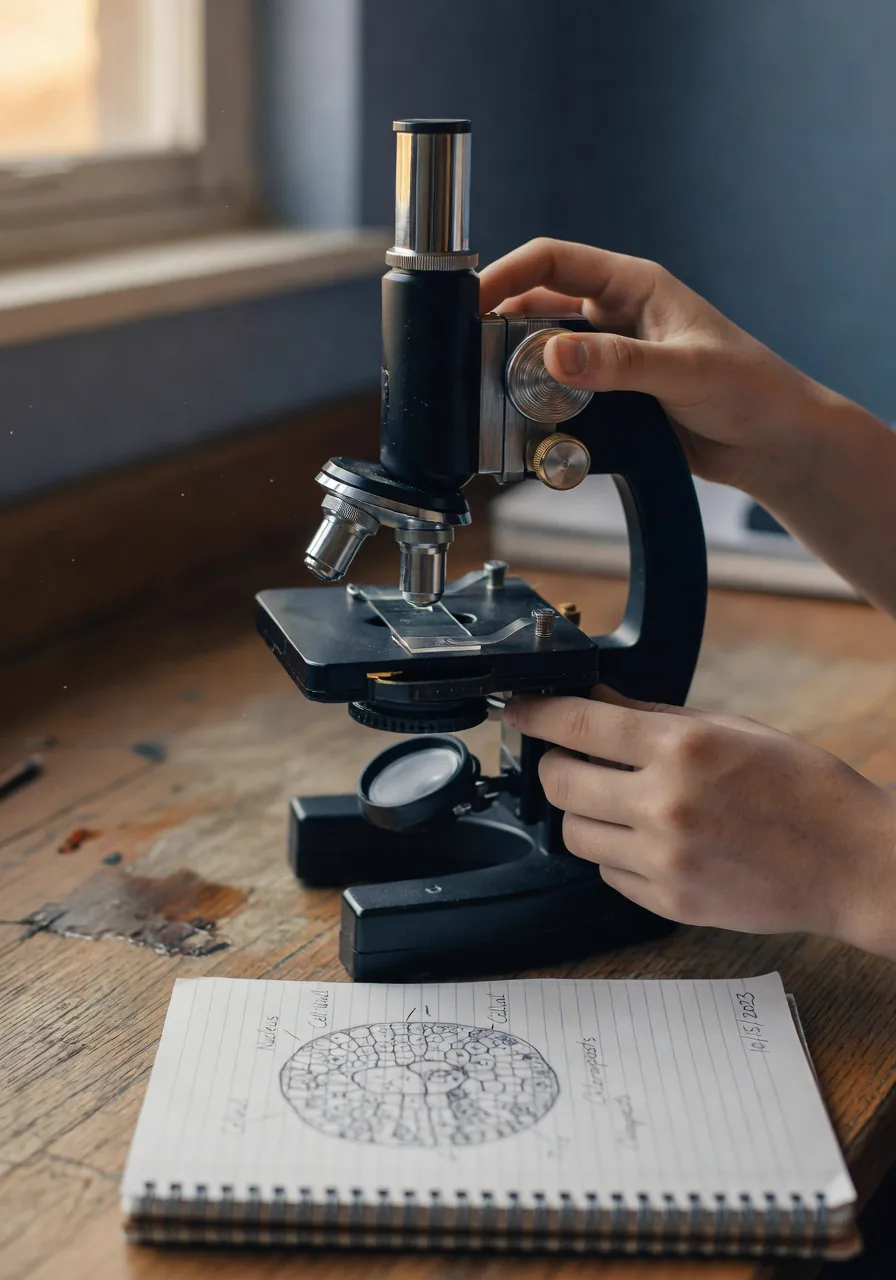
There is a particular look on a student's face the first time they actually find what they're looking for under a microscope. Not the picture in the book — the real thing, on their own slide, that they focused themselves. It is the look of a fact turning into knowledge. That moment is why this course is built the way it is.
Most biology courses are organized as a textbook with some labs attached. You read the chapter, you hear the lecture, and then (if there's time and the equipment works) you do an activity that confirms what you were already told. The lab is a garnish. Bright Minds Biology inverts that. The lab is the meal. The reading exists to prepare you for the bench and to make sense of what you saw there. We call this lab-led, not textbook-led, and it is the most important thing to understand about how the course runs.
What the bench teaches that a page cannot
Four kinds of learning happen at a lab bench and essentially nowhere else in a biology course:
- Procedural skill. Focusing a microscope, making a wet mount, handling a specimen, pipetting a measured volume. Your hands encode this in a different part of the brain than the part that memorizes facts, and watching a video of it does not transfer. You have to do it.
- Decision-making under real uncertainty. The slide doesn't look like the textbook. The result is ambiguous. Something went wrong. A real bench puts a student in front of an honestly messy problem and requires them to act anyway. That is what science actually is.
- The "find-the-thing" gap. Knowing what a structure looks like and being able to locate it on a real, variable specimen are two completely different abilities. The second only comes from repetition at the bench.
- Honest feedback from reality. A multiple-choice question can be guessed. A culture either grew or it didn't. The bench doesn't grade on a curve, and students learn quickly that nature is the examiner.
The reading still matters — it just sits underneath
Lab-led does not mean anti-reading. A student who shows up to Experiment Day without having done the at-home reading is a hazard to themselves and a drag on the cohort. The point is the order of operations: the reading prepares you for the bench, and the bench makes the reading mean something. By the time a student reads about osmosis, they have already watched a potato core lose mass in salt water and asked themselves why. The chapter lands on prepared ground.
Lab-led, not textbook-led. The course is built around what happens at the bench; the reading supports the lab, never the other way around.
Why this is the right call for grades 7–12
Adolescents are not miniature college students. They learn abstractions best when those abstractions are anchored to something they did with their hands. The two-day rhythm (a Concept Day and an Experiment Day with at-home work in between) is the operational expression of lab-led teaching. It is also why a student who finishes this course (not a College Board AP course) can sit the AP Biology exam with real understanding behind the answers: they did not memorize biology, they practiced it, and the practiced version is the one that survives to exam day and beyond.
The rest of these essays unpack the pieces — the demonstrations that prove mastery, the study system that replaces cramming, and how a biology course quietly teaches history and writing along the way. But they all come back to this one idea. We teach biology at the bench because that is where biology actually lives.