Ask a student who has only read about environmental science what an ecosystem is, and they will give you a definition. Ask a student who has surveyed one what an ecosystem is, and they will tell you about the moment the quadrat landed on bare, compacted soil where the field guide promised meadow, or the stream that smelled wrong below the outfall, or the count that came back with one species doing all the work. The first student has a sentence. The second has an experience, and the experience is what the sentence was always trying to point at.
That gap is the whole reason this course is built the way it is. Environmental Science, more than any other high-school science, lives at a scale you cannot take in at once. Biology has organisms you can see and dissect. Physics has motion you can watch and time. But the actors in environmental science (populations, nutrient cycles, watersheds, a warming atmosphere) are spread across seasons and continents, forever larger than the window in front of you. The danger is that the subject collapses into fact-reciting: a student learns to name the carbon cycle without ever believing that anything real is being cycled.
The field makes the abstraction physical
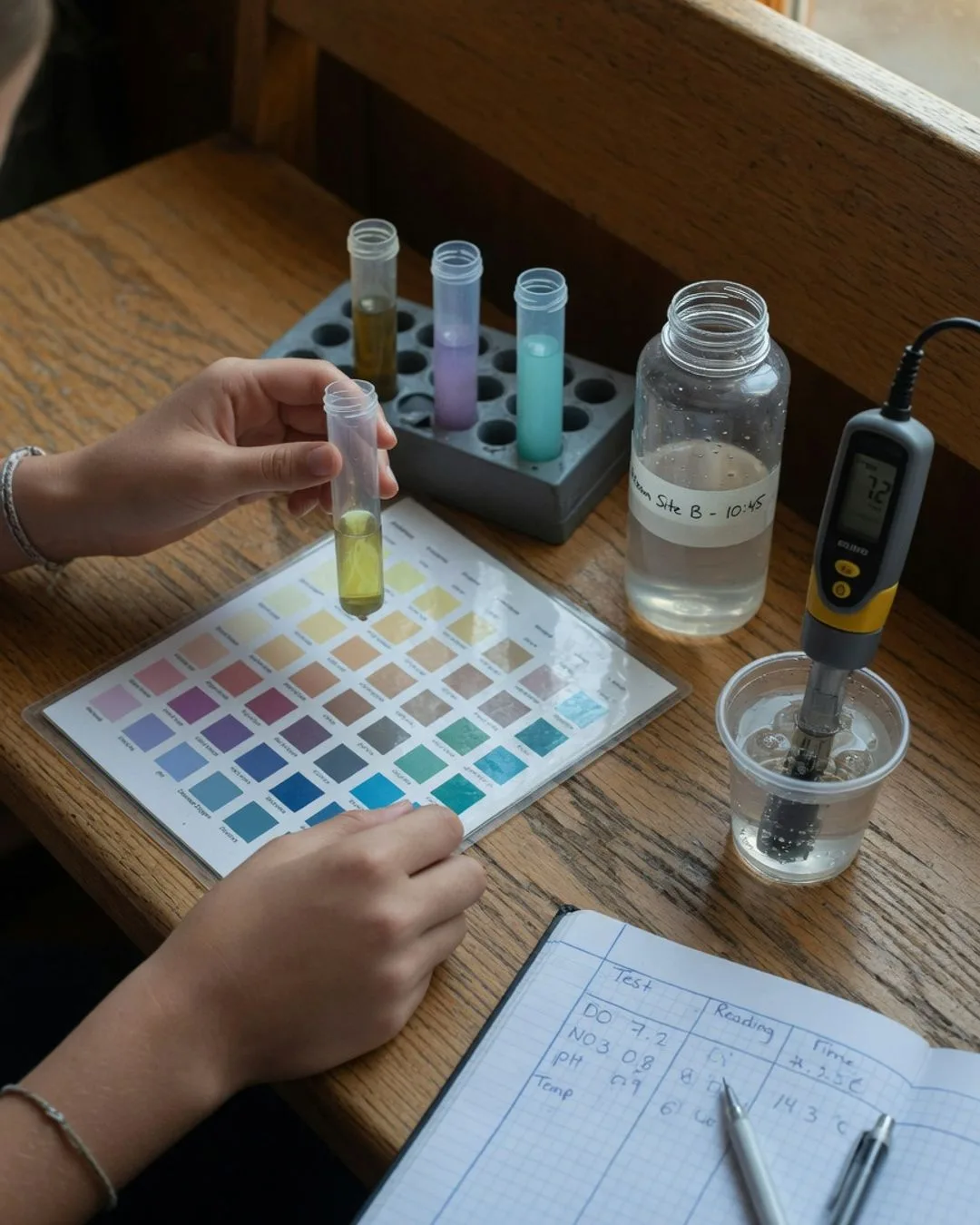
The job of the field is to drag the invisible up into the visible. You cannot see biodiversity, but you can drop a quadrat on the ground, count every species inside its frame, and hold a real, defensible measure of richness in your notebook. You cannot see a stream's health, but you can lower a dissolved-oxygen probe and watch the reading fall below the outfall and understand, in the number, that something upstream is pulling life out of the water. You cannot see a population's trajectory, but you can plot three years of a public census and watch the curve bend toward its carrying capacity.
This is what we mean when we say the course is lab-led, not textbook-led. The reading does not come first, with the fieldwork as a garnish to confirm it. The field comes first. The question is posed where it actually lives (over a quadrat, along a transect tape, in a water-test kit, inside a dataset you actually interrogate), and the textbook is the tool we reach for to explain what we just saw. A student who has watched a survey plot collapse to a single invader is ready to be told about disturbance. A student who has only been told about disturbance is ready to forget it.
The graph on the page is a claim about something real. The field is where the student finds out the claim is true.
What the field teaches that the page cannot
Beyond making concepts concrete, the field teaches a set of things a textbook structurally cannot, because they are not simply facts. They are judgments and habits that only form under real conditions:
- That measurement is hard. Reading a dissolved-oxygen meter that drifts, deciding where to lay a transect so it is honest, watching your two survey plots disagree — these teach humility about data that no worked example ever will.
- That systems don't read the textbook. The count is never what the field guide predicted. The water readings come back a little off. A species that "should" be there simply isn't. Learning to reason about why the real result departs from the ideal one is an environmental scientist's core skill.
- That technique is knowledge. How you place the quadrat, how you calibrate the probe, how long you let a reading settle, how you record what you see — the answer depends on the doing, and the doing can only be learned by doing.
The two-day rhythm
Practically, this conviction becomes a schedule. The course runs on a two-day rhythm. One day is the Concept Day: the idea is introduced and worked through on paper — energy flow, a biogeochemical cycle, carrying capacity. The next is the Field Day, where that same idea is made physical in the field or the data and written into a real lab notebook in the student's own hand. Between the two days, the student works at home, and that gap is not dead time. It is where the concept and the experience knit together into something that lasts.
We are not against the textbook; a serious environmental science course needs a rigorous one, and this course has it. We are against the textbook going first and the field going second, because we have watched what that produces: a student who can recite the definition of eutrophication and has never once smelled an algae-choked pond or watched a dissolved-oxygen reading crash. Put the field first, and the environmental science stops being a vocabulary list. It becomes a thing the student has actually seen happen, which is the only kind of environmental science anyone remembers.