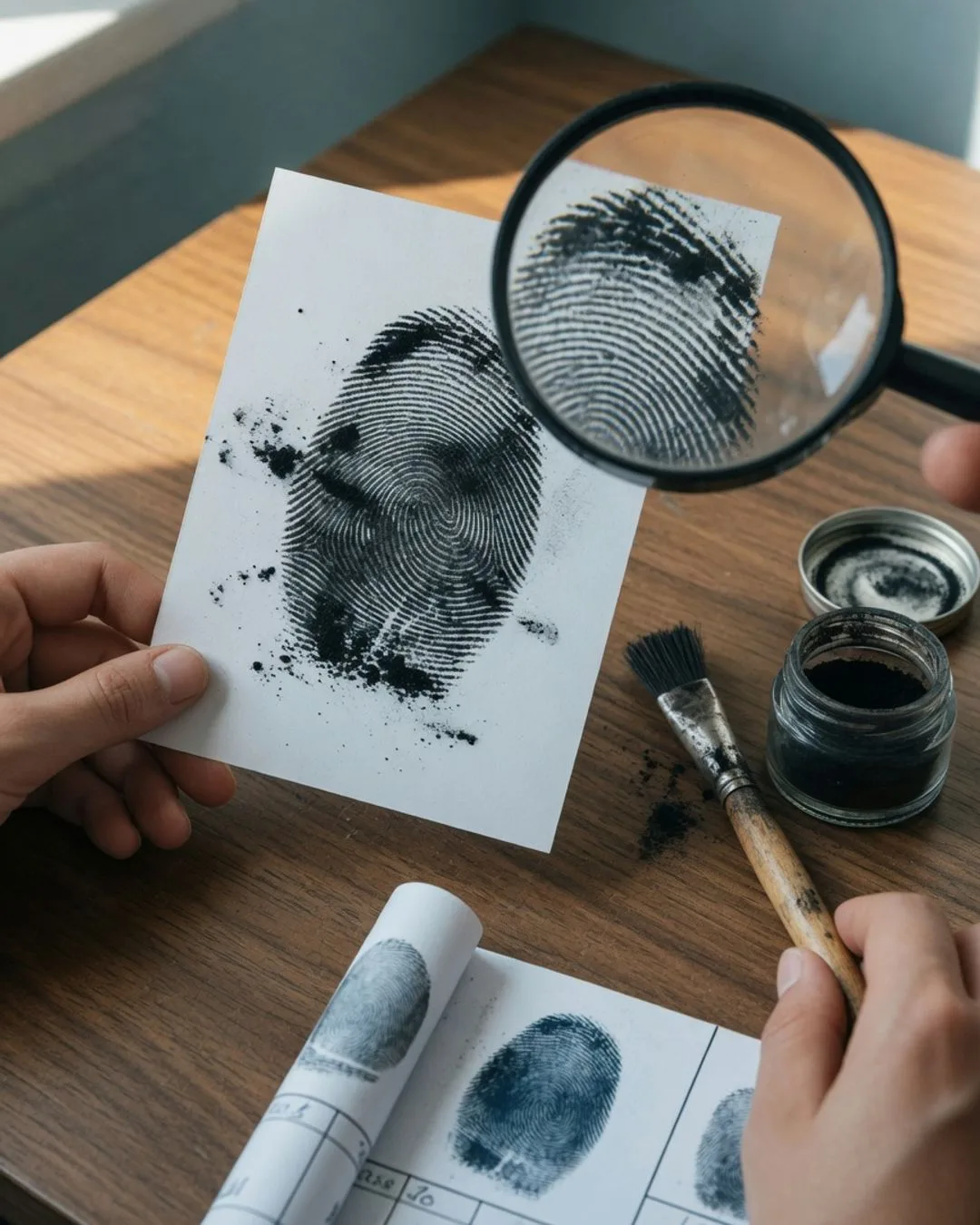
Ask a student who has only read about forensic science what a fingerprint comparison is, and they will give you a definition. Ask a student who has actually done one, and they will tell you about the moment two ridge patterns lined up point for point, or the trace fiber that refused to match the reference, or the doubt they had to resolve before they signed the report. The first student has a sentence. The second has an experience, and the experience is what the sentence was always trying to point at.
That gap is the whole reason this course is built the way it is. Forensic Science, more than any other high-school science, lives in judgment you cannot pick up from a page. Anyone can read that two prints “match.” Learning to see whether they truly correspond — and how confident that correspondence lets you be — takes the eye, the hand, and repetition. The danger is that the subject collapses into television certainty: a student learns to announce “it’s a match” without ever weighing how sure they can honestly be.
The bench makes the judgment real
The job of the laboratory is to turn a claim into something you have actually done. You cannot learn a fingerprint comparison from a diagram, but you can set a coded print beside its references and work until you can say for yourself which ridges agree, which do not, and when the honest answer is inconclusive. You cannot learn chromatography from a caption, but you can measure every band on a chromatogram, work out its Rf yourself, and decide whether two samples really share a pattern. You cannot learn chain of custody from a definition, but you can log a piece of evidence, seal it, and sign for it and feel the weight of being accountable for it.
This is what we mean when we say the course is lab-led, not textbook-led. The reading does not come first, with the lab as a garnish to confirm it. The bench comes first. The question is posed where it actually lives (on the comparison sheet, on the chromatogram, in the evidence log), and the textbook is the tool we reach for to explain what we just saw. A student who has compared two prints and hesitated is ready to be told how examiners describe a match. A student who has only been told the definition is ready to forget it.
The word “match” on the page is a claim about two pieces of evidence. The lab is where the student learns how carefully that claim has to be earned.
What the bench teaches that the page cannot
Beyond making concepts concrete, the laboratory teaches a set of things a textbook structurally cannot, because they are not simply facts. They are judgments and habits that only form under real conditions:
- That measurement is hard. Counting ridges between two points, deciding whether a fiber's color truly agrees, watching your own two readings disagree — these teach humility about evidence that no worked example ever will.
- That evidence doesn't read the textbook. The print is smudged. The sample is degraded. The "obvious" match softens the longer you look. Learning to reason about why the real result departs from the tidy one — and to report only what you can defend — is an examiner's core skill.
- That method is knowledge. How you search a scene, how you keep each item in its own envelope, how you record a reading before you see the reference, how you document each step — the answer depends on the doing, and the doing can only be learned by doing.
The two-day rhythm
Practically, this conviction becomes a schedule. The course runs on a two-day rhythm. One day is the Concept Day: the idea is introduced and worked through on paper — how a print is classified, how a chromatogram is read, what chain of custody protects. The next is the Lab Day, where that same idea is made physical at the bench and written into a real lab notebook in the student's own hand. Between the two days, the student works at home, and that gap is not dead time. It is where the concept and the experience knit together into something that lasts.
We are not against the textbook; a serious forensic science course needs a rigorous one, and this course has it. We are against the textbook going first and the bench going second, because we have watched what that produces: a student who can recite the definition of a latent print and has never once set a print beside a reference and struggled to decide whether it really matched. Put the bench first, and forensic science stops being a vocabulary list. It becomes a thing the student has actually done, which is the only kind of forensic science anyone remembers.