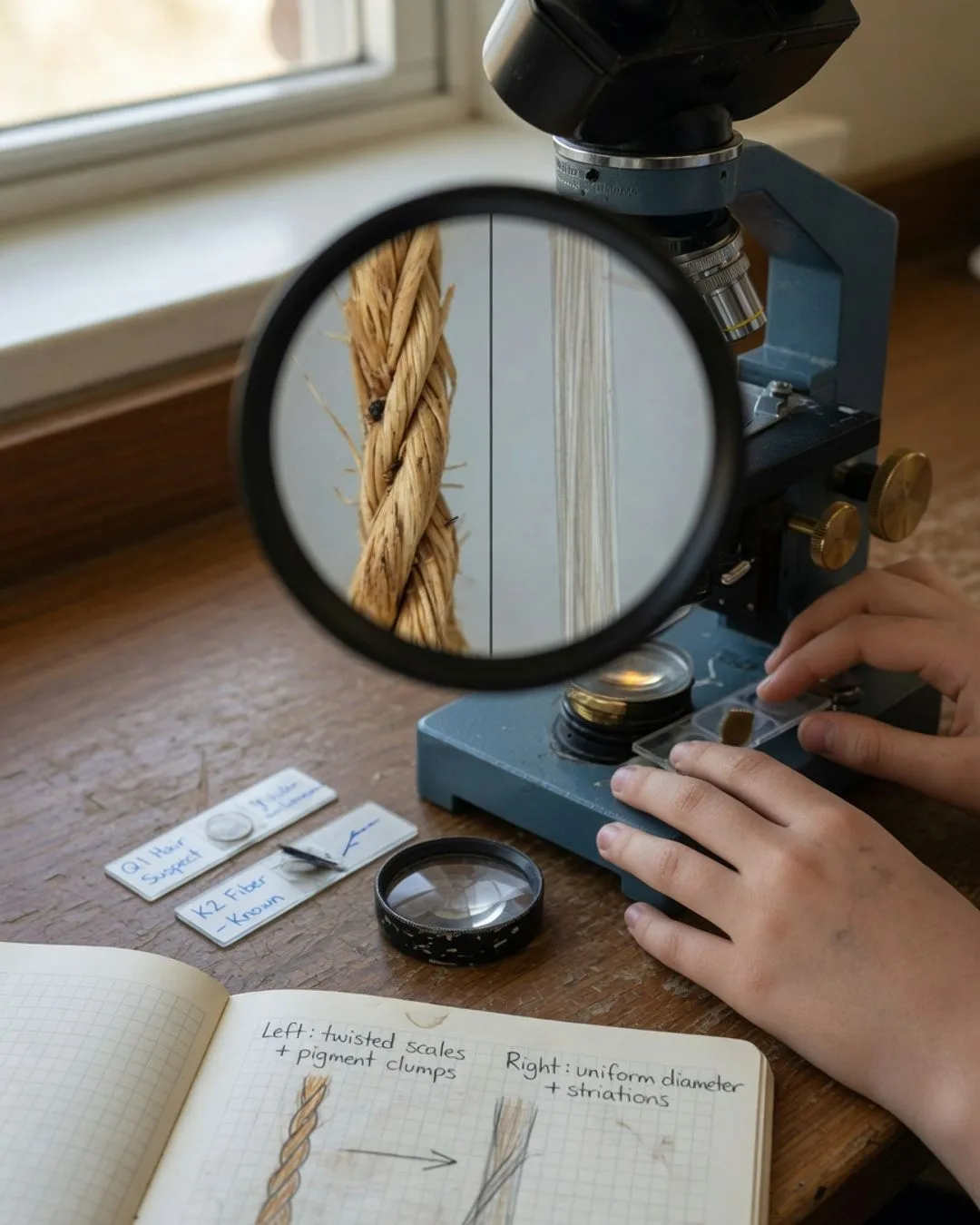
Every Bright Minds course has one unit where the walls between subjects come down on purpose — where the forensic science refuses to stay in the forensic science box and pulls in history, reading, writing, and ethics because it cannot be honestly told without them. In this course, that unit is built around the discovery of DNA fingerprinting: the realization that the human genome carries a pattern unique enough to identify a person. It is the forensic analog of the cholera map that anchors our biology course — a single real event that turns out to touch everything.
The science first
The idea looks almost simple once you know it. Most of the human genome is shared, but scattered through it are short sequences that repeat, and the number of repeats at each spot varies enormously from person to person. Read enough of those spots at once and the combined pattern becomes, for practical purposes, unique to an individual (identical twins aside). For most of history that pattern might as well not have existed, because no one had a way to pull it out of a sample and read it.
What makes DNA fingerprinting a perfect capstone is that understanding it requires nearly everything the course teaches at once. It is a problem in the comparison method — class features that many people share versus individual ones that narrow the field to a person. It is a problem in probability: a match is never absolute, only a likelihood, and the whole weight of the evidence lives in how rare that pattern is in the population. It is a problem in careful documentation: a profile is only as trustworthy as the chain of custody behind the sample. And it is a problem in honest reporting: the analyst states the odds, and the court — not the analyst — decides guilt. A serious examiner does not get to lean on one silver bullet; they have to hold all of it at once.
The same reasoning a student uses to weigh whether two profiles truly correspond is the reasoning that, in a real courtroom, decides whether the right person is convicted — or the wrong one set free.
The history and the case
On the morning of the tenth of September, 1984, at the University of Leicester, the geneticist Alec Jeffreys developed an X-ray film in his lab and saw, for the first time, a pattern of bands that differed from person to person — what he would call a DNA “fingerprint.” Two years later, the technique met its first murder case. Two teenage girls had been killed near the villages of Narborough and Enderby, and the investigation turned to Jeffreys's new method. What it did next is the reason this case is taught: it did not simply point to a suspect. It reshaped the entire investigation, and it did so in both directions.
The ethics, unflinching
And then the course refuses to leave it there, because the honest story is sharper and more useful than the tidy one. Police already had a confession. A local teenager, Richard Buckland, had admitted to one of the killings under questioning — a false confession to a crime he did not commit. When Jeffreys compared the crime-scene samples to Buckland's DNA, the profiles did not match. The same evidence that would later convict cleared an innocent man who had already confessed, and Buckland became the first person in history exonerated by DNA. The investigation then screened thousands of local men until the real killer, Colin Pitchfork — who had paid a friend to give a sample in his place — was caught, matched, and convicted. One tool, in one case, both convicted the guilty and freed the innocent.
We put that pairing in front of students deliberately, because it teaches something no single result can:
- Evidence must beat assumption. The police had a confession and believed the case was closed. The DNA said otherwise. A serious examiner follows the evidence even when it contradicts what everyone already believes.
- The same tool that convicts can clear. DNA fingerprinting is not a machine for finding the guilty — it is a machine for testing a claim, and testing it honestly means being just as ready to exonerate as to convict.
- A false confession is real. An innocent person can admit to a crime they did not commit. That is why physical evidence, weighed carefully, matters, and why the analyst reports the likelihood and lets the court, not the confession, decide.
And across the whole course
The thread runs out into every other subject. The history is a real case with real names and dates. The reading and writing is the lab report and the courtroom testimony, where a conclusion has to be stated in language precise enough to survive cross-examination. The ethics is the innocent man who confessed and the guilty man who almost walked. And the applied math is the quiet engine underneath it all: a match is a probability, and understanding match statistics — how rare a profile is, what the odds actually mean, why “one in a billion” is still not the same as “certain” — is what separates honest testimony from overreach.
That is what integration means here. Not a forensic science lesson with a history anecdote stapled on, but a single case held up to the light until a student can see, through it, how forensic science, history, reading, writing, ethics, and math were never really separate subjects at all. The core spokes, History, Reading, and Writing, are included in every unit; an applied-math lane (match probabilities, ridge counts, population statistics) runs underneath; and each unit reaches for the elective spokes its story earns — here, the ethics of wrongful conviction and the statistics of identity. The integration guide lays out the full model.