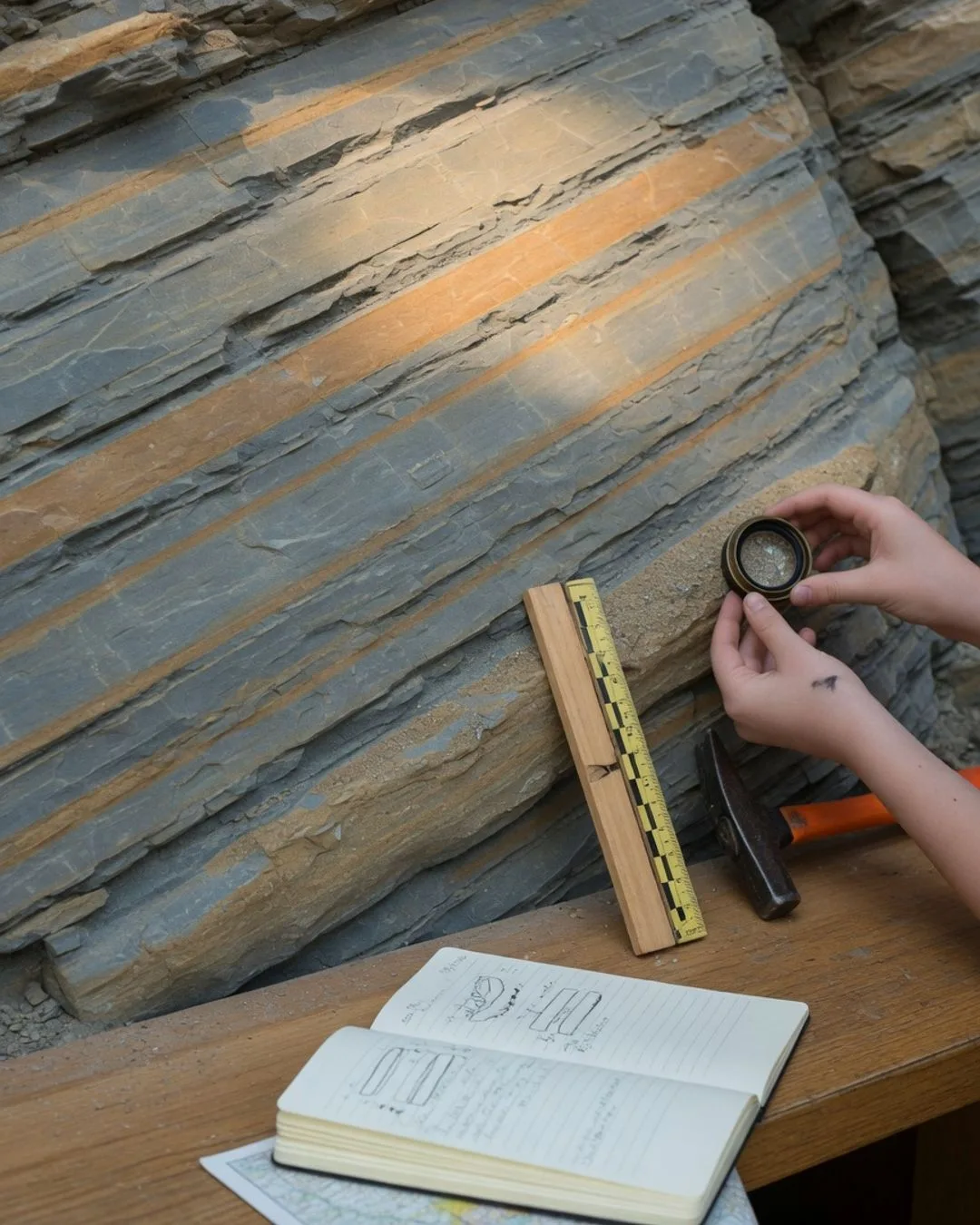
Ask a student who has only read about geology what granite is, and they will give you a definition — coarse-grained, igneous, quartz and feldspar. Ask a student who has held it under a hand lens, scratched it on a plate, and set it beside a lump of basalt in the same tray, and they will tell you about the interlocking crystals catching the light, the heft of it, the pale flecks they learned to name. The first student has a sentence. The second has judgment — and judgment is what the sentence was always trying to point at.
That gap is the whole reason this course is built the way it is. Geology, more than most high-school sciences, asks you to reason about time and process you can never watch directly. Biology has organisms you can see and dissect. Physics has motion you can watch and time. But the great actors in geology (a mountain rising, a sandstone bed gathering grain by grain over a million years, a continent drifting a fingernail's width a year) move too slowly or too vastly for any single life to witness. The danger is that the subject collapses into diagram-memorizing: a student learns to label the rock cycle without ever believing that a real rock passed through it.
The bench and the outcrop make it physical
The job of the lab and the field is to drag those slow, invisible processes down into something you can hold. You cannot watch a mineral crystallize deep in the crust, but you can drag it across a streak plate and see that hematite leaves a red-brown line no matter what color the lump looked like. You cannot see hardness, but you can take a Mohs kit and find the exact point where calcite scratches gypsum and fluorite scratches calcite. You cannot see the carbonate hidden in a gray limestone, but you can put one drop of dilute acid on it and watch it fizz — the rock answering the test out loud, in front of you.
This is what we mean when we say the course is lab- and field-led, not textbook-led. The reading does not come first, with the specimen as a garnish to confirm it. The rock comes first. The question is posed where it actually lives (under the hand lens, on the streak plate, in the beds of a roadcut), and the textbook is the tool we reach for to explain what we just saw. A student who has struggled to tell schist from gneiss in the hand is ready to be told about metamorphic grade. A student who has only been told about metamorphic grade is ready to forget it.
The diagram in the book is a claim about something real. The specimen in your hand is where you find out the claim is true.
What the bench and the field teach that the page cannot
Beyond making concepts concrete, hands-on geology teaches a set of things a textbook structurally cannot, because they are not simply facts. They are judgments and habits that only form under real conditions:
- That judgment is hard. Deciding whether a mineral is a 5 or a 6 on the Mohs scale, estimating grain size by eye, calling a hand sample thirty percent quartz — these teach a humility about data that no worked example ever will.
- That specimens don't read the textbook. The sample is weathered. The color is a little off. The streak comes out paler than the chart promised. Learning to reason about why a real rock departs from the tidy description is a geologist's core skill.
- That technique is knowledge. How hard you press on the streak plate, how you angle a specimen to the light to read its luster, how you bring the rock up to the hand lens — the answer depends on the doing, and the doing can only be learned by doing.
The two-day rhythm
Practically, this conviction becomes a schedule. The course runs on a two-day rhythm. One day is the Concept Day: the idea is introduced and worked through on paper — the rock cycle, the principles of superposition and cross-cutting, the sheer scale of deep time. The next is the Field & Lab Day, where that same idea is made physical — a tray of specimens to identify, an outcrop to read bed by bed — and written into a real field notebook in the student's own hand. Between the two days, the student works at home, and that gap is not dead time. It is where the concept and the specimen knit together into something that lasts.
We are not against the textbook; a serious geology course needs a rigorous one, and this course has it. We are against the textbook going first and the specimen going second, because we have watched what that produces: a student who can recite the definition of an unconformity and has never once run a finger across the gap in the rock where millions of years went missing. Put the specimen and the outcrop first, and geology stops being a vocabulary list. It becomes something the student has actually seen (the way James Hutton read deep time in the tilted beds at Siccar Point), which is the only kind of geology anyone remembers.