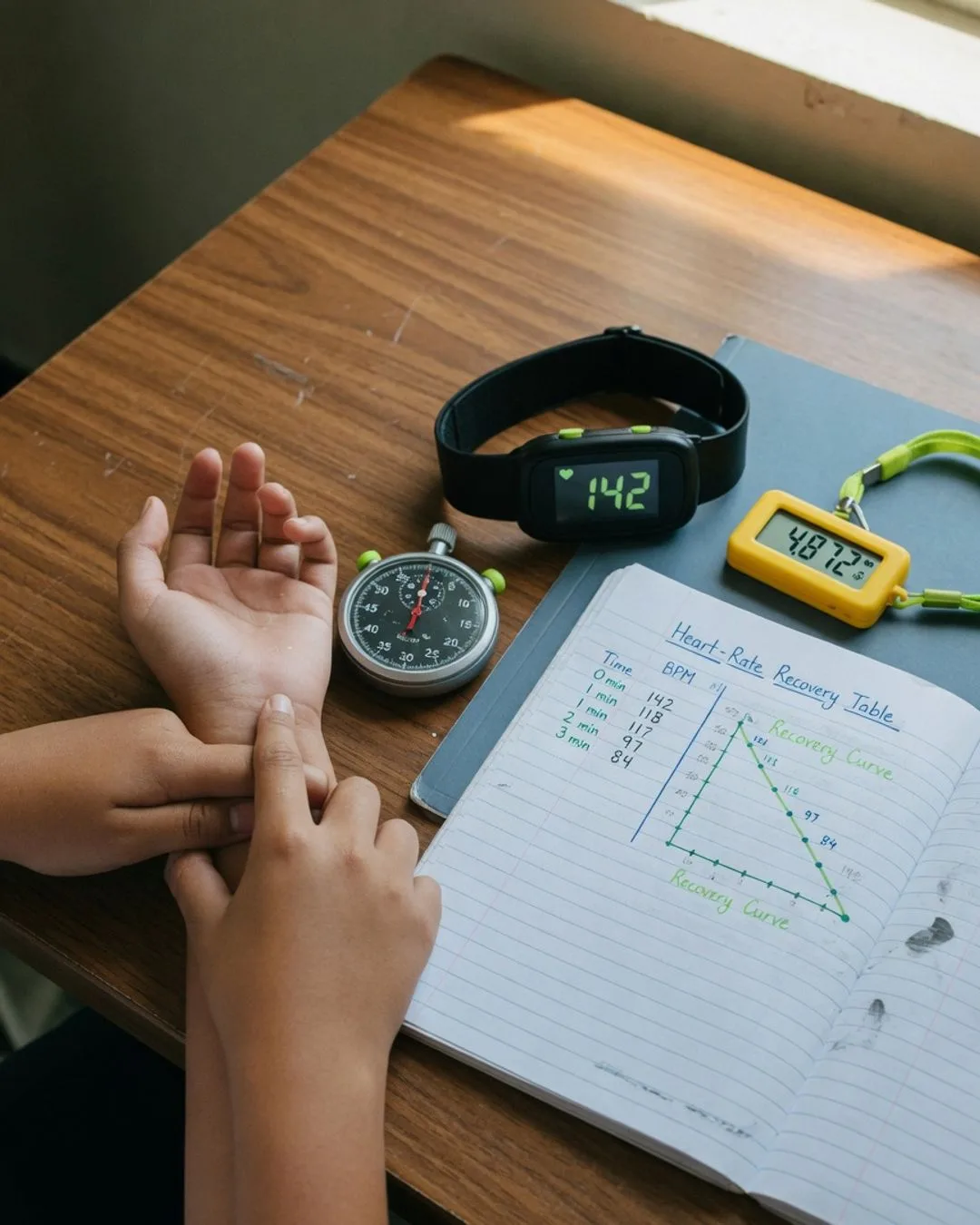
Ask a student who has only read about health & nutrition what it means to evaluate a food, and they will give you a definition. Ask a student who has actually tested one, and they will tell you about the moment the iodine turned the cracker blue-black, or their own pulse climbing and then settling back over three minutes, or the label whose numbers didn't match the promise on the front. The first student has a sentence. The second has an experience, and the experience is what the sentence was always trying to point at.
That gap is the whole reason this course is built the way it is. Health & Nutrition, more than almost any other subject, arrives pre-loaded with claims a student is expected to simply accept — from labels, from headlines, from advertising, from well-meaning advice. The danger is that the subject collapses into a list of rules to memorize and obey: a student learns to recite which foods to fear and which to trust without ever testing a claim, reading the real data, or noticing how their own body actually responds.
The bench turns claims into evidence
The job of the learning bench is to turn a claim you are told into evidence you gather for yourself. You cannot take a label's word that a cracker is mostly starch, but you can add a drop of iodine and watch it turn blue-black in front of you. You cannot see energy balance in the abstract, but you can measure the calories on a label against the activity in your own day and reason about both as data. You cannot tell how your heart handles effort by looking, but you can time it climbing during exercise and settling afterward, and read your recovery as a curve on the page.
This is what we mean when we say the course is lab-led, not textbook-led. The reading does not come first, with the investigation as a garnish to confirm it. The bench comes first. The question is posed where it actually lives (with a food label, a stopwatch, and a real dataset in hand), and the textbook is the tool we reach for to explain what we just saw. A student who has tested a food and watched it come up positive for starch is ready to be told what carbohydrates do in the body. A student who has only been told about carbohydrates is ready to forget it.
The label on the package is a claim about something real. The bench is where the student finds out whether the claim holds up.
What the bench teaches that the page cannot
Beyond making concepts concrete, the laboratory teaches a set of things a textbook structurally cannot, because they are not simply facts. They are judgments and habits that only form under real conditions:
- That measurement is hard. Reading a heart-rate monitor while your fingers search for the pulse, deciding when the count really starts, watching two trials of the same recovery disagree — these teach humility about data that no worked example ever will.
- That real data doesn't read the textbook. The label's serving size is never the amount anyone eats. Your recovery is faster one day and slower the next. A food test comes up ambiguous. Learning to reason about why the real result departs from the tidy one is the core skill of evidence-based science.
- That method is knowledge. How you time a measurement, how you control what you compare, how long you wait, how you record what you saw — the answer depends on the doing, and the doing can only be learned by doing.
The two-day rhythm
Practically, this conviction becomes a schedule. The course runs on a two-day rhythm. One day is the Concept Day: the idea is introduced and worked through on paper — a body system, a macronutrient, an energy-balance calculation. The next is the Investigation Day, where that same idea is made physical at the bench and written into a real lab notebook in the student's own hand — a food-nutrient test, a measurement, a label read closely against its marketing. Between the two days, the student works at home, and that gap is not dead time. It is where the concept and the experience knit together into something that lasts.
We are not against the textbook; a serious Health & Nutrition course needs a rigorous one, and this course has it. We are against the textbook going first and the bench going second, because we have watched what that produces: a student who can recite a rule about food and has never once tested a sample, tracked their own data, or held a label up against the evidence. Put the bench first, and Health & Nutrition stops being a vocabulary list. It becomes a set of claims the student has actually put to the test, which is the only kind of health knowledge anyone trusts.