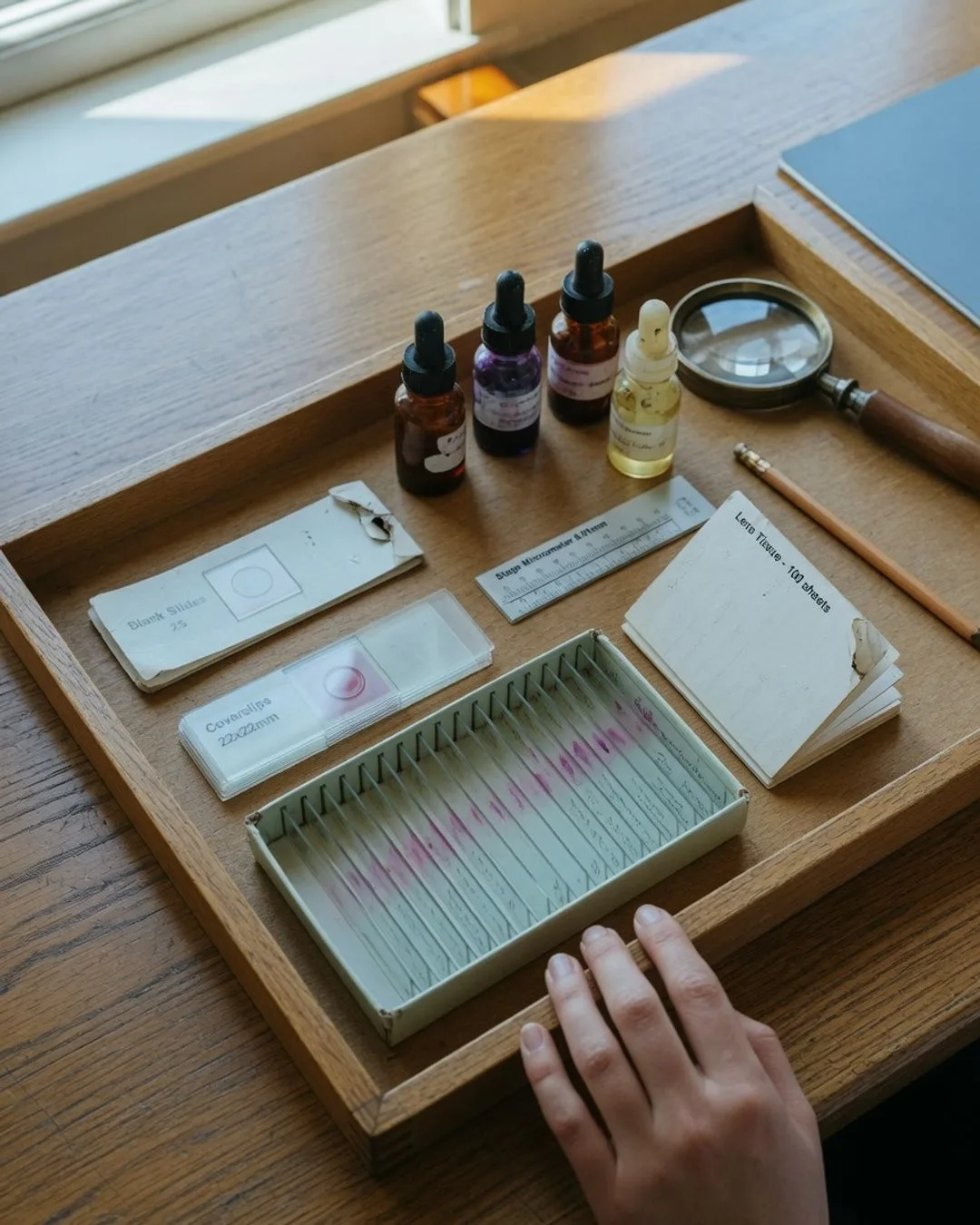
Hand a beginner an eyepiece with a scale in it and they will read a specimen as "38 units long" and call it a length. Hand a trained microscopist the same eyepiece and they will tell you the number is meaningless until it's calibrated against a stage micrometer at that exact magnification — and they will know it because they understand that every measurement under a scope is only as good as the calibration behind it, and reporting a size you never calibrated is a kind of lie.
Learning to measure honestly is one of the quiet, foundational skills of the whole course, and it is worth slowing down to assess on its own. It is not glamorous. It does not produce a striking specimen or a vivid stain. But a student who cannot measure cannot do microscopy, because every result downstream (every recorded size, every scale bar, every drawing to scale) inherits the quality of the numbers it was built from.
Significant figures are an honesty system
Students often treat significant figures as an arbitrary rule about how many digits to keep, a hoop to jump through to avoid losing points. They are nothing of the kind. Significant figures are a language for stating how much you actually know. When you write that a cell is 42 micrometres across, you are claiming the first two digits are trustworthy and the last is your best estimate between the marks of the scale. Write 42.00 and you are claiming a precision the eyepiece scale never had — you are reporting confidence you do not possess. The rule for carrying sig figs through a calculation is just the bookkeeping that keeps that honesty intact: a result can be no more precise than the least precise measurement that went into it.
Precision is not accuracy
The two words get used interchangeably in ordinary speech, and the laboratory exists in part to teach the student that they are not the same thing at all:
- Precision is how tightly your repeated measurements agree with each other. Three readings of the same cell that all land within a micrometre of one another are precise — even if every one of them is wrong.
- Accuracy is how close you are to the true value. You can be accurate on average and sloppy reading-to-reading, or precise and consistently biased.
- The hard cases are the dangerous ones: measurements that are beautifully precise and quietly inaccurate, because an uncalibrated eyepiece scale or a systematic technique error is repeating the same mistake with great reliability.
A student who internalizes this stops trusting a number just because the trials agreed, and starts asking the better question: agree with what, and compared to what?
Calibrating the scale, and where error comes from
Some of this is muscle: calibrating the eyepiece scale against a stage micrometer at each magnification, counting units across a specimen without letting it drift, knowing that the last digit is always an estimate. But the deeper lesson is that error propagates. A small uncertainty in the calibration and a small uncertainty in the count do not stay small and separate when you combine them — they travel into the final size and, depending on the arithmetic, sometimes grow. A serious result names that combined uncertainty. It says, in effect, "here is my measurement, and here is how far from it the truth might reasonably lie."
A measurement reported without its uncertainty is not a careful number. It is a guess wearing the costume of one.
Doing it right when the clock is running
It is one thing to calibrate a scale and measure a specimen carefully with all afternoon to do it. It is another to do it correctly during a timed identification, when the clock is running and the next slide is waiting. That is deliberate. In the real practice of microscopy, measurement always happens under some pressure (a specimen drifts, a mount dries out), and precision that evaporates the moment things speed up was never really owned. So the course asks students to measure well and measure promptly, not because speed is the point, but because a skill you can only perform slowly and undisturbed is a skill you only half-have.