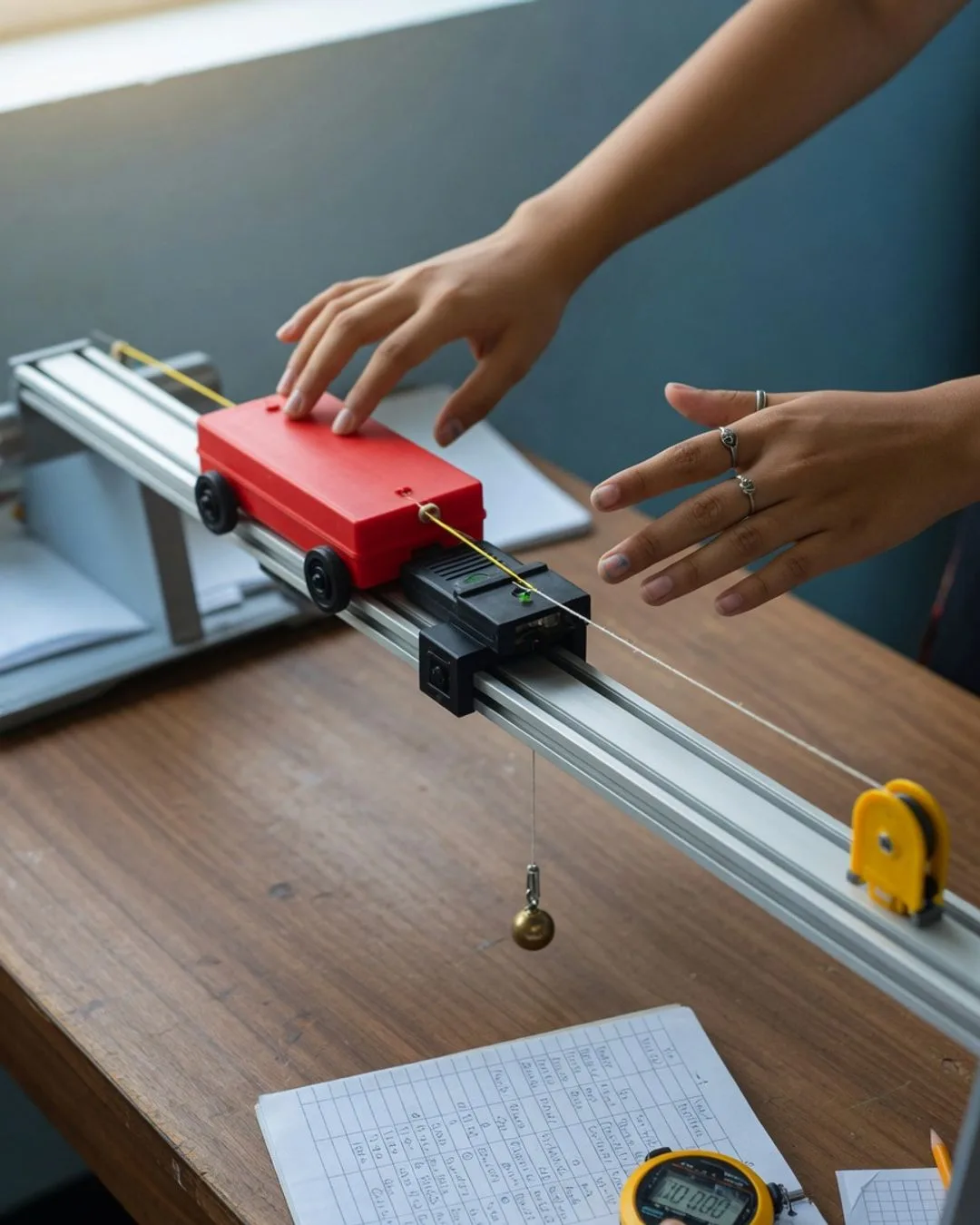
Every Bright Minds course has one unit where the walls between subjects come down on purpose — where the physics refuses to stay in the physics box and pulls in history, reading, ethics, geography, and math because it cannot be honestly told without them. In this course, that unit is built around Galileo's inclined-plane experiments: the deceptively simple act of rolling a ball down a grooved ramp to slow gravity enough to measure it. It is the physics analog of the cholera map that anchors our biology course — a single real experiment that turns out to touch everything.
The physics first
The problem looks almost trivial on the page: a ball rolling down a groove. But an object falling straight down moves too fast for any clock Galileo owned. His insight, worked out roughly between 1604 and 1638, was to tilt the plane (to dilute gravity) so the same acceleration played out slowly enough to time with a water clock, weighing the water that flowed while the ball traveled.
Rolling the ball over different distances, he found the pattern that changed everything: the distance covered grows as the square of the time. d ∝ t² — double the time and you quadruple the distance. That is uniform acceleration, stated for the first time as a measured law, and it is the seed of all of kinematics, Unit 01 of this course. What makes the inclined plane a perfect capstone is that it also carries, folded inside it, nearly everything the course later stands for.
The same discipline a student uses to time a ball on a ramp — isolate one variable, measure carefully, and weigh the results with their uncertainty — is the discipline that pried the study of nature loose from authority and made physics possible.
The controlled experiment is born
The result alone is not what makes this moment a turning point — the method is. Aristotle had taught for two thousand years that heavier objects fall proportionally faster, and for two thousand years almost no one had made the measurement to check. Galileo's move was radical: isolate one variable, hold everything else fixed, measure carefully, and let the numbers overrule the authority. Change nothing but the distance and read the time; change nothing but the angle and watch the pattern hold. This is the birth of the controlled experiment — arguably the single most powerful idea in all of science, and the reason a Bright Minds bench looks the way it does.
The history and the stakes
Galileo did not do this work in a vacuum. The same habit of trusting the measurement over the received wisdom that gave us d ∝ t² led him to build telescopes and look up — and what he saw, moons circling Jupiter and the phases of Venus, backed Copernicus's claim that the Earth moves. That claim put him in front of the Roman Inquisition, which forced him to recant and spend his final years under house arrest. His books — the Dialogue Concerning the Two Chief World Systems and the Two New Sciences, the latter smuggled out to a Dutch printer — are where students meet him in his own voice, as primary sources rather than a textbook summary. The geography is real too: Pisa, Padua, Florence, the university towns of a Scientific Revolution taking shape across northern Italy.
The ethics, unflinching
And then the course refuses to leave it there, because the honest story is sharper than the triumphant one. Galileo was right and the authorities were wrong, but they held the power, and being right did not spare him. We put that contradiction in front of students deliberately, because it teaches something no equation can:
- Evidence outranks authority, but not automatically. Galileo won the argument and lost the trial. The lesson is not that data always wins; it is that data is worth defending even when it costs you.
- The controlled experiment is a moral act, not just a technical one. Choosing to measure rather than defer is a decision about how you find the truth, and about who gets to decide what is true.
- Ideas have consequences, and enemies. A ball on a ramp reshaped how humans understand the universe within a century, and that is exactly why it frightened the people whose authority it undercut.
And back to the math
The thread runs full circle into the quantitative work students do at the bench. Galileo's law is not a slogan; it is a graph. When a student plots distance against time, they get a curve — and only when they plot distance against time squared does the data fall onto a straight line whose slope carries the acceleration. That single move — find the variable that straightens the graph — is one a physicist uses for a lifetime. A student who has rolled a ball, timed it, and graphed d against t² understands something genuinely deep: that a law of nature can be read straight off a ruled sheet of paper, and that the ratios Galileo compared four centuries ago are the same ratios on the worksheet in front of them.
That is what integration means here. Not a physics lesson with a history anecdote stapled on, but a single experiment held up to the light until a student can see, through it, how physics, history, reading, ethics, geography, and math were never really separate subjects at all. The core spokes, History, Reading, and Writing, are included in every unit; an applied-math lane (the times-squared law, ratios, graphing distance against time²) runs underneath; and each unit reaches for the elective spokes its story earns — here, the ethics of authority versus evidence and the geography of the Scientific Revolution. The integration guide lays out the full model.