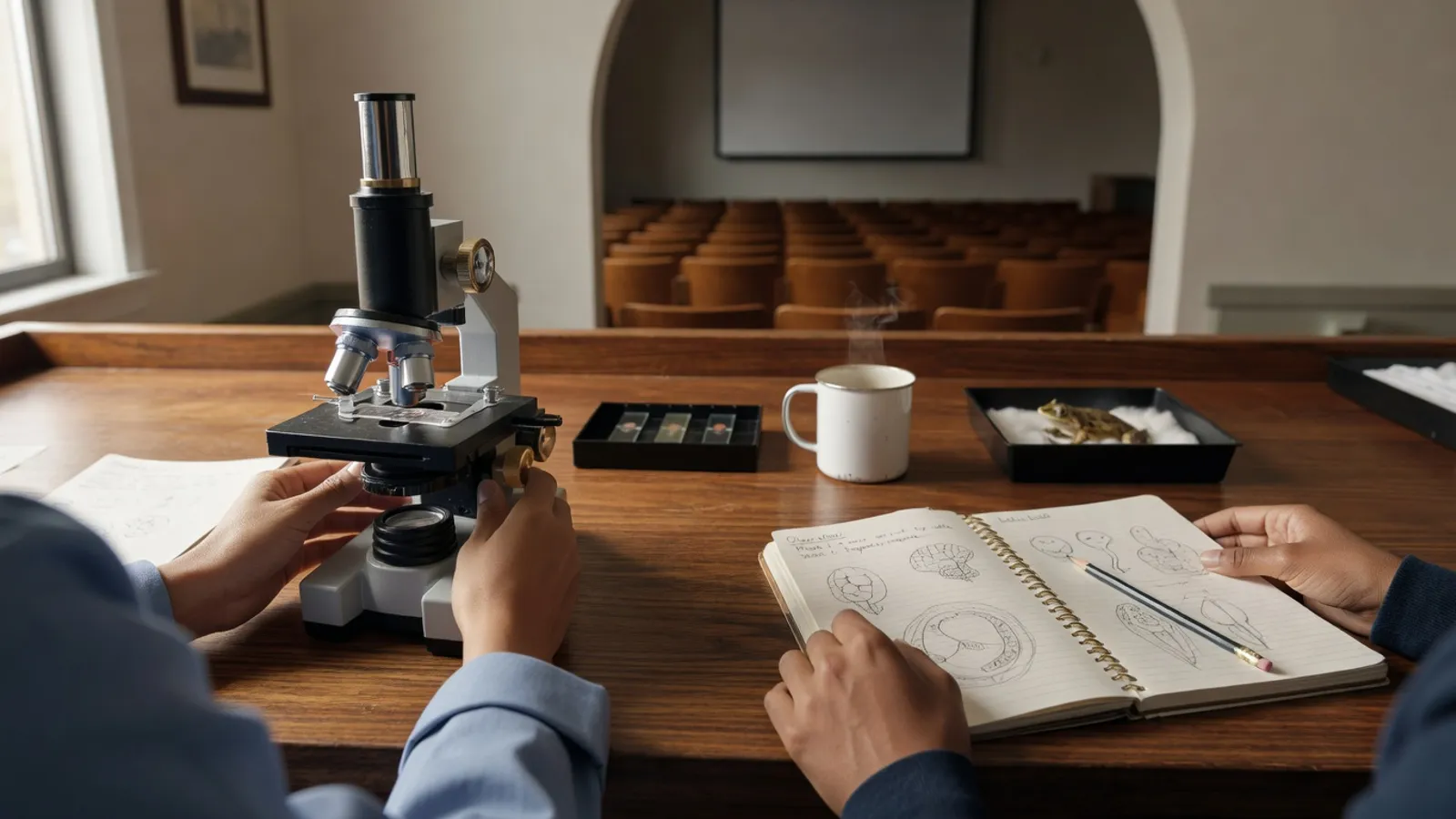
What the bench teaches that the lecture cannot.
A standing question in any large undergraduate science program is whether bench-based instruction justifies the time it takes. The answer depends on which skills students practice at the bench, and whether those things matter for the careers our students are pursuing. Both questions deserve evidence.
Questions about bench-based instruction often concern resources. Labs require time, space, supplies, and supervision. Observed performance also takes more work to score consistently than a multiple-choice answer sheet. Those are legitimate concerns, but they do not settle whether a lab should be replaced. We also need to ask what students learn there.
Before replacing a lab activity, ask whether the proposed alternative gives students comparable practice and whether they can demonstrate the same skills afterward. If it does, the alternative deserves consideration. If it does not, we need to improve the lab's efficiency without losing the practice students need.
What follows is an inventory of four kinds of learning that lab work can support. The research helps explain why practice matters in each case. It does not establish that a laboratory is the only setting where these skills can develop.
1. Tactile and procedural memory
Procedural knowledge is knowing how to carry out an action; declarative knowledge includes facts we can state. These forms of learning draw on different memory systems and benefit from different kinds of practice. Reading about a dissection technique can explain the steps, but it does not demonstrate that a student can perform them.1
Clinical-skills research examines how supervised practice and simulation help students learn procedures. A written knowledge test alone cannot show whether someone can handle an instrument or complete a sequence safely.2 Reviews of simulation-based medical education also support deliberate practice: repeated attempts at a defined task, with feedback and opportunities to improve.3
What this looks like in undergraduate A&P specifically is familiar to anyone who has graded a lab practical. A student may name the brachial plexus on a diagram yet have difficulty tracing it on a specimen. Recognizing the name and locating the structure require related but distinct practice.
- ·Consolidated via reading & recall
- ·Reliable on multiple-choice instruments
- ·Hippocampus / neocortex pathway
- ·Consolidated via repetition with feedback
- ·Performance-testable; weakly recognized on paper
- ·Basal ganglia / cerebellum pathway
2. Decision-making under genuine uncertainty
Textbook problems often provide the information needed for a defined answer. At the bench, a slide may not match the reference image, or an instrument reading may differ from the prediction. Students must decide which observations support an answer and when to check their technique or ask for help.
The cognitive-science literature distinguishes well-structured problems (clear information, goals, and solution steps) from ill-structured ones (incomplete information, competing goals, or several defensible approaches). Learning to solve the first does not automatically prepare students for the second.4 Bench work offers a supervised setting in which to practice making decisions when the evidence is less tidy than expected.
This matters for pre-health students. Nursing research, including Benner's From Novice to Expert and Tanner's model of clinical judgment, examines how clinicians learn to interpret situations that do not match textbook examples.5 Undergraduate lab work can introduce that habit of examining evidence without claiming to replace clinical training.
3. Recognizing a name and finding a structure
Naming a structure on a labeled diagram and locating that same structure on an unlabeled specimen are different tasks. In the second, the student must distinguish the relevant features from surrounding tissue. Perceptual-learning researchers describe this as structure extraction. Varied examples and feedback help students learn which features matter.6
The radiology-education literature has shown this experimentally for decades. Residents who study labeled images alone improve measurably less, and on a measurably narrower distribution of presentations, than residents who study unlabeled images with structured feedback, even when the lecture content and the testing schedule are otherwise identical.7 The anatomical-sciences-education literature has reproduced the finding repeatedly in undergraduate settings: students who learn structures on cadaveric or model-based specimens outperform students who learn the same structures on diagrams when both groups are tested on novel specimens.8
The distinction matters in later training. Naming an artery on a chart is not the same as locating a pulse. Recognizing a labeled pathology image is not the same as examining an unfamiliar slide. These tasks require students to use their knowledge under different conditions, so both need practice.
4. Comparing observations with a partner
Pair work gives students practice comparing observations, explaining a measurement, and resolving disagreements using evidence. These habits also matter in clinical teams. They can be taught in several settings; the lab adds a shared specimen or measurement that both students can examine directly.
The collaborative-learning literature in undergraduate STEM is relevant here. The Springer, Stanne, and Donovan meta-analysis of 1999 found significant positive effects of small-group learning on achievement, persistence, and attitudes toward science across 39 studies.9 The Freeman et al. 2014 PNAS meta-analysis of 225 studies found examination scores roughly half a standard deviation higher in active-learning sections than in traditional lectures. Failure rates were 55% higher in traditional-lecture sections than in active-learning sections.10
Health-professions accreditors have noticed. The Interprofessional Education Collaborative core competencies, now adopted across nursing, medical, pharmacy, dental, and allied-health accreditation, explicitly require the kind of team-based competency that pair-work at a bench begins to build.11 The lab offers extended, low-stakes practice in coordinating with another person around a specimen, instrument, or measurement. The broader active-learning findings support collaboration, not a claim that only labs can teach it.
The point is not that lecture is broken. The point is that lecture and bench teach different things, and a curriculum that treats them as substitutes is making a category error.
What this inventory does not say
Not every lab activity uses bench time well. Learning structure names, for example, can begin before lab so students arrive ready to identify them on specimens. Reviewing each activity's purpose can help a program decide what to retain, restructure, or move to another setting.
When a bench activity develops one or more of these skills, a replacement should be evaluated against those same skills. A worksheet may prepare students for a procedure without showing that they can perform it. The course needs an assessment that can reveal the difference.
A practical implication
For any program weighing reductions to its laboratory component, three suggestions, offered as professional counsel rather than advocacy:
- Review each lab activity against its learning goals, including the four categories above. Revise activities that do not serve a clear purpose.
- Assess hands-on skills through lab practicals, structured clinical-examination stations, or performance demonstrations. These give reviewers evidence of what students can do.
- Treat lecture and lab as complementary, not interchangeable, in curriculum-mapping conversations. The mapping document should make explicit which learning category each activity serves; substitution proposals should be required to name the category they are preserving and the category they are giving up.
The cost question is real. The replacement question is the one that usually gets answered without enough evidence. The literature on what the bench teaches has been accumulating for decades. It deserves a seat at the table when the budget conversations happen.
References & further reading
- Squire, L. R. (2004). “Memory systems of the brain: a brief history and current perspective.” Neurobiology of Learning and Memory, 82(3), 171–177. doi:10.1016/j.nlm.2004.06.005. The canonical short reference for the declarative / procedural distinction. For an instructionally-oriented treatment, see also Anderson, J. R. (1996), “ACT: A simple theory of complex cognition,” American Psychologist, 51(4), 355–365.
- Reznick, R. K., & MacRae, H. (2006). “Teaching surgical skills, changes in the wind.” New England Journal of Medicine, 355(25), 2664–2669. doi:10.1056/NEJMra054785. A foundational review of why simulation and supervised practice cannot be replaced by reading or video for procedural skill acquisition.
- McGaghie, W. C., Issenberg, S. B., Cohen, E. R., Barsuk, J. H., & Wayne, D. B. (2011). “Does simulation-based medical education with deliberate practice yield better results than traditional clinical education? A meta-analytic comparative review of the evidence.” Academic Medicine, 86(6), 706–711. doi:10.1097/ACM.0b013e318217e119. See also Issenberg, S. B., et al. (2005), “Features and uses of high-fidelity medical simulations that lead to effective learning: a BEME systematic review,” Medical Teacher, 27(1), 10–28.
- Jonassen, D. H. (2000). “Toward a design theory of problem solving.” Educational Technology Research and Development, 48(4), 63–85. doi:10.1007/BF02300500. The standard taxonomy of well-structured vs. ill-structured problems and the implications for instruction.
- Benner, P. (1984). From Novice to Expert: Excellence and Power in Clinical Nursing Practice. Menlo Park, CA: Addison-Wesley. Tanner, C. A. (2006), “Thinking like a nurse: a research-based model of clinical judgment in nursing,” Journal of Nursing Education, 45(6), 204–211. doi:10.3928/01484834-20060601-04.
- Kellman, P. J., & Massey, C. M. (2013). “Perceptual learning, cognition, and expertise.” In B. H. Ross (ed.), Psychology of Learning and Motivation, vol. 58, pp. 117–165. Academic Press. doi:10.1016/B978-0-12-407237-4.00004-9. The foundational treatment of perceptual learning modules and why expert vision cannot be acquired from labeled-image study alone.
- Krupinski, E. A. (2010). “Current perspectives in medical image perception.” Attention, Perception, & Psychophysics, 72(5), 1205–1217. doi:10.3758/APP.72.5.1205. A review of the radiology-perception literature on how expert visual identification develops and what training conditions support it.
- Wilhelmsson, N., Dahlgren, L. O., Hult, H., Scheja, M., Lonka, K., & Josephson, A. (2010). “The anatomy of learning anatomy.” Advances in Health Sciences Education, 15(2), 153–165. doi:10.1007/s10459-009-9171-5. Representative of a substantial literature in Anatomical Sciences Education on specimen-based vs. diagram-based learning outcomes.
- Springer, L., Stanne, M. E., & Donovan, S. S. (1999). “Effects of small-group learning on undergraduates in science, mathematics, engineering, and technology: a meta-analysis.” Review of Educational Research, 69(1), 21–51. doi:10.3102/00346543069001021.
- Freeman, S., Eddy, S. L., McDonough, M., Smith, M. K., Okoroafor, N., Jordt, H., & Wenderoth, M. P. (2014). “Active learning increases student performance in science, engineering, and mathematics.” Proceedings of the National Academy of Sciences, 111(23), 8410–8415. doi:10.1073/pnas.1319030111.
- Interprofessional Education Collaborative. (2023). IPEC Core Competencies for Interprofessional Collaborative Practice: Version 3. Washington, DC: Interprofessional Education Collaborative. ipecollaborative.org/ipec-core-competencies. Adopted across nursing, medicine, pharmacy, dentistry, and allied-health accreditation as the framework for interprofessional team competency.
Drafted May 2026.