Unit 01 · Chemistry of Life
Use the chemistry of life learning pathway for original readings, models, supplied data, checked practice and fresh transfer. The five science criteria stay distinct from integration; a paper/data alternative does not certify an unobserved technique.
Student learning: Chemistry of Life
Choose the level by readiness, not age alone, and record it before instruction. Foundation, core, and honors tasks are study pathways, not an AP course or a promise of college credit. The instructor retains practical assessment and the published science rubric; integration is reported separately.
Prerequisites: Particle models, polar versus nonpolar interactions, fractions and reading labeled axes. Foundation uses means/ranges; core adds sample SD and logarithmic pH ratios; honors distinguishes SE and experimental design.
Suggested sequence: read and discuss the explanation; attempt the worked model; analyze the data at your selected level; check the answers; then complete the source-linked response and a fresh transfer question. These activities supplement, not replace, supervised practical work and the full-year schedule.
Assigned reading and focus
- OpenStax Biology 2e (2018), 2.2 Water. [water-molecules] Read Water’s Polarity, Water’s High Heat Capacity and Water as a Solvent. Explain a property with intermolecular hydrogen bonds rather than just naming the property.
- OpenStax Biology 2e (2018), 2.1 Atoms, Isotopes, Ions, and Molecules. [water-molecules] Read chemical bonding and carbon-containing molecules. Track C, H, O, N, P and S as matter acquired from the environment, not created by cells.
- OpenStax Biology 2e (2018), 3.1 Synthesis of Biological Macromolecules. [water-molecules] Compare dehydration synthesis with hydrolysis; count links in a linear chain.
- OpenStax Biology 2e (2018), 3.2 Carbohydrates. [water-molecules] Compare the glucose linkages in starch and cellulose; connect linkage geometry with storage or structural function.
- OpenStax Biology 2e (2018), 3.3 Lipids. [water-molecules] Compare fats, phospholipids and steroids. Explain why lipids are not one family of repeating-monomer polymers.
- OpenStax Biology 2e (2018), 3.4 Proteins. [water-molecules] Read the four levels of protein structure and denaturation. Connect amino-acid side chains and folding to function.
- OpenStax Biology 2e (2018), 3.5 Nucleic Acids. [water-molecules] Compare nucleotides, sugar-phosphate backbones and base pairing in DNA and RNA.
- NobelPrize.org: The Nobel Prize in Chemistry 1972. [water-molecules] Read the 1972 prize citations for Anfinsen, Moore and Stein. Connect the stated sequence/conformation and structure/catalysis questions to this unit; a prize summary is not a complete experimental record or a list of every contributor.
- OpenStax Biology 2e (2018), 6.5 Enzymes. [enzyme-replicates] Read activation energy, active sites, induced fit, environmental effects and inhibitors. Distinguish rate from equilibrium and reversible inhibition from loss of folded structure.
Learn the science
[water-molecules] An O–H bond within water is polar covalent; a hydrogen bond is an attraction between partial charges, often on different molecules. Cohesion helps maintain water columns, adhesion helps water interact with surfaces, and disrupting hydrogen bonds absorbs energy. High heat capacity buffers temperature; it does not make water temperature unchangeable.
[water-molecules] Carbon forms molecular skeletons; nitrogen occurs in amino groups and bases, phosphorus in nucleotides and phospholipids, and sulfur in some amino acids. Hydrolysis consumes water to split a covalent linkage. A simplified linear chain made from n subunits has n − 1 links; real biosynthesis can use activated intermediates rather than directly releasing free water at every step.
[water-molecules] Carbohydrates have sugar subunits; different glycosidic linkages make starch an energy store and cellulose a structural material. Proteins have amino-acid sequences joined by peptide bonds. Primary sequence influences folding, but temperature, solvent and pH matter too. Lipids are not repeating-monomer polymers: a triglyceride contains glycerol and three fatty acids, whereas a phospholipid has a hydrophilic head and hydrophobic tails. Cis unsaturation introduces a bend, often reducing tight packing.
[water-molecules] DNA and RNA are nucleotide polymers, not proteins. Antiparallel strands and complementary bases support information storage; RNA can also have structural or catalytic roles. A food-indicator result reports a chemical response under calibrated conditions, not an exact concentration or every molecule in a food. The supplied colors below are fictional records, not instructions to use reagents.
[enzyme-replicates] Enzymes lower activation-energy barriers for reactions; they do not change the reaction’s overall free-energy difference or equilibrium position. Substrate and enzyme concentration can limit rate. Competitive inhibition competes for the active site; other interactions can alter activity without that competition.
[enzyme-replicates] Temperature influences collisions and molecular stability; pH changes ionization and can affect binding or folding. A peak in these three pH treatments is not proof that the true optimum is exactly pH 7 or that all enzymes share that optimum. The response was measured with substrate in excess in this model.
[enzyme-replicates] pH = −log10[H+] is a dilute-solution approximation using concentration in mol/L; more rigorously pH uses activity. Moving from pH 7 to pH 5 represents a 100-fold increase, not a two-fold increase, in this approximation.
[enzyme-replicates] Use x̄ = Σx/n for a mean and sample s = √[Σ(x − x̄)²/(n − 1)] for variation among independent replicates. Standard error s/√n describes uncertainty in the estimated mean under independent sampling, not the spread of individual observations. Label any error bars as range, sample SD or SE; these are not interchangeable. Tiny synthetic samples cannot establish normality, causation or population certainty. Recounts, time points from one specimen and subsamples of one slide are not independent biological replicates.

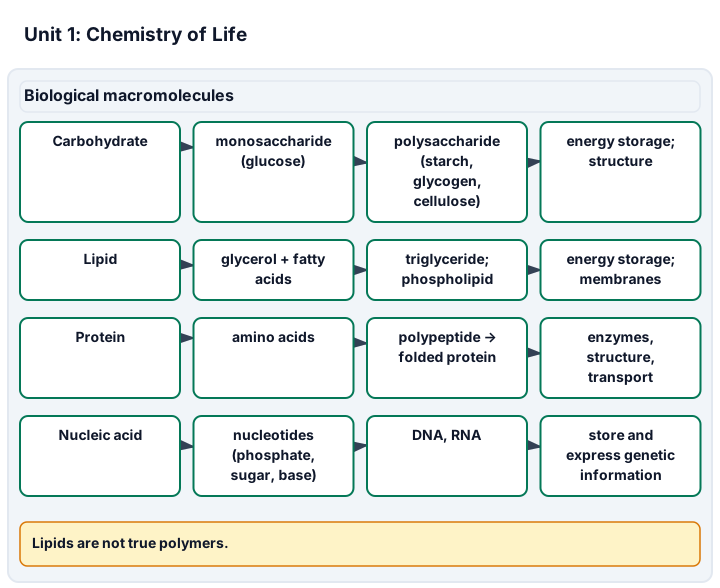
Diagram description
Unit 1: Chemistry of Life. Biological macromolecules: Carbohydrate to monosaccharide (glucose) to polysaccharide (starch, glycogen, cellulose) to energy storage; structure. Lipid to glycerol + fatty acids to triglyceride; phospholipid to energy storage; membranes. Protein to amino acids to polypeptide → folded protein to enzymes, structure, transport. Nucleic acid to nucleotides (phosphate, sugar, base) to DNA, RNA to store and express genetic information.
Data, provenance, and assumptions
| Model | Subunits | Link type |
|---|---|---|
| Linear peptide | 4 | Peptide |
| Short starch chain | 10 | Glycosidic |
| DNA strand | 5 | Phosphodiester |
| Recorded sample | Iodine observation | Biuret observation |
|---|---|---|
| Water blank | Amber | Blue |
| Known starch control | Dark blue | Blue |
| Known protein control | Amber | Violet |
| Sample X | Dark blue | Violet |
| pH | Replicate 1 | Replicate 2 | Replicate 3 |
|---|---|---|---|
| 5 | 2 | 3 | 4 |
| 7 | 8 | 9 | 10 |
| 9 | 4 | 5 | 6 |
| Substrate (mmol/L) | Initial rate (micromoles/min) |
|---|---|
| 1 | 3 |
| 2 | 5 |
| 4 | 7 |
| 8 | 8 |
Worked model
[water-molecules] Four amino acids in a linear peptide have three peptide links. In the simplified condensation picture, three waters are released when those links form and consumed when they are hydrolyzed. Sample X matches both positive controls: the model supports starch and peptide-containing material, not “all macromolecules” or a numerical nutrient concentration. [enzyme-replicates] At pH 7, x̄ = (8 + 9 + 10)/3 = 9 micromoles/min; sample s = √[(1 + 0 + 1)/2] = 1, and SE = 1/√3 ≈ 0.577350. The range is 8–10. Mean rates at pH 5 and 9 are 3 and 5. Plot all three points per pH plus the mean; label any SD bars. The substrate series approaches a plateau, consistent with enzyme limitation but not a fitted kinetic constant.
Numerical calibration
- 3 peptide links in the four-subunit model
- 9 micromoles/min
- 1 sample SD, micromoles/min
- 0.57735 SE, micromoles/min; not individual spread
- 100 fold concentration increase, pH 7 to 5
Attempt the assigned level
Try the tasks before reading the calibration. These are practice answers, not a secure examination; use a new dataset or changed assumption for the assessed transfer.
Foundation: typically grades 7-8
- [water-molecules] Use the molecule-links and indicator-records cards to count links in the peptide and identify the two responses in X. Explain one biological use of water with a particle-level reason. Evidence: science criteria 1, 3, 5; AP-connection objectives 1.1.A, 1.3.A, 1.7.A (selected task connection, not full objective mastery).
- [enzyme-replicates] Calculate the three pH-group means and ranges from enzyme-ph, and draw a labeled dot plot. What does the pH 7 group show compared with the other tested groups? Evidence: science criteria 2, 4; AP-connection objectives 3.1.A, 3.2.A (selected task connection, not full objective mastery).
Check after your attempt
- [water-molecules] The peptide has three links. X gives the starch-like and peptide-like responses. Water’s polarity allows hydrogen bonding, helping cohesion or thermal buffering; saying only “water is useful” leaves out the mechanism.
- [enzyme-replicates] Means are 3, 9 and 5 micromoles/min; ranges are 2–4, 8–10 and 4–6. The tested pH 7 group has the highest recorded rate, but three treatment values do not locate an exact optimum or establish a universal enzyme rule.
High-school core: typically grades 9-10
- [water-molecules] Draw the ten-sugar model, count hydrolyses needed to separate all subunits, and explain why the lipid family cannot use this same repeating-monomer rule. Trace environmental nitrogen into an amino acid and phosphorus into DNA. Evidence: science criteria 1, 3, 4; AP-connection objectives 1.2.A, 1.3.A, 1.4.A, 1.5.A, 1.6.A, 1.7.A (selected task connection, not full objective mastery).
- [enzyme-replicates] Compute the sample SD for pH 7 and the [H+] fold difference between pH 5 and 7. Explain the declining gain in rate as substrate increases in enzyme-substrate and what a denaturing treatment might change. Evidence: science criteria 2, 3, 4; AP-connection objectives 3.1.A, 3.2.A, 3.2.B (selected task connection, not full objective mastery).
Check after your attempt
- [water-molecules] Nine links require nine hydrolyses in the model. Lipids are a chemically diverse group, not a single repeating-monomer polymer. Organisms acquire nitrogen-containing matter and phosphate from their environment; atoms are rearranged into amino acids and nucleotides rather than created.
- [enzyme-replicates] Sample SD is 1 micromole/min and the concentration ratio is 100. The rate gains shrink as enzyme active sites become limiting under this model. Denaturation can disrupt binding or catalysis, whereas a catalyst never changes equilibrium simply by making reaction faster.
Honors extension: typically grades 11-12
- [water-molecules] Audit the controls before interpreting X. Explain why starch and cellulose can have the same glucose building block but different functions, and predict a membrane consequence of replacing straight saturated tails with cis-unsaturated tails at equal temperature. Evidence: science criteria 1, 4, 5; AP-connection objectives 1.4.A, 1.5.A, 1.7.A (selected task connection, not full objective mastery).
- [enzyme-replicates] Compute SE at pH 7, distinguish it from SD, and propose a design to separate a reversible pH effect from persistent loss of enzyme function without claiming these data already distinguish them. Evidence: science criteria 2, 4, 5; AP-connection objectives 3.2.A, 3.2.B (selected task connection, not full objective mastery).
Check after your attempt
- [water-molecules] The negative and molecule-specific positive controls behaved as defined, so the supplied responses are interpretable, but no calibration curve supports concentrations. Different glucose-link orientations alter three-dimensional structure and enzyme recognition. Cis bends generally reduce packing and increase fluidity under otherwise equal conditions; the response depends on composition and temperature.
- [enzyme-replicates] SE is about 0.577350 micromoles/min. SD describes variation among vessels; standard error is not their individual spread. A reviewed paper design compares fresh controls with treated material after return to the reference conditions, at equal enzyme and substrate amounts, with independent preparations. Recovery supports reversibility; absent recovery needs alternatives such as material loss considered.
History, reading, and writing connection
Read the official 1972 Nobel chemistry summary alongside OpenStax’s protein and enzyme explanations. State the historical questions recognized for Anfinsen, Moore and Stein, connect structure/sequence to function, and identify evidence missing from a prize summary. The synthetic indicator and enzyme records are not their experimental measurements.
Write in your own words or use an approved accessible equivalent. Cite a specific assigned section or figure, identify its evidence, and state one limitation or counterargument. Use the AI practice contract only for permitted coaching, never to invent observations or write the assessed response.
Transfer to a new case
[water-molecules] A new synthetic six-amino-acid linear chain is hydrolyzed completely, and an indicator run has a violet water blank as well as a violet unknown. How many links are broken, and may the unknown be called protein-positive? [enzyme-replicates] New synthetic independent rates are 4, 6 and 8 micromoles/min at pH 6. Calculate mean and sample SD. Can non-overlapping ranges alone prove a biological mechanism or substitute for an explained statistical test?
Calibration: [water-molecules] Five links are broken. The failed negative control makes that indicator run uninterpretable; repeat an approved analysis with working controls rather than declaring the unknown positive. Counting links does not validate a chemical assay. [enzyme-replicates] The mean is 6 and sample SD is 2 micromoles/min. Range comparisons alone neither prove a mechanism nor supply an inferential test; consider independent sampling, controls, effect size and design. No p-value is supplied or required for this descriptive task.
Evidence to retain
[water-molecules] Science criteria 1 and 4: structure-to-function diagrams; criterion 3: hydrogen-bond mechanism; criterion 5: controlled interpretation plus separately observed approved technique, not a worksheet-only practical pass. [enzyme-replicates] Science criterion 2: enzyme mechanism and predictions; criterion 3: pH reasoning; criterion 4: rate graph with independent replicates; criterion 5: design/control defense, with actual handling still separately assessed.
Record units, calculations, source/date, uncertainty, and what is measured versus inferred. A simulation or supplied dataset must stay labeled as such. These are public, nonsecure paper/data practice activities, not performed laboratory work. No culture of unknown microbes, human biological samples, medical or genetic personal disclosures, unsafe chemicals, or DNA manipulation instructions are authorized. Use supplied data, approved reference images, or a preapproved non-destructive observation. An instructor must review safety, accessibility and the exact practical contract before any physical activity; a worksheet does not certify hands-on technique.
Return to all eight learning pathways. Print this unit page for the student lessons; the linked five-page packet remains the separate assessment companion.
Use the investigation design before assessment
Each linked design gives materials, controls, sampling, procedure, uncertainty and the required human practical/safety review. No worksheet certifies an unobserved technique.
Unit mastery rubric
| Criterion | Developing | Proficient | Mastery |
|---|---|---|---|
| Macromolecule structure & function | Confuses building blocks or molecule families. | Matches families but needs help explaining linkages. | Links carbohydrate, lipid, protein and nucleic-acid structure to function; distinguishes polymers from lipids. |
| Enzyme behavior & factors | Treats all rate changes as the same mechanism. | Predicts a trend with reminders about controls. | Interprets enzyme rate data using pH, temperature, substrate and controls; reports replicate variation and limits. |
| Water & hydrogen bonding | Names a property without molecular cause. | Describes polarity with an incomplete mechanism. | Traces cohesion, polarity and heat capacity to hydrogen bonding and correctly interprets pH ratios. |
| Connecting chemistry to living systems | Lists molecules without a cell mechanism. | Connects one structure to a prompted function. | Explains how molecular interactions and energy barriers constrain cell function without changing equilibrium by catalysis. |
| Lab technique (food-test indicators) | Ignores controls or invents observations. | Interprets recorded controls with coaching. | Interprets positive/negative controls and limits; separately demonstrates any approved indicator technique required by the course contract. |
| Integration (cross-domain) | Makes no supported connection between the source and the science. | Uses the source but needs help connecting evidence, writing, or limitations to the science. | Independently connects History, Reading, and Writing using a cited source, appropriate evidence, a limitation, and a scientific explanation. |
Integration is reported separately and cannot lower the science grade or block a science demonstration pass. Science and practical criteria determine that pass. Use the integration guide's evidence checklist for the separately reported criterion.
Four amino acids in a linear peptide have three peptide links. In the simplified condensation picture, three waters are released when those links form and consumed when they are hydrolyzed. Sample X matches both positive controls: the model supports starch and peptide-containing material, not “all macromolecules” or a numerical nutrient concentration.
“I completed the chemistry of life worksheet, so I have mastered every science and practical criterion.” Completion and public answers are not evidence of independent mastery or observed technique.
Agree the level and specific science/practical contract before instruction. Retain an independent first attempt, source interpretation, calculations and a fresh instructor variation or observation. Public worked answers are nonsecure practice, not a private examination.
A 5-page clipboard packet — unit overview, key terms, the mastery rubric, anchor examples, and a score sheet you can print and grade against.