Why chemistry is taught this way.
Six short essays for parents and guides. The first two explain the core of the method; the next three address common family questions; the sixth explains how a course like this approaches learning in the age of AI.
The method
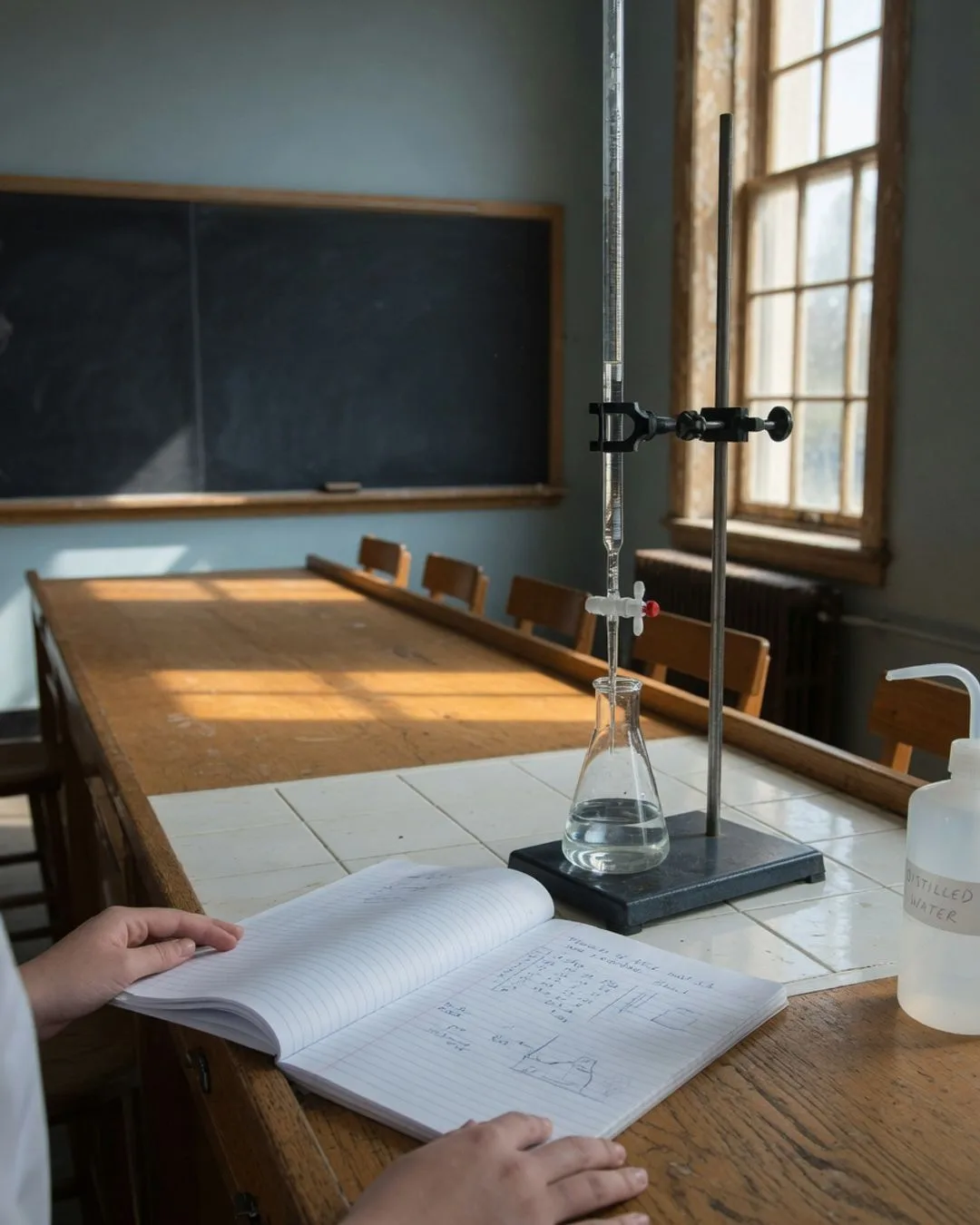
Why chemistry is taught at the bench.
Chemistry is invisible without the lab. What a balance, a burette, and a reaction that changes color teach that no textbook can, and why "lab-led, not textbook-led" is the whole game.
Cram, pass, forget in chemistry.
Why stoichiometry and equilibrium decay especially fast without mastery, and what "Learn → Master → Retain" replaces the test-and-move-on model with.
The demonstrations
The titration defense.
The single moment that captures the whole course: a student at the burette, an endpoint, and a guide asking "defend your technique, your indicator, and your math."
Measurement under uncertainty.
Significant figures, precision versus accuracy, reading a meniscus, error that propagates, and why a number without its uncertainty is meaningless.
Integration & AI
Integration: the Haber process.
How one reaction (nitrogen and hydrogen into ammonia) pulls in history, economics, ethics, and biology, from feeding billions to the chemistry of war.
AI-proof by design.
We teach students to use AI thoughtfully while assessing the skills they must demonstrate themselves. This essay explains how the two approaches support each other.