Why earth science is taught this way.
Six short essays for parents and guides. The first two explain the core of the method; the next three address common family questions; the sixth explains how a course like this approaches learning in the age of AI.
The method
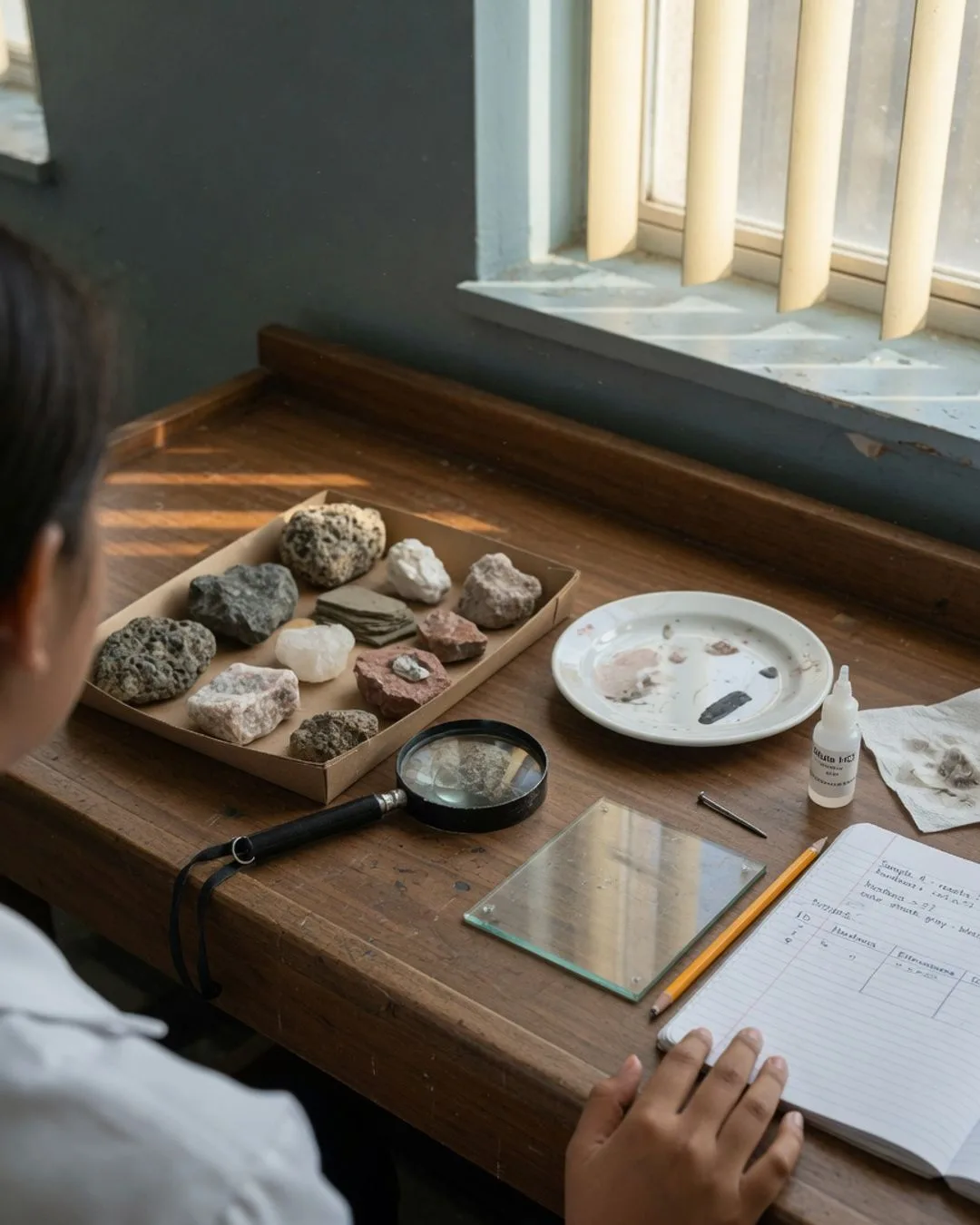
Why earth science is taught at the bench.
Earth Science is abstract on the page and concrete at the bench. What a hand lens, a streak plate, and a stream table teach that no textbook can, and why "lab-led, not textbook-led" is the whole game.
Cram, pass, forget in earth science.
Why memorized rock names and cloud types decay especially fast without mastery, and what "Learn → Master → Retain" replaces the test-and-move-on model with.
The demonstrations
The mineral-ID defense.
The single moment that captures the whole course: a student with an unknown specimen, a streak plate in hand, and a guide asking "defend your call — the streak, the hardness, the acid test."
Measurement under uncertainty.
Significant figures, precision versus accuracy, reading a topographic contour, error that propagates, and why a number without its uncertainty is meaningless.
Integration & AI
Integration: continental drift.
How one rejected idea (Wegener's drifting continents) pulls in history, geography, reading, and applied math, from matching coastlines and fossils to seafloor spreading fifty years later.
AI-proof by design.
We teach students to use AI thoughtfully while assessing the skills they must demonstrate themselves. This essay explains how the two approaches support each other.