Unit 08 · Sustainability & Environmental Policy
Use quantitative evidence, legal-source reading and explicit values to compare decisions. Calculate cost-effectiveness and sensitivity before defending a recommendation; no predetermined political or technological conclusion is required.
Student learning: Compare environmental decisions without preselecting a winner
Choose the level by readiness, not age alone, and record it before instruction. Foundation, core, and honors tasks are study pathways, not an AP course or a promise of college credit. The instructor retains practical assessment and the published science rubric; integration is reported separately.
Prerequisites: Units 4–7 impact, exposure and resource boundaries; subtraction, ratios, constraints and sensitivity analysis.
Suggested sequence: read and discuss the explanation; attempt the worked model; analyze the data at your selected level; check the answers; then complete the source-linked response and a fresh transfer question. These activities supplement, not replace, supervised practical work and the full-year schedule.
Assigned reading and focus
- EPA: Summary of the Clean Air Act. Read the opening summary and NAAQS and SIPs. Identify emissions and ambient-air standards as distinct tools; this is a source reading, not legal advice.
- EPA: Summary of the Clean Water Act. Read the opening summary and the discussion of pollutant discharges. Explain why surface-water regulation and drinking-water safety are not identical topics.
- EPA: Summary of the Endangered Species Act. Read the opening conservation purpose and named lead agencies. Identify why ESA implementation is not simply “the EPA controls all wildlife”.
- EPA: Summary of the National Environmental Policy Act. Read the opening purpose and discussion of environmental assessments/impact statements. Distinguish a decision process from a guarantee of one substantive outcome; check current requirements for any real proposal.
- EPA: International Treaties and Cooperation about Stratospheric Ozone. Read The Montreal Protocol on Substances that Deplete the Ozone Layer and the amendment history. Identify the regulated substances and a way progress is monitored, rather than asserting that every environmental treaty is the same.
- United Nations: The Paris Agreement. Read the opening goals and How does it work? Compare temperature goals and nationally determined contributions with the Montreal substance phaseout approach; avoid a predetermined success/failure judgment.
- OpenStax Biology 2e: 47.3 Threats to Biodiversity. [global-change-decision] Fresh assessment: connected habitat under warming and invasion: Connect habitat loss, climate shifts and introduced species; look for mechanisms that can make a connectivity intervention help one outcome and harm another.
- OpenStax Biology 2e: 47.2 The Importance of Biodiversity to Human Life. [global-change-decision] Fresh assessment: connected habitat under warming and invasion: Use the service discussion to identify unpriced benefits and affected people before choosing a habitat strategy.
Learn the science
Sustainability asks whether a system can maintain valued functions under stated time, resource and distributional conditions. A common-pool resource can be depleted when individual incentives ignore shared costs. Shared does not mean unowned or inevitably doomed: access rules, monitoring and collective governance can change outcomes.
An externality is a cost or benefit not fully reflected in the decision maker’s transaction. Cost-effectiveness compares costs per physical outcome. Cost-benefit analysis compares monetized benefits and costs on the same time/currency basis. Neither a low cost/kg nor positive net monetary benefit automatically resolves rights, legal duties, unpriced harm or who receives the benefit.
The policy table uses already annualized costs and avoided-damage benefits relative to no additional control. It is not a present-value calculation and needs no extra discounting in this exercise. Monetized benefits are invented scenario inputs, not measured health values or agency estimates. Low/high scenarios are sensitivity bounds, not a confidence interval.
A physical prediction, a causal claim, a legal requirement and a preferred policy are separate claims. A measured load reduction does not by itself establish an illness reduction or attribute all observed change to the intervention. Monitoring needs a baseline, timing, comparable conditions and a plan for confounders.
The Clean Air Act addresses air emissions and ambient standards; the Clean Water Act addresses surface-water quality and discharges. The Endangered Species Act protects listed species and habitat, with USFWS and NOAA Fisheries as lead federal agencies. NEPA concerns environmental review of covered federal actions. Use dated official sources because statutes, implementation rules and jurisdiction can change.
The Montreal Protocol addresses ozone-depleting substances through controls and amendments. The Paris Agreement addresses climate goals and countries’ successive nationally determined contributions. EPA is a domestic agency, not an international treaty; implementation and enforcement involve other agencies and jurisdictions. Compare stated mechanisms and evidence of outcomes, not a required political position.
A budget or land constraint can remove an otherwise attractive option. Sensitivity analysis asks which changed assumptions would change the ranking. More than one defensible recommendation can earn mastery if calculations, constraints, uncertainty, affected groups and a counterargument are explicit.
[global-change-decision] Fresh assessment: connected habitat under warming and invasion: This assessment combines two stressors rather than repeating the climate trend exercise. Warming determines modeled suitable habitat; invasive occupancy then excludes a fraction of that suitable area. Multiply conditional fractions, do not subtract the invader fraction from the original reserve unless that is its stated denominator. A corridor may support movement as climate shifts but may also assist invasion. Biological predictions, budget feasibility, legal process and values remain separate claims.
[global-change-decision] Fresh assessment: connected habitat under warming and invasion: Model and provenance assumptions: The reserve is 100 ha. Suitable habitat is a synthetic 2035 dry-season scenario, not a forecast validated against observations. Invaded fraction refers only to suitable area. Costs are annualized thousands of fixed model dollars/year, and options are mutually exclusive.
[global-change-decision] Fresh assessment: connected habitat under warming and invasion: Uncertainty and inference limits: The corridor’s invaded fraction could be 0.3–0.6; no probabilities are supplied. The lower viable-area result can fall below baseline, reversing a central ranking. Viable hectares omit species-specific habitat quality, connectivity effectiveness and distributional concerns.

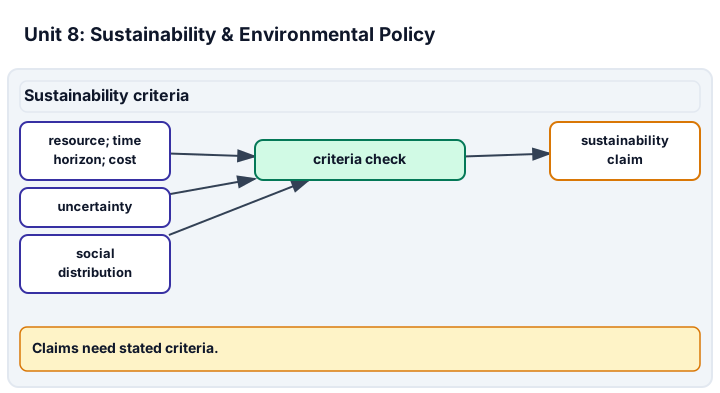
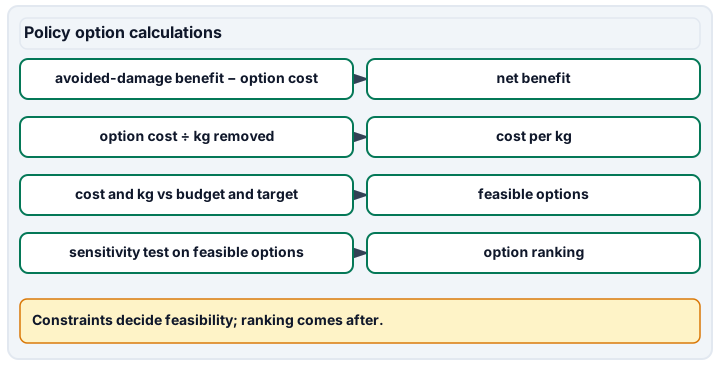
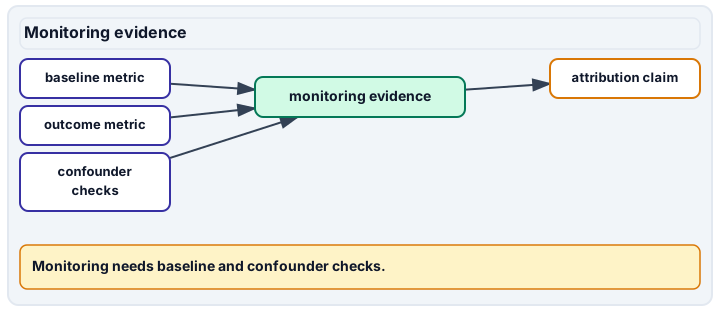
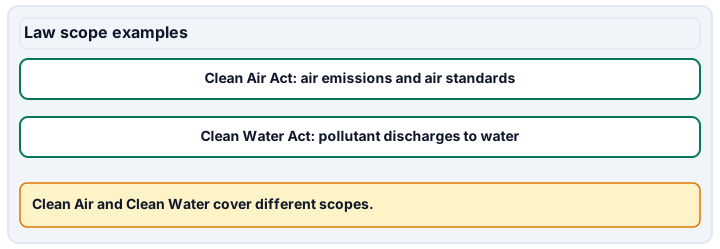
Diagram description
Sustainability claims depend on resource function, time horizon, environmental cost, social distribution and uncertainty. Policy options compute net benefit and cost per kg, then apply cost and kg against budget and target to identify feasible options before sensitivity tests rank the feasible options. Monitoring compares outcome with baseline, and confounder checks limit the attribution claim. The Clean Air Act covers air emissions and air standards, and the Clean Water Act covers pollutant discharges to water.
Data, provenance, and assumptions
| Option | Annual cost ($) | Load reduction (kg N/year) | Central benefit ($/year) | Low benefit ($/year) | High benefit ($/year) |
|---|---|---|---|---|---|
| No added control | 0 | 0 | 0 | 0 | 0 |
| Option A | 120000 | 3000 | 90000 | 60000 | 120000 |
| Option B | 160000 | 5000 | 170000 | 120000 | 220000 |
| Annual cost ($) | Load reduction (kg N/year) | Annual benefit ($) |
|---|---|---|
| 90000 | 2500 | 100000 |
| Option | Annual cost (thousand $/year) | Suitable habitat (ha) | Invaded fraction of suitable habitat |
|---|---|---|---|
| Baseline | 0 | 50 | 0.4 |
| Corridor | 60 | 70 | 0.3 |
| Combined refuge/biosecurity | 110 | 80 | 0.1 |
Worked model
A has net benefit 90000 − 120000 = −$30000/year and costs $40 per kg N removed. B has net benefit $10000/year and costs $32/kg N removed. B’s net range is −$40000 to +$60000. Under a $130000 annual budget and a required reduction of at least 2500 kg N/year, only A among the original options is feasible. [global-change-decision] Fresh assessment: connected habitat under warming and invasion: Viable area = suitable area × (1 − invaded fraction): baseline 30 ha, corridor 49 ha, combined 72 ha. Under the $100000/year budget and 40-ha target, only the corridor is centrally feasible. At corridor invasion 0.6, viable area becomes 28 ha, below baseline; uncertainty can overturn the recommendation.
Numerical calibration
- -30000 $/year
- 10000 $/year
- 40 $/kg N removed
- 32 $/kg N removed
- -60000 $/year
- 0 $/year
- -40000 $/year
- 60000 $/year
- 10000 $/year
- 36 $/kg N removed
- 30 ha viable under scenario
- 49 ha viable under scenario
- 72 ha viable under scenario
- 28 ha viable under high-spread scenario
- 72 ha centrally feasible with revised budget
Attempt the assigned level
Try the tasks before reading the calibration. These are practice answers, not a secure examination; use a new dataset or changed assumption for the assessed transfer.
Foundation
- Calculate central net benefit and cost per kg removed for A and B. Explain why no added control has no meaningful cost/kg reduction ratio.
- Match the four U.S. laws to air emissions, surface-water discharges, species/habitat conservation and federal environmental review.
- [global-change-decision] Fresh assessment: connected habitat under warming and invasion: Independently compute all three viable areas and filter options by both the annual budget and the 40-ha target. Do not read the model answer until your calculation is recorded.
Check after your attempt
- A: −$30000/year and $40/kg; B: +$10000/year and $32/kg. The no-control ratio is 0/0, undefined, not a zero-cost removal technology.
- CAA: air; CWA: surface-water discharges/quality; ESA: species/habitat; NEPA: covered federal environmental review. These are teaching summaries, not legal applicability determinations.
- [global-change-decision] Fresh assessment: connected habitat under warming and invasion: Areas are 30, 49 and 72 ha. Baseline misses the target, corridor fits both constraints centrally, and combined exceeds the budget. A highest-area ranking alone ignores the stated constraint.
High-school core: typically grades 9-10
- Calculate each benefit-sensitivity range. Apply the $130000 budget and 2500-kg minimum-reduction constraint.
- State a recommendation under those constraints and one under no budget limit, identifying an unpriced effect and a group that might bear costs.
- [global-change-decision] Fresh assessment: connected habitat under warming and invasion: Write a science decision memo using the table and two source-linked mechanisms from different units. Using this unit’s assigned ESA/NEPA and Montreal/Paris readings, distinguish domestic review/species protection from international climate/ozone coordination. Include a source-based counterargument and a record that would change your decision.
Check after your attempt
- A ranges from −$60000 to $0/year; B from −$40000 to +$60000/year. Only A meets both constraints in the original table.
- A is feasible under the stated budget; B has higher central net benefit if the budget is removed. Neither conclusion accounts for all distributional or unpriced effects; different recommendations with explicit changed assumptions are acceptable.
- [global-change-decision] Fresh assessment: connected habitat under warming and invasion: A defensible memo can provisionally choose or question the corridor using warming suitability, invasion spread, budget and monitoring triggers. ESA concerns listed species/habitat; NEPA concerns review of covered federal actions, not automatic approval. Paris addresses climate commitments, while Montreal addresses ozone-depleting substances; neither directly approves this reserve proposal. Cite the assigned official summaries and do not claim a legal determination or observed benefits.
Honors extension: typically grades 11-12
- If B’s benefit is revised to $120000 while A’s central estimate stays unchanged, compare net benefits. Find B’s break-even benefit.
- Propose a monitoring design and compare Montreal and Paris implementation mechanisms using the assigned sources. Distinguish a treaty target from achieved environmental change.
- [global-change-decision] Fresh assessment: connected habitat under warming and invasion: Test corridor invasion at 0.6 and specify a two-season comparative monitoring plan with independent sites, stable recognition rules and an agreed decision trigger. Identify the responsible domestic decision process and why a treaty goal is not local implementation evidence.
Check after your attempt
- B becomes −$40000/year versus A’s −$30000. B needs $160000/year benefit to break even; the ranking is assumption-sensitive.
- Retain baseline and comparison records, flow/weather covariates, uncertainty and a predeclared outcome. Substance controls and nationally determined climate contributions differ; evidence of implementation and environmental trends is needed before claiming success.
- [global-change-decision] Fresh assessment: connected habitat under warming and invasion: Viable corridor area falls to 28 ha. Seek independent comparable sites with repeated habitat/occupancy measures, predeclared target and cost criteria, and documented confounders. Check applicable species/review responsibilities with the relevant authorities; a Paris goal or Montreal control is not evidence that a local habitat project was implemented or succeeded. More visits to one site do not substitute for site replication.
History, reading, and writing connection
Use one domestic-law summary and one treaty source to write a brief decision memo. Give the historical purpose, scientific mechanism, physical outcome, a monetary result, an unpriced concern and a counterargument. Separate evidence from your values; no party, ideology or fixed policy recommendation is required.
Write in your own words or use an approved accessible equivalent. Cite a specific assigned section or figure, identify its evidence, and state one limitation or counterargument. Use the AI practice contract only for permitted coaching, never to invent observations or write the assessed response.
Transfer to a new case
Evaluate fresh option C with a $100000 annual budget and a minimum 2500-kg-N/year reduction. What are its net benefit and cost-effectiveness, and does feasibility establish legal compliance? [global-change-decision] Fresh assessment: connected habitat under warming and invasion: For a new review, the annual budget rises to $120000 while the original central biological assumptions and 40-ha target stay fixed. What is the largest feasible viable area, and which uncertainty must still be investigated?
Calibration: C is feasible under these numerical constraints, with +$10000/year net benefit and $36/kg N removed. Numerical feasibility does not establish a real permit, legal compliance or health benefit. [global-change-decision] Fresh assessment: connected habitat under warming and invasion: The combined option is now financially feasible with 72 viable ha. That does not validate its ecological forecast or make it obligatory; invasion response, habitat quality and affected groups still need review.
Evidence to retain
Retain original calculation sheets, source dates, explicit objective and constraints, sensitivity bounds, affected groups and monitoring proposal. A policy memo is not advocacy participation, agency advice or proof that an intervention was implemented. [global-change-decision] Fresh assessment: connected habitat under warming and invasion: Retain an independent first attempt, conditional-area calculations, two-source mechanism memo, counterargument, sensitivity and monitoring trigger. Assess all five Unit 8 science criteria; integration remains separate and public calibration remains nonsecure.
Record units, calculations, source/date, uncertainty, and what is measured versus inferred. A simulation or supplied dataset must stay labeled as such. Use supplied data or an instructor-approved supervised observation. No electrical work, combustion, radioactive materials, pesticide application, wildlife capture, microbial culture, hazardous sampling or sample ingestion is authorized.
Return to all eight learning pathways. Print this unit page for the student lessons; the linked five-page packet remains the separate assessment companion.
Unit mastery rubric
| Criterion | Developing | Proficient | Mastery |
|---|---|---|---|
| Sustainability and shared resources | Assumes shared resources must fail. | Names a shared-resource problem. | Explains incentives, limits and possible governance responses without treating shared ownership as inevitable depletion. |
| Cost, benefit and uncertainty | Mixes costs and physical outcomes. | Calculates one central ratio. | Computes net benefit and cost-effectiveness on a common basis; tests uncertainty, constraints and unpriced/distributional effects. |
| Domestic environmental law | Confuses agency and statute. | Names laws without their scope. | Matches CAA, CWA, ESA and NEPA to their purposes and lead roles; cites official sources without claiming legal advice. |
| Treaties and implementation | Treats all agreements as identical. | Names Montreal or Paris. | Compares Montreal and Paris mechanisms, domestic roles and evidence of implementation without assuming success or failure. |
| Data-grounded policy defense | Argues from preference alone. | Cites data without limits. | Defends a feasible recommendation, a counterargument, a sensitivity test and a monitoring plan while separating evidence and values. |
| Integration (cross-domain) | Makes no supported connection between the source and the science. | Uses the source but needs help connecting evidence, writing, or limitations to the science. | Independently connects History, Reading, and Writing using a cited source, appropriate evidence, a limitation, and a scientific explanation. |
Integration is reported separately and cannot lower the science grade or block a science demonstration pass. Science and practical criteria determine that pass. Use the integration guide's evidence checklist for the separately reported criterion.
B has the larger central net benefit but exceeds the $130000 budget. A meets that budget and reduction target. If constraints or benefit estimates change, I will recompute rather than protect my preferred answer.
B is automatically right because its name sounds greener; the budget and uncertainty do not matter.
Assess arithmetic, source accuracy, uncertainty and oral defense, not agreement with the instructor’s preferred policy. Integration remains a separate reported strand.
A 5-page clipboard packet — unit overview, key terms, the mastery rubric, anchor examples, and a score sheet you can print and grade against.