Unit 01 · Crime Scene & Evidence Basics
Audit a fictional paper scene through a systematic search, timed observations, a scaled sketch and image, and coded packaging. Independently check the supplied custody record, quantify its unsigned interval, and preserve any unresolved gap rather than inventing a repair. Documentation supports a bounded account of handling; it does not prove a note is true, exclude earlier contamination, or decide admissibility or guilt.
Student learning: Audit a fictional scene before making an inference
Choose the level by readiness, not age alone, and record it before instruction. Foundation, core, and honors tasks are study pathways, not an AP course or a promise of college credit. The instructor retains practical assessment and the published science rubric; integration is reported separately.
Prerequisites: Metric lengths, scale drawings, elapsed time, and observations distinguished from explanations.
Suggested sequence: read and discuss the explanation; attempt the worked model; analyze the data at your selected level; check the answers; then complete the source-linked response and a fresh transfer question. These activities supplement, not replace, supervised practical work and the full-year schedule.
Assigned reading and focus
- NIST: Evidence Management. Read the opening quotation and the two introductory paragraphs before Projects / Activities. Identify the separate requirements to preserve usable evidence and track its custody; list what a custody log alone cannot establish.
Learn the science
A systematic search makes the sampling boundary visible. Record the searched area, the order, the lighting and resolution of a supplied image, and observations before discussing a possible story. “No visible fiber in the photographed square” is narrower than “no contact occurred.” Absence can reflect detection limits or an unsearched area.
Use a unique item code to connect a note, scaled image, sketch, and package. A sketch scale of 1:20 means 1 cm on paper represents 20 cm in the scene. A north arrow, origin, units, and two coordinates locate each item without relying on memory. A ruler in the same plane helps with scale; perspective can still distort a photograph.
Keep original dated and timed notes, then append a dated correction rather than overwriting them. “Blue paper card at (180, 60) cm” is an observation. “The person who left it committed an offense” is an inference the observation cannot establish.
Separate paper items into labeled envelopes and document simulated handoffs. A signed chain records responsibility; it is not proof that an item was uncontaminated before collection, that a statement on it is true, or that anyone is guilty. A missing signature is a reportable gap, not a reason to invent a handoff or silently discard the whole record.
Here the clock intervals are supplied, not measurements by students. Independent auditors must record discrepancies before comparing notes. Two people copying one custody log do not supply two independent histories. The analyst describes the gap and its possible consequences; the court determines admissibility under the applicable rules.

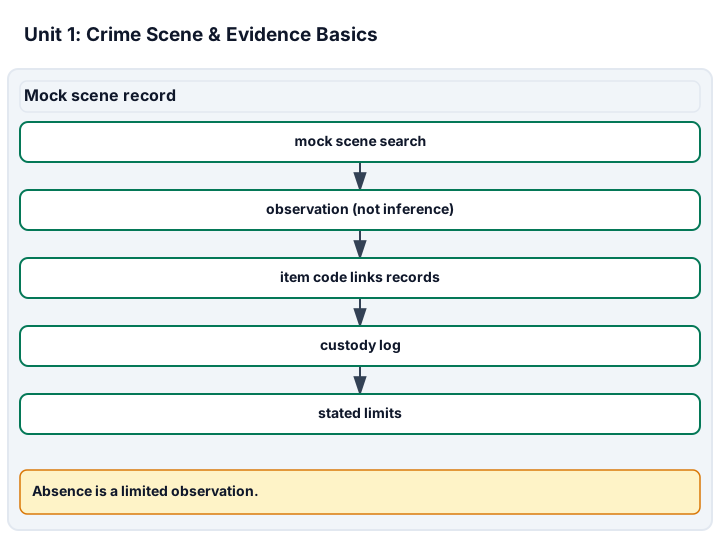
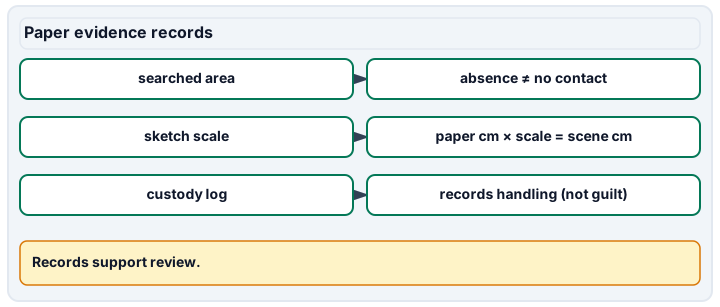
Diagram description
Mock scene record moves from a mock search to observation rather than inference, item codes, a custody log and stated limits. Paper evidence records explains absence in a searched area, scale sketches and custody logs.
Data, provenance, and assumptions
| Item | x (cm) | y (cm) | Observation |
|---|---|---|---|
| E-01 | 120 | 60 | white envelope |
| E-02 | 180 | 60 | blue card |
| E-03 | 120 | 140 | round sticker |
| Item | Start (min) | End (min) | Receiving signature | Seal observation |
|---|---|---|---|---|
| E-01 | 0 | 5 | signed | intact |
| E-01 | 5 | 15 | signed | intact |
| E-02 | 0 | 12 | signed | intact |
| E-02 | 12 | 32 | unsigned | intact |
| E-02 | 32 | 40 | signed | intact |
Independent paper-scene and custody audit
Scope and safety: Use only envelopes, paper cards, and supplied drawings; never stage a scene with weapons, personal belongings, or biological material.
Materials and preparation
- Grid paper, ruler, pencil, three coded paper items, and clean envelopes.
- Two copies of the supplied record; cover the worked answers until both auditors finish.
Procedure and schedule
- Before work, agree on the scale, search boundary, item codes, and which fields count as a complete handoff.
- Reader A makes a measured sketch and factual log. Reader B separately draws and audits a second copy without seeing A’s conclusions.
- Simulate one paper-envelope handoff with time, sender, receiver, item code, and seal observation. Keep this actual classroom record separate from the supplied synthetic history.
- Compare both audits only after recording their original conclusions. Recheck any coordinate or missing-signature disagreement against the original record, not the preferred story.
- Retain a dated correction and an unresolved-gap statement; do not backfill the supplied unsigned interval.
Record: Keep both initial audits, the scale drawing, item/package cross-reference, classroom handoff, 20-minute gap calculation, and an analyst-only limitation statement.
Worked model
E-01 and E-02 are 60 cm apart horizontally, so their separation on a 1:20 sketch is 3 cm. Four of five responsibility intervals have a receiving signature: 4 / 5 × 100 = 80%. E-02 has an unverified 32 − 12 = 20 minutes. That percentage describes record completeness, not an 80% probability of valid evidence.
Numerical calibration
- 60 cm between E-01 and E-02
- 3 cm on the 1:20 sketch
- 20 minutes with an unverified receiving signature
- 80 % of five intervals signed; not an evidence-validity probability
Attempt the assigned level
Try the tasks before reading the calibration. These are practice answers, not a secure examination; use a new dataset or changed assumption for the assessed transfer.
Foundation
- Draw the three items at 1:20 with axes, north arrow, and item codes. Convert E-01’s coordinates.
- Sort the observation “blue card” and the inference “left during the incident”; identify the unsigned row.
Check after your attempt
- E-01 is at (6, 3) cm, E-02 at (9, 3), and E-03 at (6, 7). The E-01/E-02 sketch separation is 3 cm.
- The color is a recorded observation; time of deposition is not given. The E-02 interval from minute 12 to 32 lacks a receiving signature despite a visually intact seal.
High-school core: typically grades 9-10
- Calculate signed-record coverage and the duration of the unverified interval. State both denominators and units.
- Write a correction that preserves the original record and a report distinguishing record quality from proof of a claim.
Check after your attempt
- Coverage is 4 of 5 intervals, or 80%; the unverified E-02 interval is 20 minutes. It is not a probability that the item is genuine or uncontaminated.
- Keep the original unsigned record, add the audit date and discrepancy, and seek independent documentation. Report the uncertainty without inventing a receiver, a transfer event, or a legal conclusion.
Honors extension: typically grades 11-12
- Bound the horizontal separation if each x reading can vary by ±1 cm. Compare the two independent auditors’ original records.
- Explain why a missing signature, an intact seal, and agreement between two copied logs each have different evidentiary limits.
Check after your attempt
- The separation ranges from 179 − 121 = 58 cm to 181 − 119 = 62 cm, or 2.9–3.1 cm on the sketch. These are worst-case reading bounds, not a statistical confidence interval.
- A signature gap does not prove tampering; an intact seal does not rule out earlier contamination. Agreement after copying the same source is not independent corroboration. The court, not the analyst, rules on admissibility.
History, reading, and writing connection
Use the opening NIST quotation attributed to the 2009 National Academy of Sciences report. In a short source-cited memo, explain why preservation and accountability became reform priorities. Connect the historical recommendation to this unsigned interval, then state why the memo cannot settle admissibility or guilt.
Write in your own words or use an approved accessible equivalent. Cite a specific assigned section or figure, identify its evidence, and state one limitation or counterargument. Use the AI practice contract only for permitted coaching, never to invent observations or write the assessed response.
Transfer to a new case
A later copy of the log contains a receiving name, but the original does not. Has the 20-minute gap necessarily been resolved?
Calibration: No. Preserve both versions, identify who added the name and when, and seek independent contemporaneous support. A retrospective annotation alone does not establish the missing transfer.
Evidence to retain
Retain the two initial audits, measured sketch, scale calculation, mock packaging label, signature coverage, and unresolved-gap report. Record the supplied dataset’s source/date separately from the date of your paper exercise.
Record units, calculations, source/date, uncertainty, and what is measured versus inferred. A simulation or supplied dataset must stay labeled as such. Fictional cases only. No real bodily samples, personal fingerprints, suspect profiles, personal-device searches, chemicals, cultivation, firearms, ammunition, or projectiles. Use paper, printed diagrams, and supplied mock data. Synthetic arithmetic checks are not empirical forensic-method validation or classroom pilot evidence.
Return to all eight learning pathways. Print this unit page for the student lessons; the linked five-page packet remains the separate assessment companion.
Unit mastery rubric
| Criterion | Developing | Proficient | Mastery |
|---|---|---|---|
| Systematic scene observation & search | Grabs what stands out without a record. | Searches but omits boundaries or absent items. | Records a defined paper-scene search, present and absent items, and detection limits without inferring an event from absence alone. |
| Contemporaneous notes & documentation | Reconstructs notes from memory. | Records facts but omits times or overwrites corrections. | Keeps dated, timed observations separate from inference; retains original notes, independent audits, and dated corrections. |
| Sketch & scale photography | Omits measurements or scale. | Records scale but miscalculates positions or uncertainty. | Draws a scaled sketch with north arrow and coordinates, checks paper-item scale images, and reports distances with reading bounds. |
| Evidence recognition, collection & packaging | Mixes items or loses their labels. | Labels items but omits package cross-references. | Isolates harmless paper items in coded envelopes, linking notes, images, sketch, and mock handoffs while explaining contamination controls. |
| Chain of custody | Invents or ignores missing handoffs. | Finds a gap but treats it as proof of tampering. | Audits signatures and interval coverage, retains unresolved gaps, and distinguishes custody integrity from truth, guilt, and the court’s admissibility decision. |
| Integration (cross-domain) | Makes no supported connection between the source and the science. | Uses the source but needs help connecting evidence, writing, or limitations to the science. | Independently connects History, Reading, and Writing using a cited source, appropriate evidence, a limitation, and a scientific explanation. |
Integration is reported separately and cannot lower the science grade or block a science demonstration pass. Science and practical criteria determine that pass. Use the integration guide's evidence checklist for the separately reported criterion.
“The paper items are 60 cm apart, or 3 cm at 1:20. Four of five intervals are signed; E-02 has a 20-minute gap. I kept the original record. An intact seal does not resolve that gap or prove the note is true.”
“The seal looks fine, so I filled in the missing signature and called the evidence certain.” This invents a record and confuses custody with truth.
You demonstrate this unit by documenting a mock scene — a measured sketch, scale photographs, and a sealed evidence log — plus short oral checks where you explain aloud what your notes let you claim and what they do not. A criterion counts as mastered only when you can both do the work at the scene and defend the honest limits of your conclusions. Mastery is demonstrated, not awarded.
A 5-page clipboard packet — unit overview, key terms, the mastery rubric, anchor examples, and a score sheet you can print and grade against.