Unit 02 · Fingerprints & Impression Evidence
Use fictional paper ridge cards to classify patterns, preserve scaled impressions, and practice an ACE-V teaching sequence with blind initial decisions. Study professional development and casting conceptually only. Report consistency, exclusions, and inconclusives; calculate trial error rates with explicit denominators. Neither corresponding minutiae nor independent readers establish an identification probability or a validated forensic method.
Student learning: Compare blind, report inconclusive results, and count errors honestly
Choose the level by readiness, not age alone, and record it before instruction. Foundation, core, and honors tasks are study pathways, not an AP course or a promise of college credit. The instructor retains practical assessment and the published science rubric; integration is reported separately.
Prerequisites: Unit 1 documentation; ratios, percentages, and the difference between a feature and a conclusion.
Suggested sequence: read and discuss the explanation; attempt the worked model; analyze the data at your selected level; check the answers; then complete the source-linked response and a fresh transfer question. These activities supplement, not replace, supervised practical work and the full-year schedule.
Assigned reading and focus
- NIST: Human Factors in Latent Print Analysis. Read the first four paragraphs, ending with recommendations on human-factors issues. Explain why comparison, record keeping, and communication all need safeguards.
- NIJ: The History and Legacy of the Latent Fingerprint Black Box Study. Read the opening three paragraphs and the first three paragraphs under Black Box Testing, through the input/output description. Define a known-condition test. Our exercise counts below are invented, not the study’s published error estimates.
Learn the science
Loops, whorls, and arches describe broad ridge flow. Minutiae describe features such as ridge endings and bifurcations. Many impressions share broad patterns; partial areas, pressure, smearing, and image quality can obscure details. Correspondence is not a population frequency, and minutiae counts cannot be converted into identification probabilities.
Latent means not readily visible, patent means visible, and plastic means a three-dimensional impression. Professional development methods depend on the surface and residue. Learn their purpose from supplied illustrations only: this course does not authorize powders, chemical development, fuming, or collection of personal fingerprints.
ACE-V names analysis, comparison, evaluation, and verification. Record the questioned image’s usable features before viewing a reference or a narrative; then record similarities, differences, and the allowed conclusion. A blind second reader does not see the first reader’s result or a fictional accusation before making an independent record.
For our simplified paper rule, clear pattern or feature-order disagreement excludes a card pair from that toy source. Clear agreement means only consistent; missing detail means inconclusive. Draw A as a ridge ending, B as a bifurcation, and C as a short isolated ridge, in the stated order. These tokens are not numerical minutia scores, real fingerprints, or an empirical identification method.
An error-rate study needs ground truth, representative difficulty, predefined decisions, all outcomes, and uncertainty estimates. False-positive rate divides false same-source decisions by known different-source trials; false-negative rate divides false different-source decisions by known same-source trials. State whether inconclusives are in the denominator and report their count separately.
The 100 synthetic trial decisions are arithmetic practice only. Repeated decisions on the same print, a shared examiner, or shared training can be correlated. Blind review reduces contextual influence but cannot guarantee statistical independence, eliminate error, or validate a method without appropriate known-condition research.

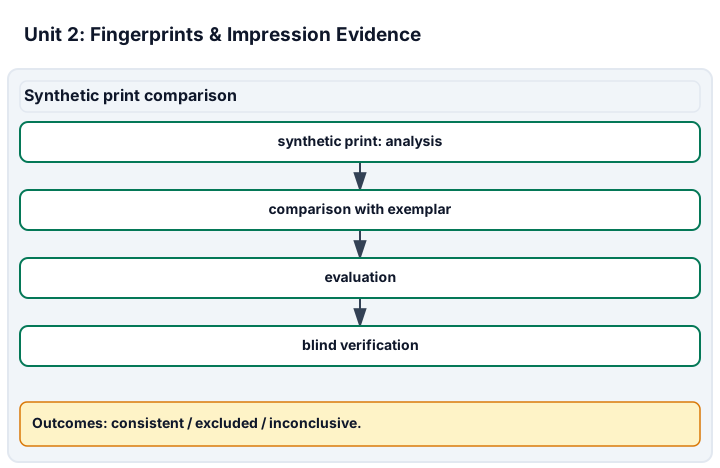
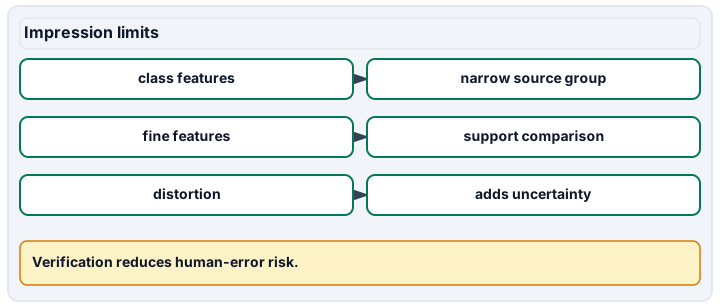
Diagram description
Synthetic print comparison follows ACE-V style analysis, comparison, evaluation and blind verification, with false-positive rate computed from denominators. Impression limits states class features, fine features and distortion effects.
Data, provenance, and assumptions
| Pair | Questioned pattern | Reference pattern | Questioned order | Reference order | Quality |
|---|---|---|---|---|---|
| P1 | loop | loop | A-B-C | A-B-C | clear |
| P2 | loop | whorl | A-B-C | A-B-C | clear |
| P3 | loop | loop | A-?-C | A-B-C | obscured |
| P4 | arch | arch | A-C-B | A-B-C | clear |
| P5 | whorl | whorl | C-A-B | C-A-B | clear |
| P6 | arch | arch | ?-B-? | A-B-C | obscured |
| Known truth | Same-source decision | Different-source decision | Inconclusive |
|---|---|---|---|
| same-source | 34 | 4 | 2 |
| different-source | 2 | 55 | 3 |
Two-reader blind card comparison
Scope and safety: Use only invented paper ridge maps and provided shoe/tire impression drawings; no fingerprints from students or anyone else.
Materials and preparation
- Six pairs of paper feature cards made from the table, ruler, and two independent decision sheets.
- Instructor-held code key and clear/obscured quality labels; cover the answer sections.
Procedure and schedule
- Define the toy decision rule first. An instructor relabels and reorders the six pairs; changing labels must not change their features.
- Each reader first describes the questioned card, then sees its reference. Record quality, correspondence, differences, and consistent/excluded/inconclusive without discussion.
- For one supplied impression drawing, preserve the original outline and scale in a tracing; explain how a distorted cast or lift could change a comparison, without performing chemical development.
- Both readers sign their first records before seeing the key or each other’s conclusions. Resolve disagreement by a new source check, keeping both original answers.
- Analyze the separate 100-trial table with explicit denominators. Do not replace its counts with the six-card practice results or call either exercise validation of fingerprint identification.
Record: Keep initial feature maps, scaled tracing, two decision sheets, blind code key, disagreement log, all trial denominators, and an honest comparison statement without identification percentages.
Worked model
Among 60 known different-source trials, 2 false same-source calls give 2 / 60 = 3.3333%. Among 40 known same-source trials, 4 false different-source calls give 10%. Five of 100 trials are inconclusive. If reporting decisive trials only, the denominators become 57 and 38: 3.5088% and 10.5263%. Neither convention means the probability that a particular positive decision is false.
Numerical calibration
- 3.333333 % of all 60 different-source trials
- 10 % of all 40 same-source trials
- 3.508772 % of 57 decisive different-source trials
- 10.526316 % of 38 decisive same-source trials
- 5 inconclusive trials out of 100
Attempt the assigned level
Try the tasks before reading the calibration. These are practice answers, not a secure examination; use a new dataset or changed assumption for the assessed transfer.
Foundation
- Name the three pattern families and distinguish latent, patent, and plastic impressions using an illustration.
- Apply the toy rule to the six cards and explain why an obscured feature is not a disagreeing feature.
Check after your attempt
- A loop turns back, a whorl circles, and an arch rises across the print. Latent concerns visibility, patent visible residue, and plastic a three-dimensional impression; none supplies an identification probability.
- P1 and P5 are consistent in the toy rule, P2 and P4 excluded, and P3 and P6 inconclusive. A question mark means not readable, not that the feature is absent.
High-school core: typically grades 9-10
- Compare independently before reading the key; retain the reason and quality call for every card.
- Build the two-by-three decision table and calculate false-positive, false-negative, and inconclusive rates using all trials.
Check after your attempt
- P1 and P5 are consistent, not identified; P2 and P4 are excluded on clear disagreement; P3 and P6 are inconclusive. Equal feature counts in P4 do not repair the differing order.
- False-positive rate = 2/60 = 3.3333%; false-negative rate = 4/40 = 10%; inconclusive = 5/100 = 5%. These are invented known-truth trial frequencies, not empirical forensic rates.
Honors extension: typically grades 11-12
- Recompute error rates after excluding inconclusives, showing the denominator change. Distinguish the FPR from false calls among all positive decisions.
- Design a stronger known-condition study covering difficult images, different readers, repeated trials, and correlation. Explain what blinding does and does not accomplish.
Check after your attempt
- Decisive-only FPR = 2/57 = 3.5088%; FNR = 4/38 = 10.5263%. False calls among the 36 same-source decisions are 2/36 = 5.5556%, a different question that depends on the supplied truth mix.
- Report inconclusives and clusters, hold out fresh cases, and use independently recorded decisions with a concealed key. These toy rates are not a case-specific identification probability; blinding cannot remove common ambiguous features or shared training.
History, reading, and writing connection
Cite NIST’s human-factors account and NIJ’s description of black-box testing. Explain how the historical move from expert assurance toward tested outcomes changes the language of a report. Use the two denominators above as evidence, and distinguish the published research from this fictional exercise.
Write in your own words or use an approved accessible equivalent. Cite a specific assigned section or figure, identify its evidence, and state one limitation or counterargument. Use the AI practice contract only for permitted coaching, never to invent observations or write the assessed response.
Transfer to a new case
A new set has zero false positives in only 20 different-source trials. May a report call the technique error-free?
Calibration: No. Zero observed errors in a small selected set is not zero underlying risk. Describe the sample size, difficulty, uncertainty, inconclusives, and possible clustering; require further representative blinded testing.
Evidence to retain
Submit the six-card decision/reason table, pre-comparison notes, blind-review records, scaled impression copy, complete confusion table, alternative denominators, and a report retaining both exclusions and inconclusives.
Record units, calculations, source/date, uncertainty, and what is measured versus inferred. A simulation or supplied dataset must stay labeled as such. Fictional cases only. No real bodily samples, personal fingerprints, suspect profiles, personal-device searches, chemicals, cultivation, firearms, ammunition, or projectiles. Use paper, printed diagrams, and supplied mock data. Synthetic arithmetic checks are not empirical forensic-method validation or classroom pilot evidence.
Return to all eight learning pathways. Print this unit page for the student lessons; the linked five-page packet remains the separate assessment companion.
Unit mastery rubric
| Criterion | Developing | Proficient | Mastery |
|---|---|---|---|
| Fingerprint patterns & classification | Confuses loop, whorl, and arch. | Names patterns but guesses on obscured detail. | Classifies drawn ridge flow, distinguishes class patterns from minutiae, and records unreadable features without inventing them. |
| Latent, patent & plastic prints & development | Confuses visibility, residue, and relief. | Names types but ignores surface and preservation limits. | Explains print types and surface-dependent professional development from illustrations only; uses no powders, reagents, fuming, or personal fingerprints. |
| Lifting, preserving & casting impressions | Changes scale or loses the original drawing. | Preserves an outline without scale or distortion notes. | Preserves scaled paper impressions and explains how lifting or casting distortion can affect comparison; retains the original image and record. |
| Minutiae & comparison (ACE-V) | Jumps to a conclusion before analysis. | Records similarities but skips blind verification or differences. | Documents analysis, comparison, evaluation, and blind verification of coded cards; retains initial decisions, disagreements, exclusions, and inconclusives. |
| Reporting a comparison honestly | Converts feature counts into identification certainty. | Reports a trial error rate without its denominator. | Computes false-positive/negative rates with stated inconclusive handling; distinguishes trial errors from case probability and never derives identity odds from minutiae counts. |
| Integration (cross-domain) | Makes no supported connection between the source and the science. | Uses the source but needs help connecting evidence, writing, or limitations to the science. | Independently connects History, Reading, and Writing using a cited source, appropriate evidence, a limitation, and a scientific explanation. |
Integration is reported separately and cannot lower the science grade or block a science demonstration pass. Science and practical criteria determine that pass. Use the integration guide's evidence checklist for the separately reported criterion.
“P1/P5 are consistent, P2/P4 excluded, and P3/P6 inconclusive under our paper rule. The separate invented table has 2 false positives among 60 different-source trials, not a 3.3333% probability that any particular comparison is wrong.”
“Both cards have three features, so that gives a 100% identification.” Equal feature counts do not establish corresponding order, population frequency, or identity.
Use coded drawings for pattern recognition, scaled preservation, and an ACE-V teaching sequence; retain blind independent decisions before discussion. Explain professional lifting/development/casting conceptually only. Defend the trial denominators and comparison limits. This is not professional fingerprint-method validation or authorization for chemical development.
A 5-page clipboard packet — unit overview, key terms, the mastery rubric, anchor examples, and a score sheet you can print and grade against.