Unit 08 · The Case & the Courtroom
Close the year with an anonymous fictional source report, independent review, and a digital custody audit. Retain contrary, negative, inconclusive, and invalid findings. Use joint or conditional likelihoods rather than multiplying dependent evidence, and distinguish byte integrity from authorship or truth. The analyst explains evidence and its limitations; the court determines admissibility and guilt.
Student learning: Build a bounded evidence report, not a verdict
Choose the level by readiness, not age alone, and record it before instruction. Foundation, core, and honors tasks are study pathways, not an AP course or a promise of college credit. The instructor retains practical assessment and the published science rubric; integration is reported separately.
Prerequisites: Units 1–7; conditional probabilities, fractions, odds for honors, and source-versus-activity reasoning.
Suggested sequence: read and discuss the explanation; attempt the worked model; analyze the data at your selected level; check the answers; then complete the source-linked response and a fresh transfer question. These activities supplement, not replace, supervised practical work and the full-year schedule.
Assigned reading and focus
- NIJ: The History and Legacy of the Latent Fingerprint Black Box Study. Read A Discipline Under Scrutiny through the five Daubert factors and the next paragraph distinguishing practitioner and discipline error rates. Describe this as the article’s account of a legal framework, not legal advice or a universal admissibility rule.
- NIST: DNA Mixture Interpretations: A Q&A With NIST’s John Butler. Revisit Why are forensic scientists now frequently dealing with casework that requires analyzing DNA mixtures in their labs? Identify the boundary between a possible contributor and how material arrived.
- NIST CSRC Glossary: Hash Function. Read the definition and the three listed resistance properties. Explain why a cryptographic digest can support a byte-integrity comparison but cannot authenticate a narrative or establish who created it.
Learn the science
An evidence report asks a defined question, lists materials and custody, identifies methods/controls, records results including negative and inconclusive findings, and separates observation from interpretation. A source-level proposition concerns where material originated; an activity-level proposition concerns how it arrived. Neither is automatically a proposition about guilt.
For this fictional classroom case, H1 says an anonymous paper item came from source batch A; H2 says it came from comparison pool B. E1 is a compatible fiber class and E2 a compatible dye observation on that same fiber. The joint table supplies all four outcome combinations under each source model. These are invented probabilities, not a person’s profile or measured forensic weights.
LR = P(evidence | H1) / P(evidence | H2). For both E1 and E2 positive, LR = 0.6/0.1 = 6. The marginal LRs are 4 and 3, but their product 12 is wrong here: the two features are dependent under the source hypotheses. Alternatively, use P(E2 | E1,H1)=0.75 and P(E2 | E1,H2)=0.5; 4 × 1.5 = 6.
A separately modeled E3 observation has P(+|H1)=0.9 and P(+|H2)=0.3 and is stipulated independent of the E1/E2 pair conditional on each hypothesis. This explicit fictional assumption permits a positive multiplier of 3, or a negative multiplier of 0.1/0.7. A negative result can therefore weaken or reverse the combined support; never report only supportive findings.
Bayes’ rule updates prior odds by the likelihood ratio. A classroom prior of 1:9 for H1:H2 and LR 6 gives odds 2:3, or probability 0.4 for H1. The provided prior is a model demonstration about anonymous item sources, not something an analyst may invent about guilt. Legal standards, other evidence, and the court’s role remain separate.
Digital evidence also needs a preserved source, documented copies, and reliable interpretation. Comparing a strong cryptographic digest under a trustworthy procedure supports byte identity, subject to algorithm/procedure limits; a changed digest shows a changed byte sequence, not motive. An unchanged digest does not prove who wrote a file or that its contents are true.
A timestamp has a clock, timezone, and event type. File modification time need not be the time of the event described inside the file. Our provided 10:15 UTC−04:00 and 14:17 UTC records differ by two minutes after conversion; real clock error and provenance would also need investigation. No devices, accounts, or private records are inspected.

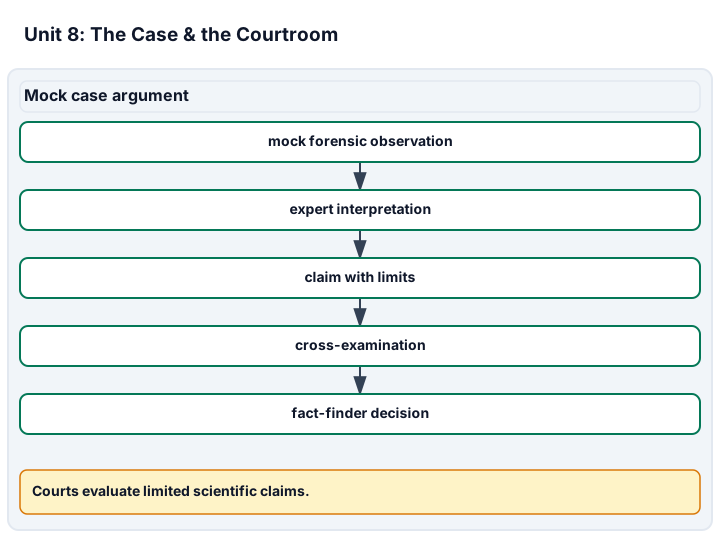
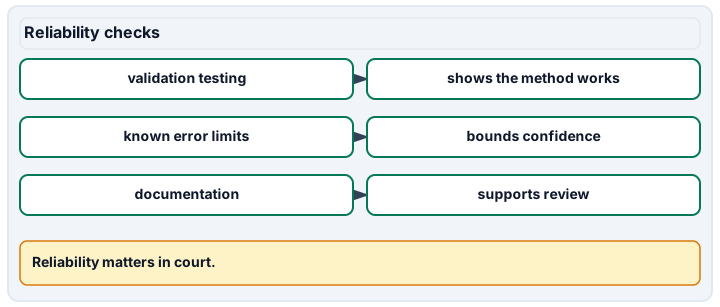
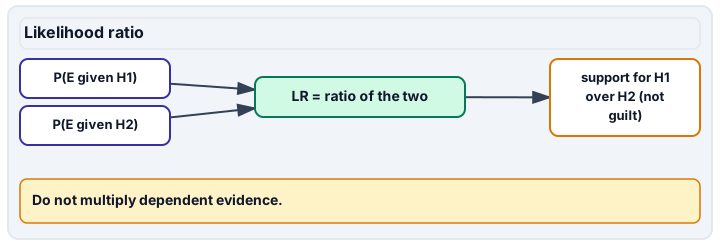
Diagram description
Mock case argument moves from mock forensic observation through expert interpretation, limited claim, cross-examination and fact-finder decision. Reliability checks list validation testing, known error limits and documentation. Likelihood ratio compares two conditional probabilities and outputs support for one hypothesis over another, not guilt.
Data, provenance, and assumptions
| E1 | E2 | P(outcome | H1) | P(outcome | H2) |
|---|---|---|---|
| + | + | 0.6 | 0.1 |
| + | - | 0.2 | 0.1 |
| - | + | 0 | 0.1 |
| - | - | 0.2 | 0.7 |
| E3 | P(outcome | H1) | P(outcome | H2) |
|---|---|---|
| + | 0.9 | 0.3 |
| - | 0.1 | 0.7 |
| Copy | Digest compared with preserved original | Custody record | Content claim |
|---|---|---|---|
| A | same | complete | unverified note |
| B | different | complete | unverified note |
| C | same | gap | unverified note |
| Record | Local clock time | UTC offset | Recorded operation |
|---|---|---|---|
| A | 10:15 | -04:00 | file modified |
| server | 14:17 | +00:00 | copy received |
Independent report, adversarial review, and fresh-data defense
Scope and safety: Anonymous fictional paper-source case and supplied audit cards only; no real accusations, devices, personal records, account access, or guilt adjudication.
Materials and preparation
- Prior units’ supplied data with control/custody limitations, the joint table, and digital audit cards.
- A report sheet with question, methods, data, controls, alternatives, limits, and separate source-cited integration fields.
Procedure and schedule
- Choose an anonymous source question before selecting results. List all relevant results, including exclusions, failed controls, and inconclusives from the preceding units.
- Each student independently drafts a report and dependency diagram before viewing the model answer or another report.
- Calculate the joint LR, the incorrect marginal product for comparison, and both E3 branches. State the conditional-independence assumption where it is used.
- A second reader audits the original report against the data, not a preferred conclusion. Log missing controls, unsupported independence assumptions, and any reversed conditional probabilities.
- Present a brief analyst-only defense and answer a fresh changed-data question. Score science/practical evidence first; record the cited history/reading/writing response separately.
Record: Keep original and corrected reports, complete evidence/decision ledger, conditional-probability tree, dependency diagram, digital/timestamp audit, reviewer comments, and a fresh transfer response.
Worked model
E1/E2 both positive give LR 6, not 4 × 3 = 12. With an independent E3 positive, combined LR = 18. With E3 negative, it is 6 × 0.1/0.7 = 0.857143, slightly favoring H2. Prior odds 1:9 updated by LR 6 become 6:9 = 2:3, so P(H1 | E1+, E2+) = 0.4 in this anonymous-source model. None is a guilt probability.
Numerical calibration
- 6 joint source LR for E1+ and E2+
- 12 incorrect marginal product; do not report as combined evidence
- 18 combined source LR with conditionally independent E3+
- 0.857143 combined source LR with conditionally independent E3−
- 0.4 H1 source probability only under the supplied 1:9 prior
- 2 minutes between the supplied UTC-normalized operations
Attempt the assigned level
Try the tasks before reading the calibration. These are practice answers, not a secure examination; use a new dataset or changed assumption for the assessed transfer.
Foundation
- Draft a report outline that retains a negative, an inconclusive, and an invalid result from earlier units rather than selecting only apparent matches.
- Interpret the three digital-copy cards and identify which equality, custody, and content claims are separately supported.
Check after your attempt
- For example, retain M1 not confirmed, profile C inconclusive, and X invalid from failed controls. Each has a different reason and reporting consequence; none should be disguised as a positive or deleted.
- A’s digest is the same; B is different, so byte identity is not supported; C’s digest is the same but its custody has a gap. None establishes the truth, author, timing of the described event, or guilt from the note.
High-school core: typically grades 9-10
- Check that each joint-probability column sums to 1. Calculate the E1/E2 joint LR and both marginal LRs; explain the difference.
- Convert the two timestamp records to UTC and write an analyst statement separating file operations from the event described in the note.
Check after your attempt
- Both columns sum to 1. The joint LR is 0.6/0.1 = 6; E1 marginal = 0.8/0.2 = 4; E2 marginal = 0.6/0.2 = 3. Their product 12 double-counts dependent information from the same fiber.
- 10:15 at UTC−04:00 is 14:15 UTC; receipt at 14:17 is two minutes later under the exact-clock assumption. A modification timestamp is not the event time described in the file; contents, clock reliability, author, and custody remain separate questions.
Honors extension: typically grades 11-12
- Compute combined support for E3 positive and E3 negative; state exactly what independence is assumed and what happens if E3 shares the same contaminated item.
- Apply the supplied 1:9 source prior to LR 6. Explain the analyst/court boundary and why a likelihood ratio cannot silently become a guilt probability.
Check after your attempt
- Conditional independence gives LR 18 for E3 positive. E3 negative gives 6/7 ≈ 0.857143, which favors H2. If the independence or valid-control assumptions fail, the product is unsupported; use an appropriate joint model or report that the available data cannot quantify it.
- Posterior source odds = 6:9 = 2:3, probability 0.4 for H1 within this artificial complete model. This is not guilt: the source propositions omit activity, intention, legal standards, and other evidence. The analyst reports evidence and limitations; the court decides admissibility and guilt.
History, reading, and writing connection
Cite NIJ’s account of the 1993 Daubert factors and NIST’s source/activity discussion. Write a student-authored report revision explaining the historical demand for tested methods, the numerical dependence problem, and one meaningful limitation. Record this history/reading/writing evidence separately; it cannot lower the science grade or block the science/practical pass.
Write in your own words or use an approved accessible equivalent. Cite a specific assigned section or figure, identify its evidence, and state one limitation or counterargument. Use the AI practice contract only for permitted coaching, never to invent observations or write the assessed response.
Transfer to a new case
The only E3 record comes from the same compromised item as E1/E2, and its negative control failed. Can you keep LR 18 because three results sound stronger than two?
Calibration: No. Both valid interpretation and conditional independence are unsupported. Retain the control failure and the result as invalid for the proposed calculation, report what remains usable, and do not manufacture a combined weight or verdict.
Evidence to retain
Submit a question-led report with item/source/date/custody ledger, all outcomes, probability tree and dependency diagram, correct denominators and assumptions, digital-integrity limits, an independent review record, and fresh transfer evidence.
Record units, calculations, source/date, uncertainty, and what is measured versus inferred. A simulation or supplied dataset must stay labeled as such. Fictional cases only. No real bodily samples, personal fingerprints, suspect profiles, personal-device searches, chemicals, cultivation, firearms, ammunition, or projectiles. Use paper, printed diagrams, and supplied mock data. Synthetic arithmetic checks are not empirical forensic-method validation or classroom pilot evidence.
Return to all eight learning pathways. Print this unit page for the student lessons; the linked five-page packet remains the separate assessment companion.
Unit mastery rubric
| Criterion | Developing | Proficient | Mastery |
|---|---|---|---|
| Assembling converging evidence | Selects only supportive findings. | Combines findings without specifying alternatives or dependence. | States source hypotheses; computes joint likelihoods and conditioned combinations, retains contrary findings, and rejects unsupported independence or prior assumptions. |
| Case-file & report writing | Blurs facts, inferences, and verdicts. | Reports positives but omits controls or inconclusives. | Writes a sourced question-led report with custody, methods, controls, all outcomes, uncertainty, and source-versus-activity limitations. |
| Expert testimony & its boundaries | Calls a likelihood ratio a guilt probability. | Uses cautious language without explaining the model. | Defends evidence, model assumptions, and limits under questioning; leaves guilt, legal standards, and admissibility decisions to the court. |
| Ethics, cognitive bias & wrongful conviction | Lets a narrative replace the evidence. | Names bias but omits a practical safeguard. | Explains risks of bias and false confessions; retains independent initial review and corrections without narrative pressure or selective reporting. |
| Chain of custody & admissibility | Treats a checksum as proof of a story. | Checks custody or timestamps but ignores their limits. | Audits paper/digital custody, digest comparisons, and timezone-labeled timestamps; distinguishes byte integrity from authorship, event time, truth, and admissibility. |
| Integration (cross-domain) | Makes no supported connection between the source and the science. | Uses the source but needs help connecting evidence, writing, or limitations to the science. | Independently connects History, Reading, and Writing using a cited source, appropriate evidence, a limitation, and a scientific explanation. |
Integration is reported separately and cannot lower the science grade or block a science demonstration pass. Science and practical criteria determine that pass. Use the integration guide's evidence checklist for the separately reported criterion.
“The dependent fiber/dye observations give source LR 6, not 12. With the conditionally independent E3 negative it becomes 6/7, favoring H2. I retain contrary and invalid results; neither likelihood ratio nor a matching file digest proves guilt.”
“All the evidence points to him, so my report should just say he’s guilty. The DNA alone is enough to prove it.”
You demonstrate this unit by assembling a case file from the year’s evidence and defending it as testimony — sourced, honest about its limits — not a multiple-choice test. A criterion counts as mastered only when your report separates fact from inference and you keep the verdict where it belongs, with the court. Mastery is demonstrated, not awarded.
A 5-page clipboard packet — unit overview, key terms, the mastery rubric, anchor examples, and a score sheet you can print and grade against.