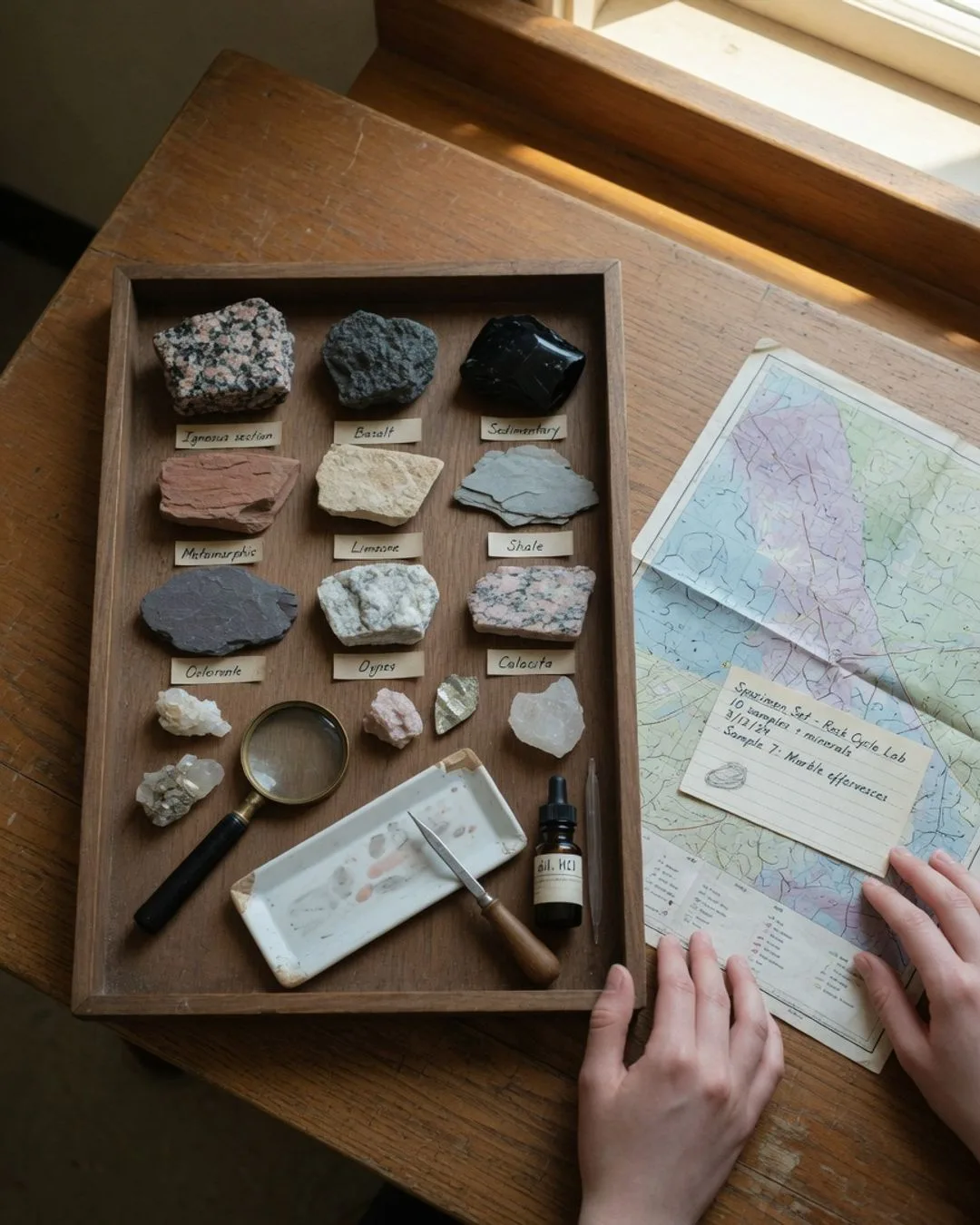
Hand a beginner a rock and ask its hardness, and they will grab the first number that seems to fit and call it the truth. Hand a geologist the same rock and they will tell you it sits between two points on the Mohs scale (harder than a steel blade, softer than quartz), and they will report that range on purpose, because they understand that every field call has a limit, and reporting past that limit is a kind of lie.
Learning to measure honestly is one of the quiet, foundational skills of the whole course, and it is worth slowing down to assess on its own. It is not glamorous. It produces no dramatic specimen and no sweeping view. But a student who cannot measure cannot do geology, because every conclusion downstream (every rock name, every grain-size estimate, every age read off a cross-section) inherits the quality of the observations it was built from.
A measurement is a claim about how much you know
Students often treat a hardness number or a percent estimate as something to pin down to a single confident value, as if precision were about sounding sure. It is nothing of the kind. A good measurement is a language for stating how much you actually know. When you write "hardness 5 to 6," you are claiming the mineral scratches apatite but not orthoclase, and that you cannot honestly split that difference with a field scratch. Write "hardness 5.5" from a single scratch and you are claiming a precision the test never gave you — you are reporting confidence you do not possess. The discipline of carrying that honesty through to your final call is just the bookkeeping that keeps it intact: a conclusion can be no more certain than the shakiest observation that went into it.
Precision is not accuracy
The two words get used interchangeably in ordinary speech, and the fieldwork exists in part to teach the student that they are not the same thing at all:
- Precision is how tightly your repeated observations agree with each other. Three passes at the same sandstone that all land within a few percent on quartz content are precise — even if every one of them is wrong.
- Accuracy is how close you are to the real value. You can be right on average and scattered call-to-call, or tightly consistent and consistently biased.
- The hard cases are the dangerous ones: an identification that is confidently repeatable and quietly wrong, because a habit of misreading luster or a chipped streak plate is repeating the same mistake with great reliability.
A student who internalizes this stops trusting a call just because the passes agreed, and starts asking the better question: agree with what, and compared to what?
Why geologists never trust one test
Some of this is muscle: pressing the streak plate hard enough to draw a true powder color, angling a specimen so a metallic luster doesn't masquerade as dull, learning that a single field scratch is always an estimate. But the deeper lesson is that no one property settles an identification. Streak, hardness, cleavage, luster, and the fizz under dilute acid are separate lines of evidence, and a careful geologist gathers several before committing (streak and hardness and the acid test, not any one alone) because a look-alike that fools one test rarely fools three. The same discipline scales all the way up: a radiometric date is never reported as a bare number but as an age plus or minus its error, a mineral's age carrying its own honest margin the way a hand-sample call does.
A measurement reported without its uncertainty is not a careful number. It is a guess wearing the costume of one.
Doing it right when the clock is running
It is one thing to identify a specimen carefully with all afternoon to do it. It is another to do it correctly in the field, with the light fading and a dozen more beds to log before you lose the outcrop. That is deliberate. In the real practice of geology, observation almost always happens under some pressure, and a judgment that evaporates the moment things speed up was never really owned. So the course asks students to read and identify well and promptly, not because speed is the point, but because a skill you can only perform slowly and undisturbed is a skill you only half-have.