A good test result shows performance at one point in time. It does not establish what a student will remember later. Revisiting earlier ideas helps the teacher identify what has been retained and what needs further practice.
Later topics depend on earlier concepts and techniques. Students need opportunities to use those foundations again, not just encounter them once.
Why geology decays so fast
Some knowledge is sticky because it connects to something you already feel — a story, an image, a lived experience. Geology, taught badly, has none of that to hold onto. It is procedures and relationships: read the streak, run the dilute-acid test, place the bed in the sequence, name the rock. A procedure you have memorized but not understood is held in place by nothing. The moment you stop rehearsing it, it slides off.
Two foundations to revisit throughout the course are:
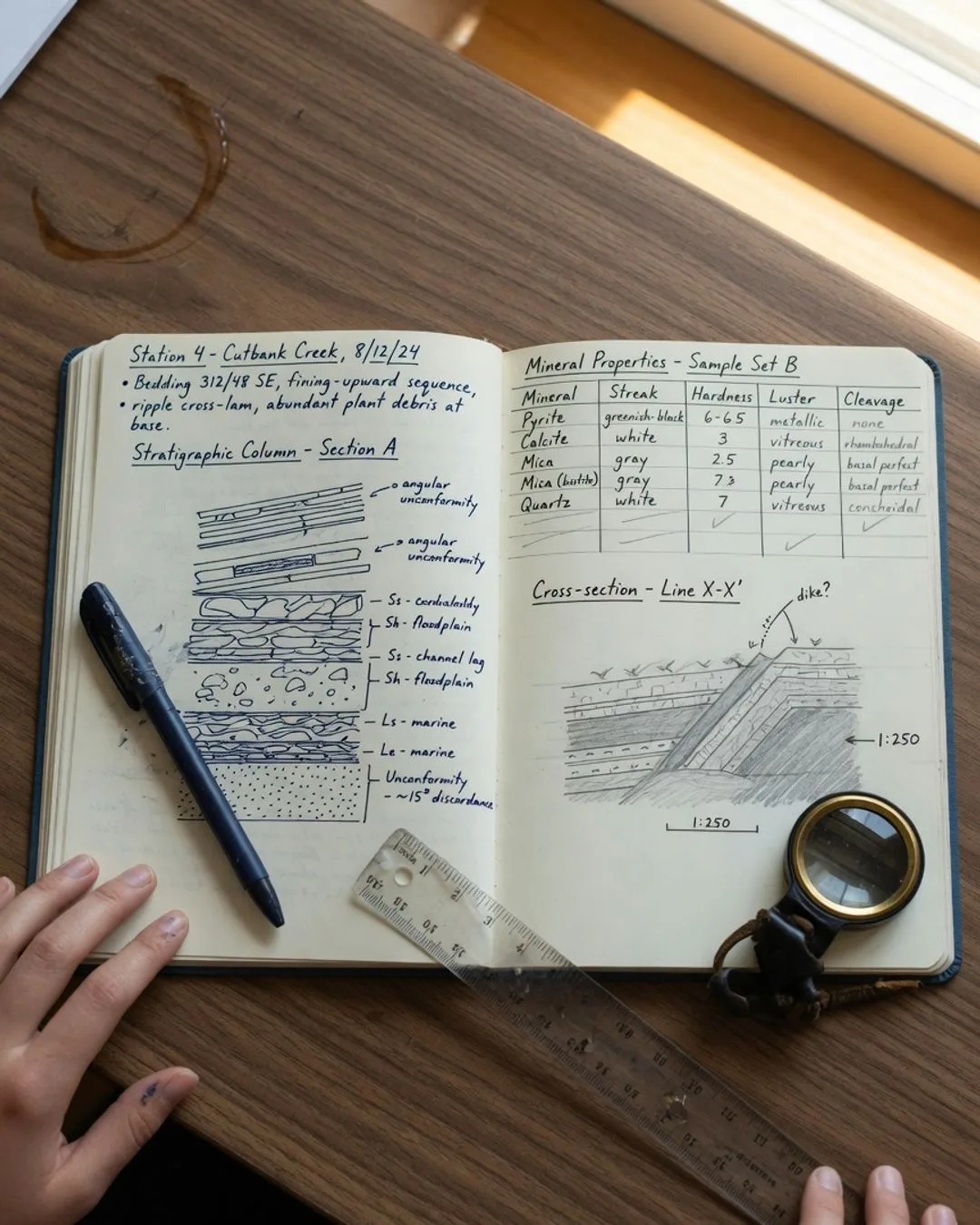
- Reading rock sequences. It is the grammar of geology — every history you reconstruct runs through the order of the beds. Memorize the rules of superposition and cross-cutting without grasping why a stack of layers is a story recorded in stone, and the whole apparatus evaporates the week after the test, taking the rest of the year's stratigraphy with it.
- Deep time. It asks the student to hold a genuinely strange idea (that the ground beneath them was built, buried, tilted, and worn away across spans no human mind can picture) and reason about it anyway. Crammed, it becomes a fog of half-remembered eon names and decay constants. Mastered, it becomes intuition.
When these decay, they don't fail quietly. They pull down the rock cycle, plate tectonics, and Earth history with them, because those units assume the earlier ones are still standing.
Learn, Master, Retain
The course replaces the test-and-move-on cycle with a three-stage one: Learn → Master → Retain. Learn is the first encounter with the idea, on Concept Day and on Field & Lab Day. Master is the more demanding standard: the student can reproduce the reasoning, explain it, and apply it to a problem they haven't seen before. And Retain is the part the ordinary model skips entirely: deliberately returning to the idea after time has passed, so it is rebuilt rather than allowed to fade.
The engine for that last stage is two well-established practices that the course bakes into its schedule:
- Spaced practice. Instead of one concentrated burst before a test, a concept is revisited at widening intervals. Each return requires students to reconstruct part of what they learned. That effort helps strengthen their understanding.
- Retrieval. The student is asked to produce the answer from memory before checking it, not to re-read until it feels familiar. Pulling a stratigraphic sequence out of your own head, repeatedly, is what makes it stay there. Recognition feels like learning and isn't; retrieval feels harder and is.
Mastery is not seat-time. A student does not understand deep time because the calendar spent two weeks on it. They understand it when they can rebuild the reasoning on demand — and that is what we measure.
Why mastery beats seat-time
The old model confuses coverage with learning. It assumes that if a topic was taught, and time was spent, and a test was passed, then learning occurred. But the forgetting curve does not care how many days the syllabus allotted. It only responds to whether the knowledge was built deeply and revisited deliberately.
In this course, students advance when they can demonstrate mastery through their own words and work. They must be able to reproduce and apply what they have learned, rather than move on simply because the unit has ended. "Developing" is an honest and expected default, not a failure. The rubrics are what make that judgment fair and repeatable. The goal was never to get the student through the test in October. It was to make sure they can still do the geology in March — and in the year after that.