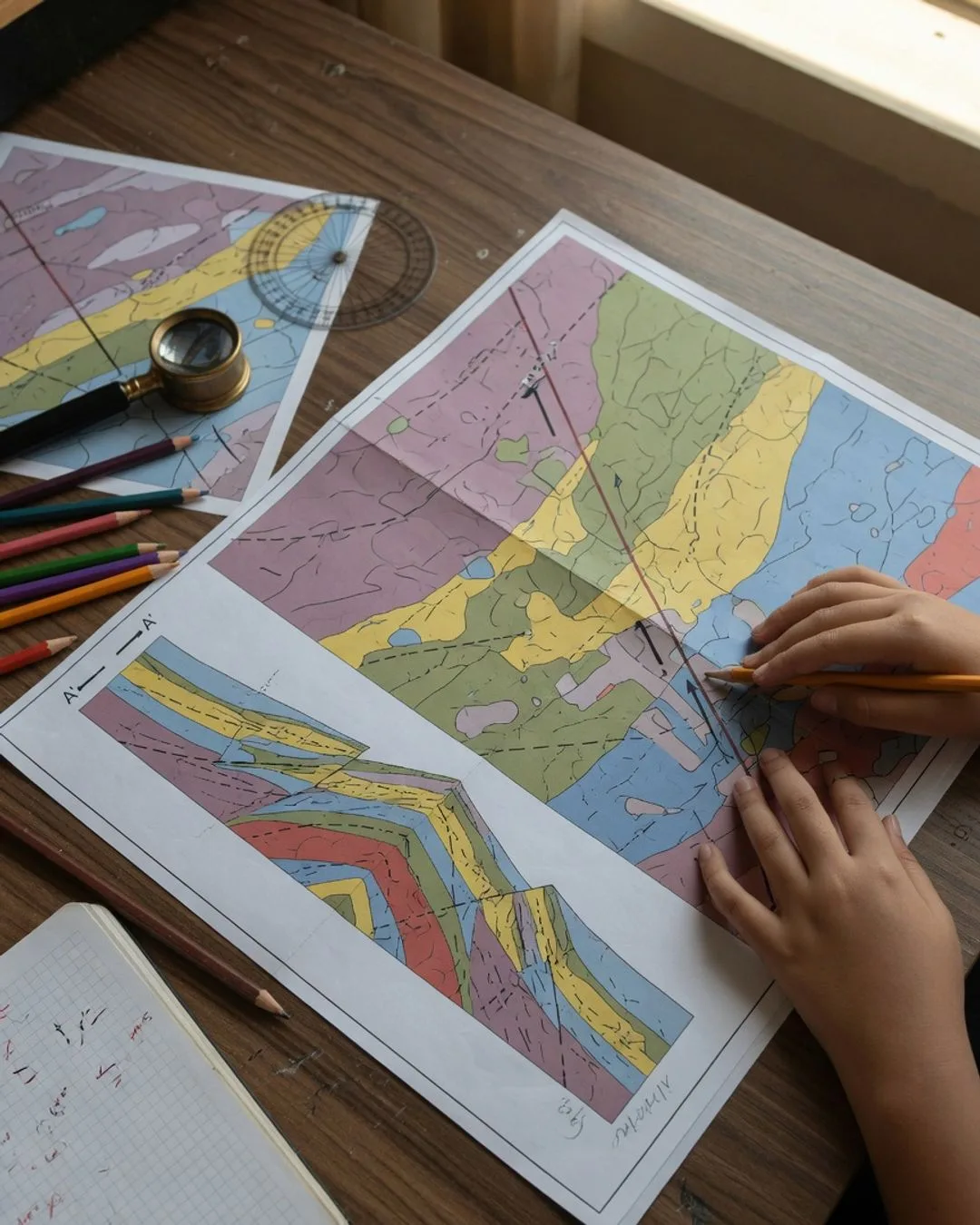
Every Bright Minds course has one unit where the walls between subjects come down on purpose — where the geology refuses to stay in the geology box and pulls in history, reading, writing, and mathematics because it cannot be honestly told without them. In this course, that unit is built around James Hutton and the discovery of deep time: one man, one outcrop, and the idea that broke Earth's history open. It is the geology analog of the integration figure that anchors every other pack — a single real place that turns out to touch everything.
The outcrop first
The place looks almost ordinary from the cliff path: a wave-cut ledge at Siccar Point, on the Berwickshire coast of Scotland, where the sea has scoured the rock bare. But look at the layers. Underneath, a set of grey beds stands nearly vertical, their edges sheared off flat. Resting straight across those cut-off edges, a second set of reddish beds lies almost horizontal. Two stacks of rock, meeting at a right angle, with a knife-clean surface between them. Geologists call that surface an angular unconformity, and in the summer of 1788 it was the most important thing anyone in Europe had ever failed to notice.
Hutton read that junction the way a detective reads a room. The lower beds had once been flat sea-floor mud, buried and hardened into rock, then tilted on end by forces deep in the Earth, then lifted into the air and worn away by weather until their upturned edges were planed flat. Then the whole surface had sunk beneath the sea again, and a new set of sediments had settled on top, hardened, and risen once more to make the ledge he was standing on. Every one of those steps (deposition, burial, uplift, erosion, subsidence) is slow beyond imagining. Stacked in a single cliff, they were a receipt for an amount of time no one in 1788 was prepared to spend.
Standing at Siccar Point, Hutton saw a world that had been built, tilted, worn away, drowned, and built again more times than the rock could count — and he wrote the sentence that founded geology: in the Earth's history he could find “no vestige of a beginning, no prospect of an end.”
The history and the reading
To feel the weight of that sentence you have to know what it argued against. In Hutton's Europe, most educated people believed the Earth was a few thousand years old — a bishop had once added up the ages in scripture and set its creation at 4004 BC. Time was short, and the world was assumed to be finished. Hutton, an Edinburgh farmer with a doctor's training and a habit of watching soil wash off his fields and rivers carry it to the sea, argued the opposite: that the same slow processes visible today — erosion grain by grain, sediment settling layer by layer — had done their work over and over across a past almost without limit. Siccar Point was his proof. He sailed there in 1788 with two friends, the mathematician John Playfair and the geologist James Hall, and it was Playfair who wrote the line everyone remembers: “the mind seemed to grow giddy by looking so far into the abyss of time.”
The reach of one idea
And then the idea refused to stay in geology. A generation later, the lawyer-turned-geologist Charles Lyell gathered Hutton's insight into his Principles of Geology and gave it a name and a method: uniformitarianism — the rule that the present is the key to the past, that the forces shaping the Earth now are the same ones that shaped it always, given enough time. A young naturalist named Charles Darwin carried the first volume of Lyell's book aboard HMS Beagle and read it as he sailed. Deep time was the gift that made his own idea possible: evolution by natural selection needs an almost unimaginable stretch of years to work, and Hutton and Lyell had just argued that the Earth had exactly that to give.
We trace that line for students on purpose, because it teaches something no single lesson can:
- The present is the key to the past. You do not need to have watched a mountain rise to know how it happened; you watch a river carry sand today and reason backward across millions of years. Reading rock is reading the present carefully enough to see the past in it.
- An outcrop is a document. Hutton's whole method was reading — treating a cliff face as a text with an order, an author, and a history that can be recovered if you look closely and write down exactly what you see. That is why the field notebook is not optional.
- A big enough idea will not stay in its field. Deep time began as a claim about rocks and ended up remaking biology, geography, and our sense of our own smallness. The strongest ideas leak across every subject line a school ever drew.
And the mathematics, added later
Hutton gave the world deep time, but he could not measure it. He knew the Earth was old beyond counting; he had no way to say how old, and for more than a century “very old” was the best geology could do. The number came from mathematics. Once physicists understood that unstable elements decay at a fixed, clock-like rate — each with a half-life, the time for half a sample to break down — a rock could be dated by measuring how far that decay had run. Arthur Holmes and others turned the arithmetic of decay rates into calendar years, and the answer that came back was staggering: the Earth is about 4.5 billion years old. A student who wires Hutton's outcrop to a half-life calculation understands something genuinely deep — that applied math is what finally put a number on the abyss Playfair only felt.
That is what integration means here. Not a geology lesson with a history anecdote stapled on, but a single outcrop held up to the light until a student can see, through it, how geology, history, reading, writing, and mathematics were never really separate subjects at all. The core spokes, History, Reading, and Writing, are included in every unit; an applied-math lane (radiometric ages, decay rates, half-lives) runs underneath; and each unit reaches for the elective spokes its story earns — here, the history of science and its reach into biology. The integration guide lays out the full model.