Unit 01 · Minerals
Start with mineral structure and composition, then combine density, hardness, cleavage, luster, and reference evidence to distinguish specimens. Apply grade and recovery fractions to a separate resource example. Use approved samples and procedures or supplied property records; the data exercises do not authorize destructive testing, and they do not certify an unobserved practical skill.
Student learning: Identify mineral evidence and calculate a resource mass balance
Choose the level by readiness, not age alone, and record it before instruction. Foundation, core, and honors tasks are study pathways, not an AP course or a promise of college credit. The instructor retains practical assessment and the published science rubric; integration is reported separately.
Prerequisites: Mass and volume, fractions and percentages, measurement uncertainty, and an approved mineral-property reference.
Suggested sequence: read and discuss the explanation; attempt the worked model; analyze the data at your selected level; check the answers; then complete the source-linked response and a fresh transfer question. These activities supplement, not replace, supervised practical work and the full-year schedule.
Assigned reading and focus
- Physical Geology 2e, 2.6: Mineral Properties. Read density, hardness, cleavage/fracture, and the limits of color as an identifier. Use supplied property records; these descriptions do not authorize scratching, powdering, or acid testing unknown specimens.
- Physical Geology 2e, 20.1: Metal Deposits. Read the definitions of deposit, concentration, and ore grade. Use the independent synthetic dataset below, not historical market values or illustrative economic cutoffs, for the calculations.
Learn the science
Minerals have characteristic compositions and structures, but a specimen can show variable color, weathering, impurities, or mixtures. A defensible identification combines independent properties and states the reference set used.
Density is mass divided by volume; 1 mL equals 1 cm^3. Density alone does not uniquely identify every mineral. The two examples below are close enough that measurement uncertainty and other properties matter.
Mohs hardness is an ordinal scratch-resistance scale, not a linear measure: hardness 8 is not twice hardness 4. Cleavage is a structural break pattern, not simply a shiny crystal face. No new destructive test is needed for this data exercise.
Ore grade is a concentration, contained metal is feed mass times grade fraction, and recovered metal includes an additional recovery fraction. A geological resource is not automatically an economically recoverable reserve; economics, access, engineering, environmental constraints, and appropriate professional evaluation matter.
The ore example is a simplified material calculation, not a mine design or investment recommendation. It does not give the composition, safety, or disposal requirements of the remaining material.

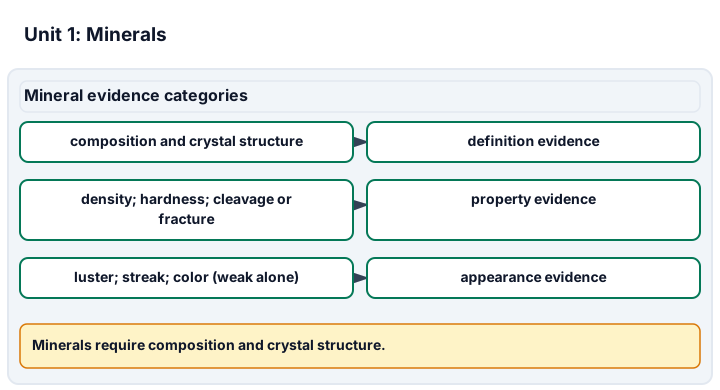
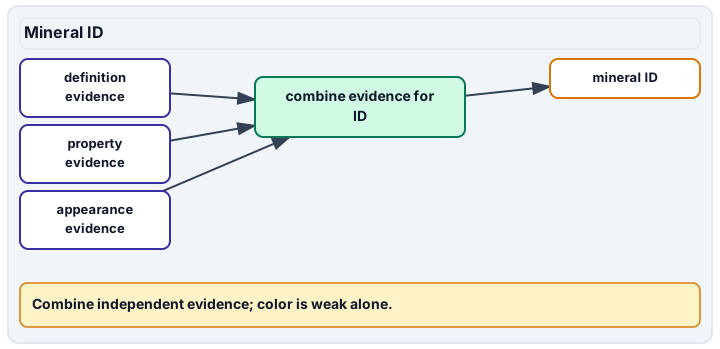
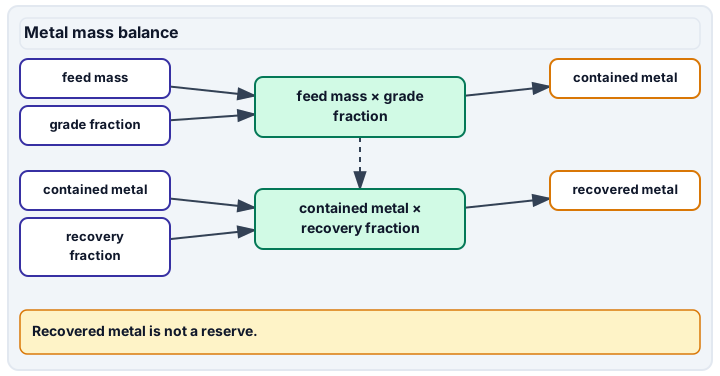
Diagram description
Composition and crystal structure give definition evidence; density, hardness and cleavage or fracture give property evidence; luster, streak and color give appearance evidence, and color is weak alone. The three evidence categories combine to support a mineral ID. Contained metal is feed mass times grade fraction; recovered metal is contained metal times recovery fraction, and recovered metal is not an economic reserve.
Data, provenance, and assumptions
| Sample | Mass (g) | Displaced volume (mL) | Reference hardness | Other supplied evidence |
|---|---|---|---|---|
| A | 54 | 20 | 3 | Three cleavage directions, not right angles |
| B | 53 | 20 | 7 | No cleavage; conchoidal fracture |
| Feed (tonnes) | Metal grade (%) | Recovery (%) |
|---|---|---|
| 1000 | 1.2 | 80 |
Worked model
Sample A has density 54/20 = 2.70 g/cm^3; B has 53/20 = 2.65 g/cm^3. In the separate ore model, 1000 tonnes at 1.2% contains 12 tonnes of metal. An 80% recovery yields 9.6 tonnes, not 80% of the whole feed.
Numerical calibration
- 2.7 g/cm^3
- 2.65 g/cm^3
- 12 tonnes
- 9.6 tonnes
- 1250 tonnes for the stated target
Attempt the assigned level
Try the tasks before reading the calibration. These are practice answers, not a secure examination; use a new dataset or changed assumption for the assessed transfer.
Foundation
- Calculate both specimen densities and compare the supplied hardness/cleavage evidence with the reading.
- Convert 1.2% to a fraction and calculate contained metal.
Check after your attempt
- A: 2.70 g/cm^3; B: 2.65 g/cm^3. The supplied evidence is consistent with calcite and quartz respectively within this reference exercise, not every possible unknown.
- 1.2% is 0.012; the feed contains 12 tonnes of metal.
High-school core: typically grades 9-10
- Calculate recovered metal and explain why grade and recovery are different fractions.
- If A has mass 54.0 +/- 0.1 g and volume 20.0 +/- 0.2 mL, use endpoint combinations to bound its density.
Check after your attempt
- Recovered metal is 9.6 tonnes; recovery acts on contained metal, not the total feed.
- The endpoint range is about 2.668 to 2.732 g/cm^3. An interval and other properties are more informative than a falsely exact identification.
Honors extension: typically grades 11-12
- Find the feed mass needed for 12 tonnes of recovered metal under the same assumptions.
- Explain why a material balance cannot by itself establish a reserve, feasibility, or safe waste management.
Check after your attempt
- 12/(0.012 times 0.80) = 1250 tonnes of feed.
- The model omits costs, losses outside the stated recovery, resource variability, permissions, engineering, and environmental evidence.
History, reading, and writing connection
Compare identification evidence with the reading and explain why a measured material property and a decision to extract a resource answer different questions. Cite a source, retain units, and identify a missing decision factor.
Write in your own words or use an approved accessible equivalent. Cite a specific assigned section or figure, identify its evidence, and state one limitation or counterargument. Use the AI practice contract only for permitted coaching, never to invent observations or write the assessed response.
Transfer to a new case
Recovery improves to 90% while the grade stays 1.2%. Has the deposit become 90% metal?
Calibration: No. The grade remains 1.2%; the model now recovers 10.8 tonnes of the 12 tonnes contained in the same feed.
Evidence to retain
Submit the property comparison, mass-balance work at the chosen level, and a limitation. Use known reference data or approved non-destructive specimens; do not taste or chemically test unknown minerals.
Record units, calculations, source/date, uncertainty, and what is measured versus inferred. A simulation or supplied dataset must stay labeled as such. Use supplied data, approved photographs, or the non-destructive observation plan. No hammering, acids, excavation, water sampling, unstable-site entry, or engineering/safety clearance is authorized by these lessons.
Return to all eight learning pathways. Print this unit page for the student lessons; the linked five-page packet remains the separate assessment companion.
Unit mastery rubric
| Criterion | Developing | Proficient | Mastery |
|---|---|---|---|
| Mineral identity & resource quantities | Confuses a mineral, rock, grade, and recovered material. | Names properties or percentages but misuses their meaning. | Explains mineral identity and rock composition; applies assigned density, grade, and recovery calculations without equating a resource with a reserve. |
| Streak & luster | Reads the specimen’s surface color as its streak; cannot name luster. | Gets a streak on the plate but forgets that streak can differ from surface color; luster call is inconsistent. | Powders the mineral on the porcelain plate to read true streak, and classifies luster as metallic or non-metallic to narrow the field — e.g. pyrite’s greenish-black streak under a brassy metallic shine. |
| Mohs hardness | Guesses hardness by appearance; misuses the kit. | Runs scratch tests but reverses which scratches which, or reports a single number instead of a range. | Uses fingernail, copper penny, glass plate, and steel nail methodically to bracket hardness on the Mohs scale and reads it accurately (e.g. calcite ~3, quartz 7). |
| Cleavage vs. fracture | Uses the terms interchangeably or not at all. | Defines both but misreads a specimen — calls conchoidal fracture “cleavage” or misses a plane. | Distinguishes flat cleavage planes from irregular fracture, counts cleavage directions, and cites mica’s one perfect cleavage against quartz’s fracture. |
| Property evidence & the dichotomous key | Guesses without a reference or ignores the approved procedure. | Uses a property but overlooks uncertainty or another possible identity. | Combines approved or supplied property evidence with a key, explaining uncertainty and why one result alone need not establish identity. |
| Integration (cross-domain) | Makes no supported connection between the source and the science. | Uses the source but needs help connecting evidence, writing, or limitations to the science. | Independently connects History, Reading, and Writing using a cited source, appropriate evidence, a limitation, and a scientific explanation. |
Integration is reported separately and cannot lower the science grade or block a science demonstration pass. Science and practical criteria determine that pass. Use the integration guide's evidence checklist for the separately reported criterion.
“It fizzed under the dilute acid, so it’s a carbonate — and the steel nail scratched it easily, hardness near 3, with a white streak and rhombic cleavage. That’s calcite. Hardness is what rules out quartz here: quartz would scratch the glass plate, calcite won’t. The key gets me to the name; the tests tell me why.”
“It’s kind of gold, so… pyrite? And it looks hard, I think — I didn’t really do the streak, the outside was already that color.”
You demonstrate this unit through the mineral-identification lab — streak, hardness, cleavage, luster, and the acid test on a specimen set — plus short oral checks where you reason from the properties aloud, all recorded in your lab notebook, not a multiple-choice test. A criterion counts as mastered only when you can both run the test with proper technique and justify why that property distinguishes one mineral from another. Mastery is demonstrated, not awarded.
A 5-page clipboard packet — unit overview, key terms, the mastery rubric, anchor examples, and a score sheet you can print and grade against.