Unit 02 · Igneous Rocks & Volcanism
Igneous rock is the record of molten Earth cooling into stone. This unit covers the difference between magma below ground and lava at the surface, why intrusive (plutonic) rock grows coarse crystals while extrusive (volcanic) rock chills to a fine or glassy texture, how Bowen's reaction series orders minerals from ultramafic and mafic through intermediate to felsic, and how a volcano's shape and eruption style follow from the composition of its melt. Mastery means you can hold a rock, read its cooling history from the crystals, and place it in the story of the magma that made it.
Student learning: Relate texture, cooling, composition, and volcanic uncertainty
Choose the level by readiness, not age alone, and record it before instruction. Foundation, core, and honors tasks are study pathways, not an AP course or a promise of college credit. The instructor retains practical assessment and the published science rubric; integration is reported separately.
Prerequisites: Mineral properties, temperature differences, elapsed time, ratios, and graph axes.
Suggested sequence: read and discuss the explanation; attempt the worked model; analyze the data at your selected level; check the answers; then complete the source-linked response and a fresh transfer question. These activities supplement, not replace, supervised practical work and the full-year schedule.
Assigned reading and focus
- Physical Geology 2e, 3.3: Crystallization of Magma. Read the Bowen reaction series and its composition/temperature conditions. Laboratory melting described in the history is not a student procedure for this course.
- USGS: Understanding Plate Motions. Read divergent and convergent boundary descriptions. Distinguish a broad tectonic setting from prediction of an individual eruption.
Learn the science
Igneous texture records aspects of crystallization and cooling, but also composition, volatile content, nucleation, and later change. Intrusive and extrusive settings help explain common textures; a texture alone does not recover a complete temperature history.
Bowen's reaction series describes conditional mineral stability during cooling, not a rule that every magma must make every listed mineral. Fractionation, mixing, pressure, and water can change the assemblage.
A mean cooling rate is temperature decrease divided by time. The rate is an interval average, not necessarily a constant instantaneous value or a universal formula for crystal size.
Eruption behavior depends on viscosity, temperature, volatiles, pressure, and setting. A rock composition or a cooling table is not an eruption forecast or permission to enter a hazardous area.

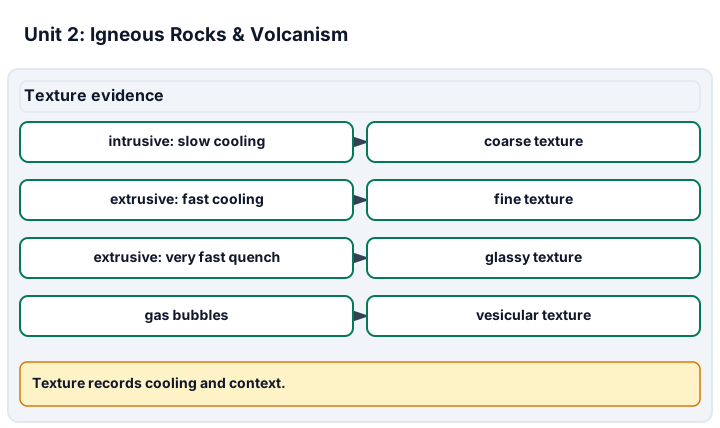
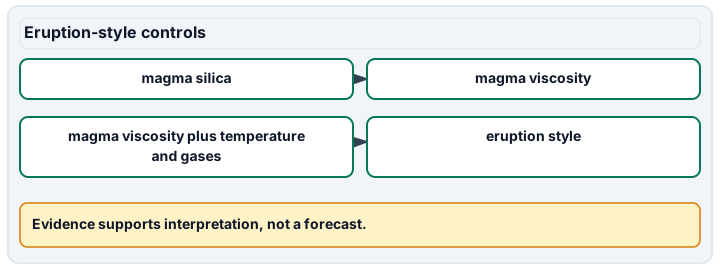
Diagram description
Texture rows link intrusive slow cooling to coarse texture, extrusive fast cooling to fine texture, very fast quench to glassy texture, and gas bubbles to vesicular texture. Silica contributes to magma viscosity; viscosity, temperature and dissolved gases control eruption style. Eruption style plus monitoring evidence supports interpretation rather than forecast.
Data, provenance, and assumptions
| Model | Initial temperature (C) | Final temperature (C) | Elapsed time (minutes) | Mean crystal size (mm) |
|---|---|---|---|---|
| Fast | 800 | 400 | 4 | 0.05 |
| Slow | 800 | 400 | 200 | 1.5 |
| Quartz (%) | Potassium feldspar (%) | Plagioclase (%) | Mafic minerals (%) |
|---|---|---|---|
| 20 | 35 | 40 | 5 |
Worked model
Both examples cool through 400 C. Their average rates are 400/4 = 100 C/min and 400/200 = 2 C/min. The slow example has crystals 30 times larger, but the two rows do not establish a universal linear relationship.
Numerical calibration
- 100 C/min, interval average
- 2 C/min, interval average
- 30 slow/fast
Attempt the assigned level
Try the tasks before reading the calibration. These are practice answers, not a secure examination; use a new dataset or changed assumption for the assessed transfer.
Foundation
- Calculate the temperature drop and describe the texture trend.
- Find the total feldspar percentage in the supplied composition.
Check after your attempt
- The drop is 400 C in each case; the slower example has larger crystals.
- The total feldspar is 35 + 40 = 75%.
High-school core: typically grades 9-10
- Calculate both average cooling rates and the crystal-size ratio.
- Identify two additional factors needed before inferring eruption behavior.
Check after your attempt
- Rates are 100 and 2 C/min; size ratio is 1.5/0.05 = 30.
- Examples include volatiles, temperature/viscosity, confining conditions, and independent monitoring evidence.
Honors extension: typically grades 11-12
- Compare the 50-fold rate difference with the 30-fold size difference. Explain why predicting a third size by proportionality is unjustified.
- Use the reference to explain why removing early crystals can change the remaining liquid without claiming a unique history from one sample.
Check after your attempt
- The observed ratios differ and only two idealized cases are provided. A fitted model and additional controlled evidence would be needed.
- Fractionation changes the residual composition; the interpretation still depends on the initial composition and other conditions.
History, reading, and writing connection
Use the account of Bowen's experiments to separate observations, a conditional mineral model, and a claim about a real volcanic hazard. Evaluate what the synthetic cooling examples actually test.
Write in your own words or use an approved accessible equivalent. Cite a specific assigned section or figure, identify its evidence, and state one limitation or counterargument. Use the AI practice contract only for permitted coaching, never to invent observations or write the assessed response.
Transfer to a new case
Two rocks have similar chemistry but different vesicle content. Must their eruption behavior have been identical?
Calibration: No. Volatiles and physical conditions also matter; similar bulk chemistry does not uniquely determine an eruption.
Evidence to retain
Retain rate calculations, a composition/texture explanation, and a model limitation. Use supplied records and approved images; no hot-rock or volcanic-site activity is authorized.
Record units, calculations, source/date, uncertainty, and what is measured versus inferred. A simulation or supplied dataset must stay labeled as such. Use supplied data, approved photographs, or the non-destructive observation plan. No hammering, acids, excavation, water sampling, unstable-site entry, or engineering/safety clearance is authorized by these lessons.
Return to all eight learning pathways. Print this unit page for the student lessons; the linked five-page packet remains the separate assessment companion.
Unit mastery rubric
| Criterion | Developing | Proficient | Mastery |
|---|---|---|---|
| Magma, lava & cooling rate | Confuses settings or temperature change with elapsed time. | Names a trend but cannot calculate or qualify a rate. | Distinguishes magma/lava and common settings; calculates assigned interval cooling rates and states their limits. |
| Texture & crystal size | Cannot describe diagnostic textures. | Connects texture to cooling but assumes a unique quantitative history. | Describes coarse, fine, glassy, and vesicular textures, using composition and conditions to qualify the inferred history. |
| Composition & Bowen's reaction series | Cannot order minerals or tell felsic from mafic. | Sorts felsic and mafic by color but ignores mineral content. | Uses Bowen's reaction series to rank a melt from ultramafic through mafic and intermediate to felsic. |
| Rock identification (granite, basalt, obsidian, pumice) | Confuses common igneous rocks with one another. | Names some rocks but not from texture and composition together. | Identifies granite, basalt, obsidian, and pumice from texture and composition and justifies each call. |
| Volcano type & eruption interpretation | Treats all eruptions alike. | Infers behavior from composition alone. | Relates volcano forms to viscosity, volatiles, temperature, and setting, while distinguishing interpretation from an eruption forecast. |
| Integration (cross-domain) | Makes no supported connection between the source and the science. | Uses the source but needs help connecting evidence, writing, or limitations to the science. | Independently connects History, Reading, and Writing using a cited source, appropriate evidence, a limitation, and a scientific explanation. |
Integration is reported separately and cannot lower the science grade or block a science demonstration pass. Science and practical criteria determine that pass. Use the integration guide's evidence checklist for the separately reported criterion.
“The supplied texture and composition are consistent with a mafic volcanic rock. Texture constrains the cooling interpretation, but it does not provide an exact rate. Volatiles and physical conditions also matter; this specimen alone does not determine eruption behavior or a safe forecast.”
“It’s some kind of black rock. Volcanoes just explode. I think the big crystals mean it’s older.”
You demonstrate this unit at the specimen bench — classifying real igneous rocks with a hand lens, sorting them by texture and composition, and explaining each rock's cooling history and volcanic origin aloud — not a multiple-choice test. A criterion counts as mastered only when you can both identify the rock and defend the cooling story the crystals record. Mastery is demonstrated, not awarded.
A 5-page clipboard packet — unit overview, key terms, the mastery rubric, anchor examples, and a score sheet you can print and grade against.