Unit 08 · Geologic Time & Earth History
The year closes with the deepest idea in geology: time itself. This unit covers relative dating — the stratigraphic principles from Unit 03 that order events without numbers — and absolute, radiometric dating that puts years on them through half-lives and decay curves; the geologic time scale of eons, eras, and periods; the mass extinctions that punctuate it; and the sweep of Earth history read as a single record. Beneath all of it sits James Hutton’s founding insight — deep time, with “no vestige of a beginning, no prospect of an end.” Mastery means you can order events, calculate an age, and place them on the scale Hutton first made thinkable.
Student learning: Date an event, bracket deposition, and reason across deep time
Choose the level by readiness, not age alone, and record it before instruction. Foundation, core, and honors tasks are study pathways, not an AP course or a promise of college credit. The instructor retains practical assessment and the published science rubric; integration is reported separately.
Prerequisites: Relative dating, fractions and half-lives, unit conversion; honors work uses logarithms and uncertainty bounds.
Suggested sequence: read and discuss the explanation; attempt the worked model; analyze the data at your selected level; check the answers; then complete the source-linked response and a fresh transfer question. These activities supplement, not replace, supervised practical work and the full-year schedule.
Assigned reading and focus
- Physical Geology 2e, 8.4: Isotopic Dating Methods. Read assumptions about initial daughter material, retention, and the difference between mineral ages and sediment deposition. Use the hypothetical clock below rather than applying one simplified formula to every real isotope system.
- Physical Geology 2e, 8.1: The Geological Time Scale. Read the account of relative ordering and correlation before numerical dating. Use an instructor-supplied current ICS chart for formal boundary dates; older numerical summaries and typographical errors are not the authority for current boundaries.
- International Commission on Stratigraphy: International Chronostratigraphic Chart. Use the current dated chart to locate eons, eras, periods, and the Cretaceous-Paleogene boundary; record the chart version. The rounded classroom scale below is not a replacement for formal boundary definitions.
Learn the science
A radiometric date must be tied to the material, isotopic system, initial conditions, and event being recorded. Crystallization is not automatically sediment deposition; heating, inherited grains, or open-system behavior can change the interpretation.
For the hypothetical one-parent/one-daughter clock below, assume zero initial daughter and a closed system. Remaining fraction is P/(P+D), and age equals -log2(fraction) times the stated half-life. Real isotope systems can have branching, initial daughter, or other corrections that this toy clock omits.
A sediment can contain older detrital grains. Under the supplied undisturbed context, the youngest dated detrital grain provides a maximum depositional age, while an overlying ash can provide a younger bound. The larger number in Ma represents the older time.
Relative order, numerical age, and duration are distinct. An unconformity does not directly show its duration, and a single inconsistent date must be investigated rather than averaged away to force the expected story.
Geologic time is organized into named intervals and updated numerical boundaries. Use the current assigned chart, with rounded 4540 Ma for Earth formation and 66 Ma for the Cretaceous-Paleogene event only for this scale exercise.

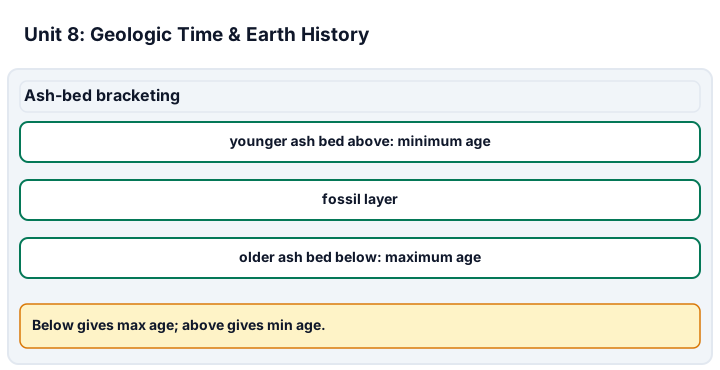
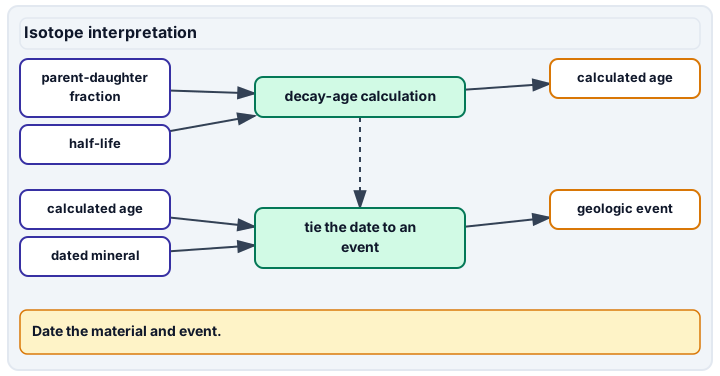
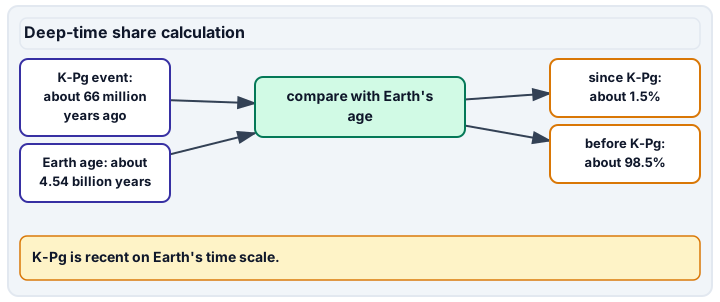
Diagram description
The bracketing column lists the younger ash bed above (minimum age), the fossil layer, and the older ash bed below (maximum age), top to bottom, so the dated beds bracket the fossil layer. Intrusion and unconformity add event-order reasoning alongside the column. The isotope panel turns the parent-daughter fraction and half-life into a calculated age, then ties that age and the dated mineral to the interpreted geologic event. The deep-time panel compares the K-Pg event at about 66 million years ago with Earth age at about 4.54 billion years: 66 / 4540 × 100 is about 1.5% since K-Pg, leaving about 98.5% before K-Pg.
Data, provenance, and assumptions
| Sample | Parent count units | Daughter count units | Half-life (Ma) |
|---|---|---|---|
| A | 25 | 75 | 100 |
| B | 12.5 | 87.5 | 100 |
| Dated material | Age (Ma) | Stated interpretation |
|---|---|---|
| Detrital grain | 200 | Crystallization before erosion/deposition |
| Detrital grain | 130 | Crystallization before erosion/deposition |
| Detrital grain | 120 | Youngest supplied detrital crystallization |
| Overlying ash | 110 | Eruption/deposition after the sediment |
| Reference | Age before present (Ma) |
|---|---|
| Earth formation | 4540 |
| Cretaceous-Paleogene event | 66 |
Worked model
Sample A retains 25/(25+75) = 0.25 of the hypothetical parent, so two half-lives give 200 Ma. B retains 0.125, giving 300 Ma. The separate sediment was deposited between 120 and 110 Ma under the stated context; dating an old grain does not give a 200 Ma depositional age.
Numerical calibration
- 200 Ma in the hypothetical clock
- 300 Ma in the hypothetical clock
- 120 Ma under the exact-age model
- 110 Ma under the exact-age model
- 1.45 percent of the rounded Earth-history scale
Attempt the assigned level
Try the tasks before reading the calibration. These are practice answers, not a secure examination; use a new dataset or changed assumption for the assessed transfer.
Foundation
- Use repeated halving to find the ages of A and B.
- Order the supplied crystallization, sediment deposition, and ash events, distinguishing old from large numerical age.
Check after your attempt
- A: 200 Ma; B: 300 Ma in the hypothetical clock.
- The detrital grains crystallized first, the sediment accumulated later, and the 110 Ma ash was deposited afterward.
High-school core: typically grades 9-10
- Calculate the remaining fractions and the sediment depositional bracket.
- At 1 mm per Ma, locate the 66 Ma event relative to the present and compare it with the full Earth-history length.
Check after your attempt
- Fractions are 0.25 and 0.125; the bracket is 110-120 Ma.
- The event is 66 mm from the present end of a 4540 mm timeline, about 1.45% of its total length.
Honors extension: typically grades 11-12
- Allow +/-2 Ma for both bounding ages and give a conservative possible depositional bracket under the same model.
- A newly reported detrital grain age is 107 Ma. Explain why that conflicts with the stated 110 Ma overlying ash and what must be checked.
Check after your attempt
- A conservative possible interval is 108-122 Ma; this is not a formal combined confidence interval.
- Check sample identity, dated event, contamination, disturbance, analytical uncertainty, and the geological assumptions. Do not average an inconsistent date into an apparently precise answer.
History, reading, and writing connection
Connect the history of relative ordering to the development of numerical dating. Cite the assigned source and chart version, and explain why a date without geological context is not a complete history.
Write in your own words or use an approved accessible equivalent. Cite a specific assigned section or figure, identify its evidence, and state one limitation or counterargument. Use the AI practice contract only for permitted coaching, never to invent observations or write the assessed response.
Transfer to a new case
The system gained daughter material after formation. Can the simple P/(P+D) clock still be used without correction?
Calibration: No. The closed-system/initial-daughter assumptions have changed; the uncorrected result is not a defensible event age.
Evidence to retain
Retain the decay work, event-order/bracketing argument, scaled timeline, and uncertainty discussion. Use supplied data only; no radioactive specimen, laboratory preparation, or physical dating experiment is required.
Record units, calculations, source/date, uncertainty, and what is measured versus inferred. A simulation or supplied dataset must stay labeled as such. Use supplied data, approved photographs, or the non-destructive observation plan. No hammering, acids, excavation, water sampling, unstable-site entry, or engineering/safety clearance is authorized by these lessons.
Return to all eight learning pathways. Print this unit page for the student lessons; the linked five-page packet remains the separate assessment companion.
Unit mastery rubric
| Criterion | Developing | Proficient | Mastery |
|---|---|---|---|
| Relative dating principles | Cannot order rock layers or events. | Names superposition but misapplies cross-cutting or inclusions. | Orders events using superposition, cross-cutting relationships, and inclusions, and reads an unconformity as missing time. |
| Radiometric dating & half-life | Cannot connect a ratio to a stated clock model. | Computes an age but ignores initial daughter or system history. | Uses the assigned decay model and assumptions, identifying the material and event dated rather than equating every mineral age with deposition. |
| The geologic time scale | Cannot place major events in order. | Names eras but not their sequence or defining events. | Places major events — the origin of life, mass extinctions, key evolutionary steps — within their eons, eras, and periods. |
| Deep time & Earth history | Thinks Earth’s past fits human timescales. | Repeats “deep time” but cannot reason at its scale. | Uses Hutton’s deep time to interpret slow processes and mass extinctions across the full sweep of Earth history. |
| Decay simulation & dated-event interpretation | Misreads the model or invents missing chronological evidence. | Calculates dates but combines inconsistent events uncritically. | Plots/interprets a decay simulation, brackets events with context, and investigates inconsistent dates instead of averaging away conflicts. |
| Integration (cross-domain) | Makes no supported connection between the source and the science. | Uses the source but needs help connecting evidence, writing, or limitations to the science. | Independently connects History, Reading, and Writing using a cited source, appropriate evidence, a limitation, and a scientific explanation. |
Integration is reported separately and cannot lower the science grade or block a science demonstration pass. Science and practical criteria determine that pass. Use the integration guide's evidence checklist for the separately reported criterion.
“The hypothetical clock retains one quarter of its parent, giving two half-lives under the closed-system and initial-daughter assumptions. The youngest detrital grain and overlying ash bracket deposition in the separate model; neither an old grain nor a visible unconformity gives a complete history by itself.”
“It’s really old rock. Half-life is how long something lasts. The bottom layer is older, I think, but I can’t put a number on it.”
You demonstrate this unit through a radiometric-dating simulation and a relative-dating sequence — computing an age from a half-life and ordering events by stratigraphic principles, explained aloud rather than on a multiple-choice test. A criterion counts as mastered only when your age calculation is defensible and you can place the events on the geologic time scale. Mastery is demonstrated, not awarded.
A 5-page clipboard packet — unit overview, key terms, the mastery rubric, anchor examples, and a score sheet you can print and grade against.