Unit 01 · Body Systems & Wellness Basics
Body systems cooperate, and baseline records are neutral evidence about function. Use only fictional, synthetic, de-identified, or educator-supplied public records. Using supplied records instead of private data has no grade penalty or token charge. This is science literacy, not medical advice, personal diagnosis, or prescriptive dieting.
Student learning: Body Systems & Wellness Basics
Choose the level by readiness, not age alone, and record it before instruction. Foundation, core, and honors tasks are study pathways, not an AP course or a promise of college credit. The instructor retains practical assessment and the published science rubric; integration is reported separately.
Prerequisites: [systems-baseline] Can name major body systems and read a small table.
Suggested sequence: read and discuss the explanation; attempt the worked model; analyze the data at your selected level; check the answers; then complete the source-linked response and a fresh transfer question. These activities supplement, not replace, supervised practical work and the full-year schedule.
Assigned reading and focus
- NIH ODS: Calcium consumer fact sheet. [systems-baseline] Use the sections on calcium functions to connect muscles, nerves, blood vessels, and vitamin D without making a personal-health judgment.
- NIH ODS: Calcium consumer fact sheet. Use the public fact-sheet functions as a source-backed systems example rather than a personal assessment.
Learn the science
Grades 7-12; choose foundation, core, or honors/readiness by prerequisites and task complexity, not age alone.
[systems-baseline] Body-system cooperation in a fictional baseline record. A baseline is a starting observation in a stated context. In this course it is always a fictional, de-identified, or educator-supplied public record for grading. The scientific task is to connect the circulatory, respiratory, nervous, musculoskeletal, digestive, and immune systems to function.
[systems-baseline] Assumptions: The record below is synthetic classroom data. It is not a medical record, a screening result, or evidence about any learner body.
[systems-baseline] Uncertainty: Resting measures vary with timing, recent activity, equipment, stress, hydration, and measurement method. A single baseline supports a systems explanation, not a diagnosis.

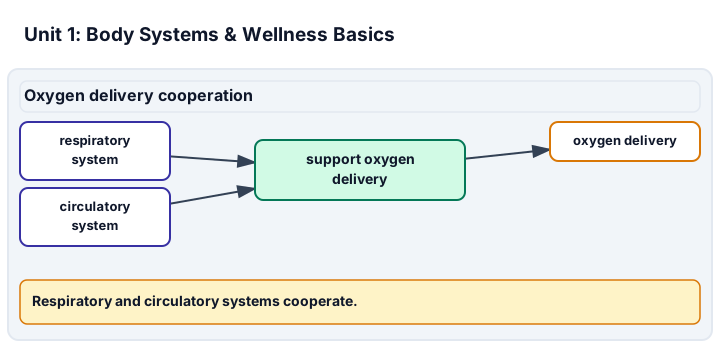
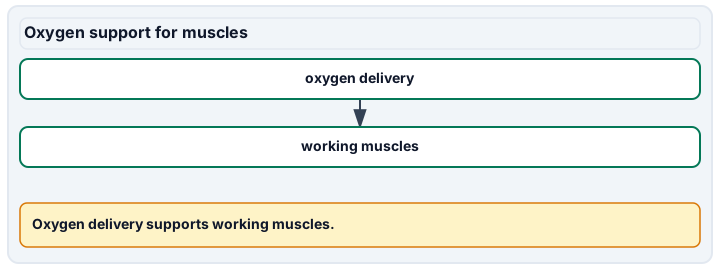
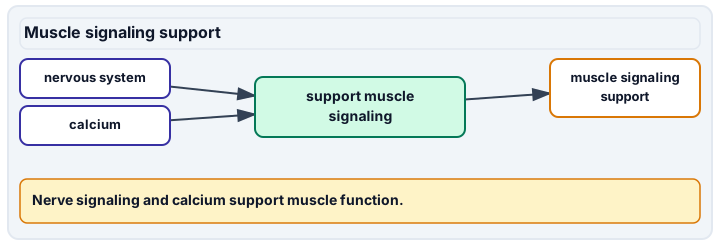
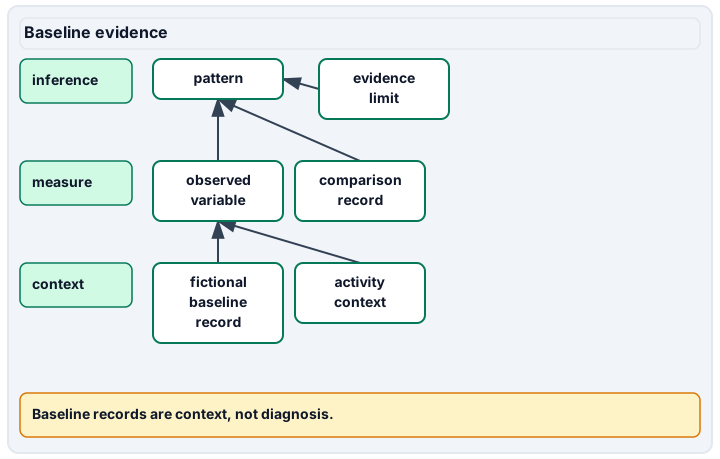
Diagram description
Respiratory and circulatory systems support oxygen delivery; oxygen delivery supports working muscles; the nervous system and calcium support muscle signaling for working muscles, and calcium is also needed for nerve signaling. The baseline panel uses fictional records and activity context to interpret an observed variable against a comparison record, with evidence limits preventing diagnosis.
Data, provenance, and assumptions
| Record | Resting pulse (beats/min) | Breaths/min | Context note |
|---|---|---|---|
| A | 72 | 14 | quiet seated model |
| B | 78 | 16 | after hallway walk |
| C | 68 | 13 | quiet seated model |
| D | 82 | 17 | after stairs model |
Paper investigation sequence and evidence record
Scope and safety: Health and nutrition work uses fictional, synthetic, de-identified, or educator-supplied public records. It is not medical advice, does not diagnose, screen, treat, or prescribe, and never grades a learner body, disclosure, food choice, mood, sleep, fitness, weight, or medical status. Students’ own health, diet, sleep, fitness, or mood data are never collected or graded. Any tasting, cooking, allergen exposure, or food handling requires educator approval and an opt-out alternative.
Materials and preparation
- [systems-baseline] Use the supplied systems-baseline-records records, assigned source sections, calculator and an accessible graph or diagram. No physical apparatus is required.
Procedure and schedule
- [systems-baseline] Question: How can a fictional baseline record show cooperation among body systems without grading a learner body? Prerequisites: Can name major body systems and read a small table.
- [systems-baseline] Variables: Pulse and breathing values are outcomes; activity context is a condition; learner identity is deliberately absent. Controls: Use the same fictional source and units for every student. Replication: Compare multiple de-identified records rather than repeating a personal measure.
- [systems-baseline] Analysis: Compute means and explain system cooperation with limits. Review: An educator reviews prerequisites, source interpretation, reasoning and accessibility before assessment. A paper response does not certify unobserved practical technique; approved hands-on work requires a separate record.
Record: Retain systems-baseline, the selected level, original inputs and first attempt, source/date, system and axes, units, assumptions, calculation/graph, uncertainty, correction and fresh transfer. Link only to the stated science criteria.
Worked model
[systems-baseline] Average the four fictional pulse values and the four breathing values, then explain why circulation and respiration must be interpreted together.
Numerical calibration
- 75 beats/min synthetic mean
- 15 breaths/min synthetic mean
- 8 beats/min difference in changed case
Attempt the assigned level
Try the tasks before reading the calibration. These are practice answers, not a secure examination; use a new dataset or changed assumption for the assessed transfer.
Foundation: typically grades 7-8
- [systems-baseline] Name two systems in record D and state each job.
Check after your attempt
- [systems-baseline] Circulatory moves blood and respiratory exchanges oxygen and carbon dioxide; the numbers are practice data, not a verdict.
High-school core: typically grades 9-10
- [systems-baseline] Explain why pulse and breathing should be read together in this fictional record.
Check after your attempt
- [systems-baseline] Working muscles need oxygen delivery and carbon dioxide removal, so heart and lungs coordinate; the record supports function talk, not medical status.
Honors extension: typically grades 11-12, with study-design reasoning
- [systems-baseline] Identify two confounders before comparing records B and C.
Check after your attempt
- [systems-baseline] Recent movement and measurement context differ; a fair comparison would standardize timing, posture, and method before interpreting a difference.
History, reading, and writing connection
Use the assigned NIH ODS calcium section to connect muscles, nerves, blood vessels, and vitamin D to body-system cooperation. Explain why this supports a systems model but does not diagnose anyone or evaluate a learner body.
Write in your own words or use an approved accessible equivalent. Cite a specific assigned section or figure, identify its evidence, and state one limitation or counterargument. Use the AI practice contract only for permitted coaching, never to invent observations or write the assessed response.
Transfer to a new case
[systems-baseline] A changed case lists pulse 82 after stairs and 74 after the same rest period. What is the difference, and what can it not prove?
Calibration: [systems-baseline] The difference is 8 beats/min. It cannot prove fitness, illness, stress level, or body status without context and professional interpretation.
Evidence to retain
[systems-baseline] Completion evidence is a systems explanation tied to the fictional record, plus a note that the record is not personal diagnosis or comprehensive health credit.
Record units, calculations, source/date, uncertainty, and what is measured versus inferred. A simulation or supplied dataset must stay labeled as such. Health and nutrition work uses fictional, synthetic, de-identified, or educator-supplied public records. It is not medical advice, does not diagnose, screen, treat, or prescribe, and never grades a learner body, disclosure, food choice, mood, sleep, fitness, weight, or medical status. Students’ own health, diet, sleep, fitness, or mood data are never collected or graded. Any tasting, cooking, allergen exposure, or food handling requires educator approval and an opt-out alternative.
Return to all eight learning pathways. Print this unit page for the student lessons; the linked five-page packet remains the separate assessment companion.
Evidence this unit can actually support
Integration is reported separately and cannot lower the science grade or block a science demonstration pass. Science and practical criteria determine that pass. Supplied-data paper work, source evaluation, and an educator-approved practical are distinct records. Never grade a student's body, private disclosure, medical status, mood, sleep, fitness, diet, or weight.
- Science 1: Major body systems & their functions. The source-backed systems explanation names the relevant circulatory, respiratory, nervous, musculoskeletal, digestive, and immune jobs without evaluating a learner body.
- Science 2: How the systems work together. The pulse/breathing model supports a cooperation explanation between oxygen exchange, circulation, muscle work, and signaling; it is not a diagnosis.
- Science 3: Reading baseline data. The mean pulse and breathing calculations use only synthetic baseline records, with context notes and limits stated before any interpretation.
- Science 4: Wellness as a whole-person baseline. The response can explain why one fictional measure cannot capture physical, mental, and social wellness or grade personal health status.
- Science 5: Anchor lab (body-systems & wellness analysis). Supplied records evidence the analysis portion only; any live baseline or wellness practical needs a separate educator-approved, opt-out-safe record.
Case inventory, source, data, transfer, and limits. Keep the selected readiness level, original attempt, corrections, source/date, calculation, limitation, and transfer response. Public worked answers are practice, not secure assessor items.
Unit mastery rubric
| Criterion | Developing | Proficient | Mastery |
|---|---|---|---|
| Major body systems & their functions | Confuses the major body systems or cannot say what any one of them does. | Names the systems but stumbles explaining the job each one performs. | Names the circulatory, respiratory, digestive, nervous, musculoskeletal, and immune systems and explains the core function of each. |
| How the systems work together | Treats each body system as if it worked alone. | Knows the systems connect but cannot trace how one depends on another. | Traces how systems cooperate — e.g. how the respiratory and circulatory systems together deliver oxygen to working muscles. |
| Reading baseline data | Cannot interpret the supplied baseline measurement. | Reads the number but treats it as a verdict rather than evidence. | Interprets a fictional, synthetic, de-identified, or educator-approved optional baseline as neutral functional evidence; states limits without judging health status. |
| Wellness as a whole-person baseline | Thinks wellness means only one thing, like just being fit. | Lists a few parts of wellness but cannot connect them into a whole-person picture. | Describes wellness as a whole-person baseline — physical, mental, and social — and explains why no single measure captures it. |
| Anchor lab (body-systems & wellness analysis) | Records no evidence from the approved task. | Records values but cannot connect them to body systems. | Analyzes a supplied body-systems/wellness record with units, context, and privacy boundaries; observed personal disclosure is never required. |
| Integration (cross-domain) | Makes no supported connection between the source and the science. | Uses the source but needs help connecting evidence, writing, or limitations to the science. | Independently connects History, Reading, and Writing using a cited source, appropriate evidence, a limitation, and a scientific explanation. |
Integration is reported separately and cannot lower the science grade or block a science demonstration pass. Science and practical criteria determine that pass. Use the integration guide's evidence checklist for the separately reported criterion.
“The fictional records average 75 beats/min and 15 breaths/min. I can explain respiratory and circulatory cooperation, but I cannot diagnose or judge anyone from these synthetic numbers.”
“The lower pulse record must prove better health. (Turns neutral practice data into a personal verdict.)”
Use the supplied fictional baseline record or approved measurement model and explain the body-systems science. Personal records are not collected; using the supplied record has no grade penalty or token charge. Assess the evidence and reasoning, not the learner's body or willingness to disclose health information.
A 5-page clipboard packet — unit overview, key terms, the mastery rubric, anchor examples, and a score sheet you can print and grade against.