Unit 02 · Nutrients & the Science of Food
Macronutrients, micronutrients, and adolescent variation matter more than simple food-category verdicts. Use only fictional, synthetic, de-identified, or educator-supplied public records. Using supplied records instead of private data has no grade penalty or token charge. This is science literacy, not medical advice, personal diagnosis, or prescriptive dieting.
Student learning: Nutrients & the Science of Food
Choose the level by readiness, not age alone, and record it before instruction. Foundation, core, and honors tasks are study pathways, not an AP course or a promise of college credit. The instructor retains practical assessment and the published science rubric; integration is reported separately.
Prerequisites: [adolescent-micronutrients] Can distinguish macronutrients, micronutrients, and units.
Suggested sequence: read and discuss the explanation; attempt the worked model; analyze the data at your selected level; check the answers; then complete the source-linked response and a fresh transfer question. These activities supplement, not replace, supervised practical work and the full-year schedule.
Assigned reading and focus
- NIH ODS: Iron consumer fact sheet. [adolescent-micronutrients] Use the recommended-amount table and absorption notes to explain why needs vary by age, sex, pregnancy status, and diet pattern.
- NIH ODS: Calcium consumer fact sheet. [adolescent-micronutrients] Use the age bands to compare adolescent calcium needs with adult needs.
- NIH ODS: Vitamin D consumer fact sheet. [adolescent-micronutrients] Use the teen recommendation and food-source sections; do not prescribe supplements.
- NIH ODS: Iron consumer fact sheet. Use the public recommended-amount and absorption notes to explain variation rather than prescribing a diet.
Learn the science
Grades 7-12; choose foundation, core, or honors/readiness by prerequisites and task complexity, not age alone.
[adolescent-micronutrients] Adolescent nutrient variation from supplied records. Macronutrients provide energy and structure, while micronutrients support growth and body functions. Adolescents can have different recommended amounts because growth stage, sex, pregnancy status, and dietary pattern affect need and absorption.
[adolescent-micronutrients] Assumptions: The sample day is fictional and simplified. It omits many nutrients and does not evaluate a real person or diet quality.
[adolescent-micronutrients] Uncertainty: One day of intake cannot represent a usual pattern. Food databases, fortification, absorption, and medical needs add uncertainty.

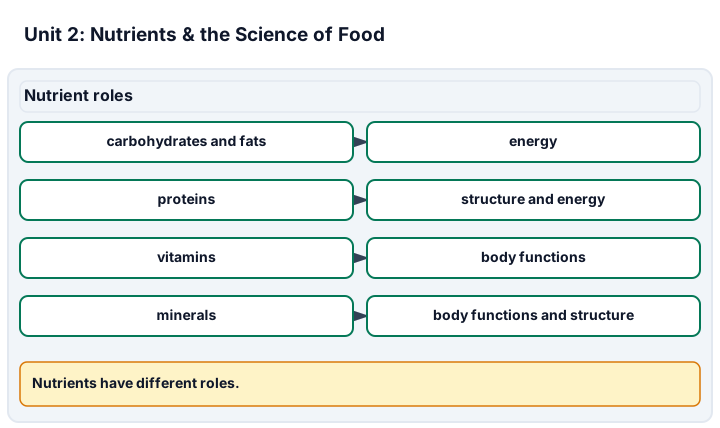
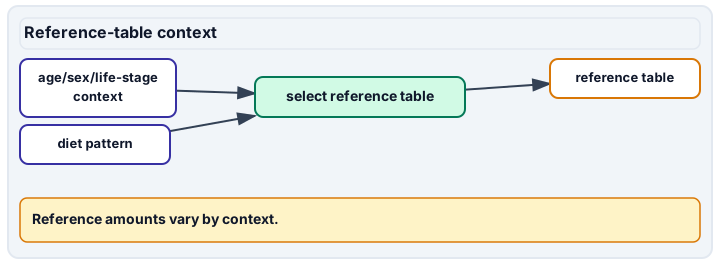
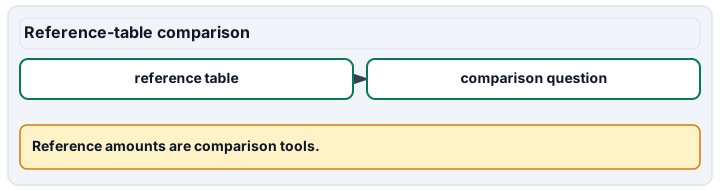
Diagram description
Macronutrients and micronutrients are mapped to roles: carbohydrates, fats and proteins to energy; proteins and minerals to structure; and vitamins and minerals to body functions. Age group, sex category and life stage are grouped as age/sex/life-stage context, and diet pattern also selects the reference table before a comparison question is asked.
Data, provenance, and assumptions
| Nutrient | Fictional intake | Reference amount | Unit |
|---|---|---|---|
| Calcium | 910 | 1300 | mg/day teen |
| Iron | 10 | 15 | mg/day teen girls example |
| Vitamin D | 9 | 15 | mcg/day teen |
Paper investigation sequence and evidence record
Scope and safety: Health and nutrition work uses fictional, synthetic, de-identified, or educator-supplied public records. It is not medical advice, does not diagnose, screen, treat, or prescribe, and never grades a learner body, disclosure, food choice, mood, sleep, fitness, weight, or medical status. Students’ own health, diet, sleep, fitness, or mood data are never collected or graded. Any tasting, cooking, allergen exposure, or food handling requires educator approval and an opt-out alternative.
Materials and preparation
- [adolescent-micronutrients] Use the supplied adolescent-micronutrient-day records, assigned source sections, calculator and an accessible graph or diagram. No physical apparatus is required.
Procedure and schedule
- [adolescent-micronutrients] Question: How do adolescent nutrient recommendations and variation change the interpretation of a supplied food record? Prerequisites: Can distinguish macronutrients, micronutrients, and units.
- [adolescent-micronutrients] Variables: Nutrient intake and reference amount are compared; age/sex/diet pattern is context, not student disclosure. Controls: Use the same fictional day and public source rows. Replication: Use a second fictional day for transfer rather than asking students for personal intake.
- [adolescent-micronutrients] Analysis: Calculate percent of reference amount and state why one record is limited. Review: An educator reviews prerequisites, source interpretation, reasoning and accessibility before assessment. A paper response does not certify unobserved practical technique; approved hands-on work requires a separate record.
Record: Retain adolescent-micronutrients, the selected level, original inputs and first attempt, source/date, system and axes, units, assumptions, calculation/graph, uncertainty, correction and fresh transfer. Link only to the stated science criteria.
Worked model
[adolescent-micronutrients] Compare fictional intake with the supplied teen reference values for calcium, iron, and vitamin D.
Numerical calibration
- 70 % of listed teen calcium amount
- 5 mg difference from listed iron example
- 60 % of listed teen vitamin D amount
Attempt the assigned level
Try the tasks before reading the calibration. These are practice answers, not a secure examination; use a new dataset or changed assumption for the assessed transfer.
Foundation: typically grades 7-8
- [adolescent-micronutrients] Sort the three listed nutrients into mineral or vitamin.
Check after your attempt
- [adolescent-micronutrients] Calcium and iron are minerals; vitamin D is a vitamin.
High-school core: typically grades 9-10
- [adolescent-micronutrients] Which listed nutrient has the largest percent shortfall in this fictional day?
Check after your attempt
- [adolescent-micronutrients] Vitamin D is 60% of the listed amount; calcium is 70%; iron is about 67%, so vitamin D is lowest by percent.
Honors extension: typically grades 11-12, with study-design reasoning
- [adolescent-micronutrients] Explain why the iron row cannot be generalized to every adolescent.
Check after your attempt
- [adolescent-micronutrients] NIH lists different iron amounts by age, sex, pregnancy status, and plant-based pattern; this row is a case example, not a universal target.
History, reading, and writing connection
Use NIH ODS iron, calcium, or vitamin D sections to show that needs vary by age, sex, pregnancy status, diet pattern, and absorption. Explain why a category like carbohydrate or fat is not inherently unhealthy, while dose, context, allergy, contamination, and medical needs still matter.
Write in your own words or use an approved accessible equivalent. Cite a specific assigned section or figure, identify its evidence, and state one limitation or counterargument. Use the AI practice contract only for permitted coaching, never to invent observations or write the assessed response.
Transfer to a new case
[adolescent-micronutrients] A second fictional day has 1040 mg calcium against a 1300 mg reference. What percent is that?
Calibration: [adolescent-micronutrients] 1040 / 1300 × 100 = 80%. It is a supplied-data comparison, not advice for an individual.
Evidence to retain
[adolescent-micronutrients] Completion evidence is a nutrient-variation explanation and a supplied-data comparison, not a prescription to eat, restrict, or supplement.
Record units, calculations, source/date, uncertainty, and what is measured versus inferred. A simulation or supplied dataset must stay labeled as such. Health and nutrition work uses fictional, synthetic, de-identified, or educator-supplied public records. It is not medical advice, does not diagnose, screen, treat, or prescribe, and never grades a learner body, disclosure, food choice, mood, sleep, fitness, weight, or medical status. Students’ own health, diet, sleep, fitness, or mood data are never collected or graded. Any tasting, cooking, allergen exposure, or food handling requires educator approval and an opt-out alternative.
Return to all eight learning pathways. Print this unit page for the student lessons; the linked five-page packet remains the separate assessment companion.
Evidence this unit can actually support
Integration is reported separately and cannot lower the science grade or block a science demonstration pass. Science and practical criteria determine that pass. Supplied-data paper work, source evaluation, and an educator-approved practical are distinct records. Never grade a student's body, private disclosure, medical status, mood, sleep, fitness, diet, or weight.
- Science 1: Naming macronutrients & micronutrients. The case identifies calcium, iron, and vitamin D as micronutrients and distinguishes them from macro categories without ranking foods or people.
- Science 2: What each nutrient does. The NIH-backed explanation connects calcium, iron, and vitamin D to body functions and adolescent growth contexts without prescribing supplements.
- Science 3: Reading nutrient content. The percent-of-reference and gap calculations read supplied nutrient amounts against stated public reference rows with units preserved.
- Science 4: Type and amount, not category. The response explains dose, context, adolescent variation, allergies, contamination, and medical needs as exceptions to simple category verdicts.
- Science 5: Anchor lab (nutrient evidence analysis). This supplied-record case supports nutrient-evidence analysis; any reagent test or food handling requires separate educator approval and evidence.
Case inventory, source, data, transfer, and limits. Keep the selected readiness level, original attempt, corrections, source/date, calculation, limitation, and transfer response. Public worked answers are practice, not secure assessor items.
Unit mastery rubric
| Criterion | Developing | Proficient | Mastery |
|---|---|---|---|
| Naming macronutrients & micronutrients | Cannot tell a macronutrient from a micronutrient or name examples of either. | Names carbohydrates, proteins, and fats but is unsure which nutrients count as micronutrients. | Names macro- and micronutrients and explains adolescent variation in needs using source-backed examples. |
| What each nutrient does | Thinks all food does the same one thing in the body. | Knows nutrients have jobs but cannot match a nutrient to its role. | Explains that food is both energy and building material — carbohydrates and fats fuel the body, proteins build and repair, and vitamins and minerals keep the systems running. |
| Reading nutrient content | Cannot find the nutrients listed on a food's nutrition information. | Locates nutrients on a label but misreads the serving size or the amounts. | Reads a nutrition label accurately — serving size, macronutrients, and key micronutrients — and describes what the food provides. |
| Type and amount, not category | Sorts foods into “good” and “bad” and calls carbs or fats inherently unhealthy. | Senses that category labels are too simple but still leans on them. | Reasons about type, amount, dose, context, allergy, contamination, and individual medical needs without assigning simple verdicts to foods or people. |
| Anchor lab (nutrient evidence analysis) | Skips the supplied nutrient record or records values with no evidence. | Reads one or two values but cannot say what each value supports about nutrients. | Uses supplied nutrient records or an educator-approved practical record to explain what the evidence can and cannot show about food composition. |
| Integration (cross-domain) | Makes no supported connection between the source and the science. | Uses the source but needs help connecting evidence, writing, or limitations to the science. | Independently connects History, Reading, and Writing using a cited source, appropriate evidence, a limitation, and a scientific explanation. |
Integration is reported separately and cannot lower the science grade or block a science demonstration pass. Science and practical criteria determine that pass. Use the integration guide's evidence checklist for the separately reported criterion.
“The fictional day gives 70% of the listed teen calcium amount, about 67% of one listed iron example, and 60% of vitamin D. That supports a variation discussion, not a prescription.”
“Carbs and fats are categories I can rank without context, and every teen needs the same plan.”
You demonstrate this unit by reading supplied nutrient records or an educator-approved practical record, then explaining what the evidence can and cannot show — not a multiple-choice test. A criterion counts as mastered only when you can reason about nutrients, dose, context, allergies, contamination, and medical boundaries without assigning a simple category verdict. Mastery is demonstrated, not awarded.
A 5-page clipboard packet — unit overview, key terms, the mastery rubric, anchor examples, and a score sheet you can print and grade against.