Unit 03 · Digestion, Metabolism & Energy Balance
Digestion and metabolism transform food energy; calories are units, not moral judgments. Use only fictional, synthetic, de-identified, or educator-supplied public records. Using supplied records instead of private data has no grade penalty or token charge. This is science literacy, not medical advice, personal diagnosis, or prescriptive dieting.
Student learning: Digestion, Metabolism & Energy
Choose the level by readiness, not age alone, and record it before instruction. Foundation, core, and honors tasks are study pathways, not an AP course or a promise of college credit. The instructor retains practical assessment and the published science rubric; integration is reported separately.
Prerequisites: [label-energy] Can multiply decimals and read a Nutrition Facts label.
Suggested sequence: read and discuss the explanation; attempt the worked model; analyze the data at your selected level; check the answers; then complete the source-linked response and a fresh transfer question. These activities supplement, not replace, supervised practical work and the full-year schedule.
Assigned reading and focus
- FDA: How to understand and use the Nutrition Facts Label. [label-energy] Use the serving-size section to scale label values by servings and skip the FDA weight-management guidance.
- FDA: Added sugars on the Nutrition Facts Label. [label-energy] Use the Daily Value explanation for added sugars without turning it into a personal diet target.
- FDA: How to understand and use the Nutrition Facts Label. Use serving-size and calorie sections to scale a label before interpreting a claim.
Learn the science
Grades 7-12; choose foundation, core, or honors/readiness by prerequisites and task complexity, not age alone.
[label-energy] Serving-size scaling and neutral energy arithmetic. A calorie is a unit of energy. Labels report values per serving, so the first scientific step is to identify the serving and scale the facts. The calculation is neutral evidence, not a command to change weight or eating.
[label-energy] Assumptions: The label is fictional but follows Nutrition Facts logic. It does not represent a complete day or personal recommendation.
[label-energy] Uncertainty: Labels round values; portion estimates vary; metabolism differs. These calculations describe the label record only.

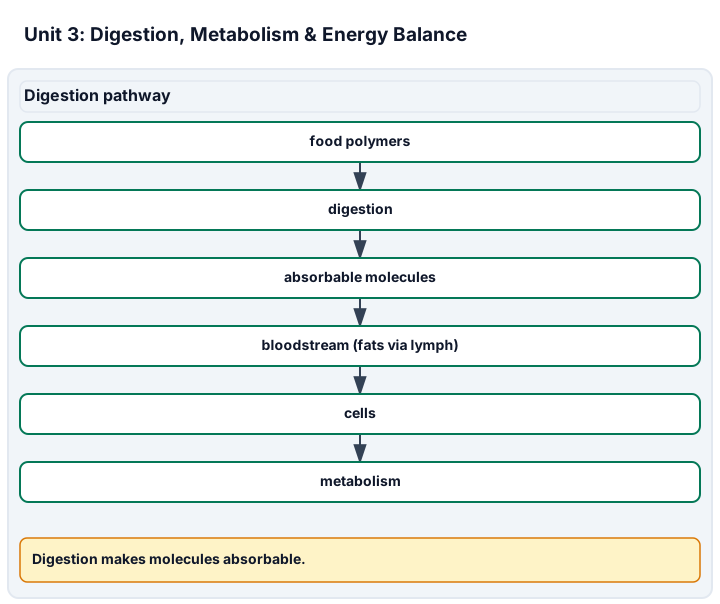
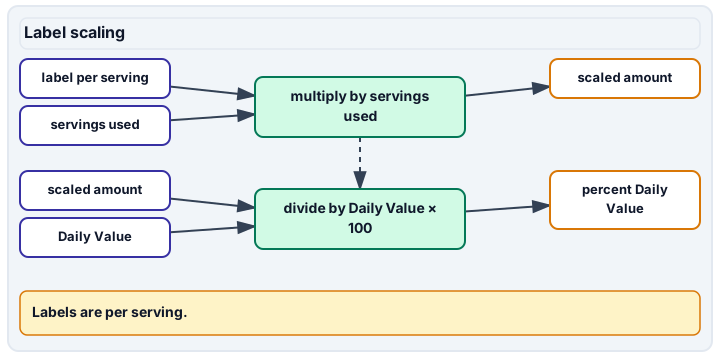
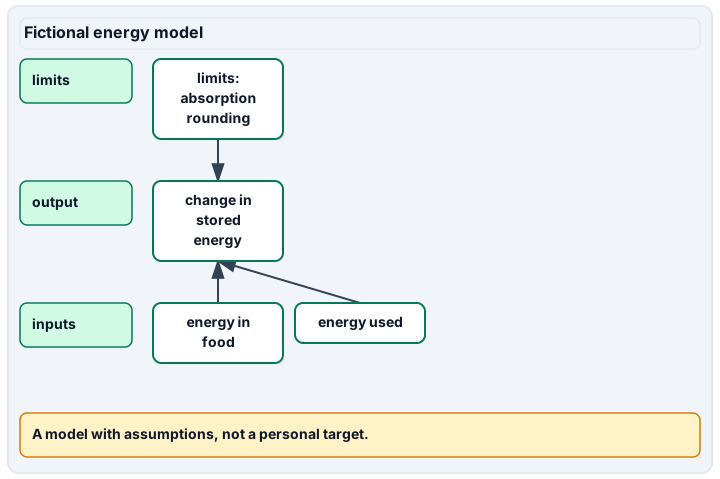
Diagram description
Food polymers are digested into absorbable molecules; those reach bloodstream, with fats via lymph first, then cells and metabolism. Label values are scaled by servings and compared to Daily Value by formula. The energy model uses fictional inputs only and ends at limits about absorption and rounding, not advice.
Data, provenance, and assumptions
| Quantity | Value | Unit / meaning |
|---|---|---|
| servings | 2 | servings used in example |
| calories | 230 | kcal per serving |
| addedSugar | 12 | g per serving |
| addedSugarDailyValue | 50 | g Daily Value |
Paper investigation sequence and evidence record
Scope and safety: Health and nutrition work uses fictional, synthetic, de-identified, or educator-supplied public records. It is not medical advice, does not diagnose, screen, treat, or prescribe, and never grades a learner body, disclosure, food choice, mood, sleep, fitness, weight, or medical status. Students’ own health, diet, sleep, fitness, or mood data are never collected or graded. Any tasting, cooking, allergen exposure, or food handling requires educator approval and an opt-out alternative.
Materials and preparation
- [label-energy] Use the supplied label-serving-record records, assigned source sections, calculator and an accessible graph or diagram. No physical apparatus is required.
Procedure and schedule
- [label-energy] Question: How does serving-size arithmetic change a health claim about a packaged food? Prerequisites: Can multiply decimals and read a Nutrition Facts label.
- [label-energy] Variables: Servings used, calories, added sugar grams, and Daily Value are the table variables. Controls: Use the same fictional label and do not substitute personal food records. Replication: Repeat with a changed fictional label.
- [label-energy] Analysis: Scale each label fact before interpreting a claim. Review: An educator reviews prerequisites, source interpretation, reasoning and accessibility before assessment. A paper response does not certify unobserved practical technique; approved hands-on work requires a separate record.
Record: Retain label-energy, the selected level, original inputs and first attempt, source/date, system and axes, units, assumptions, calculation/graph, uncertainty, correction and fresh transfer. Link only to the stated science criteria.
Worked model
[label-energy] Multiply the per-serving values by the number of servings and compare added sugars with the listed Daily Value.
Numerical calibration
- 460 kcal for two servings
- 24 g added sugar for two servings
- 48 % Daily Value for two servings
Attempt the assigned level
Try the tasks before reading the calibration. These are practice answers, not a secure examination; use a new dataset or changed assumption for the assessed transfer.
Foundation: typically grades 7-8
- [label-energy] If the label says 230 kcal per serving and the case uses two servings, compute the energy.
Check after your attempt
- [label-energy] 230 × 2 = 460 kcal. It is label arithmetic, not a recommended target.
High-school core: typically grades 9-10
- [label-energy] Compute added sugar grams and percent Daily Value for the two-serving case.
Check after your attempt
- [label-energy] 12 × 2 = 24 g. 24 / 50 × 100 = 48% Daily Value.
Honors extension: typically grades 11-12, with study-design reasoning
- [label-energy] Explain two reasons this label calculation is not an energy-balance diagnosis.
Check after your attempt
- [label-energy] It is one product, labels are rounded, and energy balance depends on many contextual factors not measured here.
History, reading, and writing connection
Use the FDA Nutrition Facts Label explanation to scale calories and added sugar by serving. Connect the arithmetic to digestion and metabolism while explicitly avoiding personal intake targets, body-change goals, or prescriptive plans.
Write in your own words or use an approved accessible equivalent. Cite a specific assigned section or figure, identify its evidence, and state one limitation or counterargument. Use the AI practice contract only for permitted coaching, never to invent observations or write the assessed response.
Transfer to a new case
[label-energy] A new label lists 180 kcal and 7 g added sugar per serving. A case uses 1.5 servings. What are the scaled values?
Calibration: [label-energy] 270 kcal and 10.5 g added sugar. The result describes the label case only.
Evidence to retain
[label-energy] Completion evidence is correctly scaled label arithmetic and a boundary statement against personal intake targets or dieting prescriptions.
Record units, calculations, source/date, uncertainty, and what is measured versus inferred. A simulation or supplied dataset must stay labeled as such. Health and nutrition work uses fictional, synthetic, de-identified, or educator-supplied public records. It is not medical advice, does not diagnose, screen, treat, or prescribe, and never grades a learner body, disclosure, food choice, mood, sleep, fitness, weight, or medical status. Students’ own health, diet, sleep, fitness, or mood data are never collected or graded. Any tasting, cooking, allergen exposure, or food handling requires educator approval and an opt-out alternative.
Return to all eight learning pathways. Print this unit page for the student lessons; the linked five-page packet remains the separate assessment companion.
Evidence this unit can actually support
Integration is reported separately and cannot lower the science grade or block a science demonstration pass. Science and practical criteria determine that pass. Supplied-data paper work, source evaluation, and an educator-approved practical are distinct records. Never grade a student's body, private disclosure, medical status, mood, sleep, fitness, diet, or weight.
- Science 3: The calorie as a unit of energy. The scaled kcal calculation shows calories as label energy units and explicitly avoids personal intake targets.
- Science 4: Energy balance as neutral science. The response states that a one-label calculation is a simplified model with assumptions, not a diet, diagnosis, or weight prescription.
- Science 5: Anchor lab (calorie & energy-balance calculation). The supplied label arithmetic supports the paper calculation part; any observed practical must be separately approved; learner-specific energy-balance calculations are not used.
Case inventory, source, data, transfer, and limits. Keep the selected readiness level, original attempt, corrections, source/date, calculation, limitation, and transfer response. Public worked answers are practice, not secure assessor items.
Unit mastery rubric
| Criterion | Developing | Proficient | Mastery |
|---|---|---|---|
| Tracing digestion | Cannot describe what happens to food after it’s eaten. | Names a digestive organ or two but cannot trace food through the system. | Traces food through the digestive system and explains where it is broken down into nutrients the body can absorb. |
| Metabolism & extracting energy | Thinks the body uses food without changing it. | Knows the body gets energy from food but cannot say how. | Explains metabolism as the process that breaks nutrients down and releases the energy stored in them for the body to use. |
| The calorie as a unit of energy | Calls calories “bad” or something to be avoided. | Knows a calorie measures energy but still treats it as harmful. | Uses calories as an energy unit and scales label values by serving without setting personal intake targets. |
| Energy balance as neutral science | Treats energy balance as a personal body-change rule. | Describes energy in versus energy out but frames it as personal advice. | Explains energy balance as a model with assumptions and context, never as a prescription for personal body changes. |
| Anchor lab (calorie & energy-balance calculation) | Cannot set up a calorie or energy-balance calculation. | Sets up the calculation but slips on the units or the arithmetic. | Completes a calorie and energy-balance calculation correctly and explains what the numbers describe about energy, using them as evidence rather than a verdict. |
| Integration (cross-domain) | Makes no supported connection between the source and the science. | Uses the source but needs help connecting evidence, writing, or limitations to the science. | Independently connects History, Reading, and Writing using a cited source, appropriate evidence, a limitation, and a scientific explanation. |
Integration is reported separately and cannot lower the science grade or block a science demonstration pass. Science and practical criteria determine that pass. Use the integration guide's evidence checklist for the separately reported criterion.
“Two servings of the fictional label give 460 kcal and 24 g added sugar, which is 48% of the listed Daily Value. This scales label evidence; it does not set a diet.”
“Two servings are a verdict because the calories are high.”
You demonstrate this unit through a label-energy calculation where you trace the energy in a supplied food record and explain what the numbers mean aloud — not a multiple-choice test. A criterion counts as mastered only when you can both do the calculation and explain energy balance as neutral science, never as personal advice. Mastery is demonstrated, not awarded.
A 5-page clipboard packet — unit overview, key terms, the mastery rubric, anchor examples, and a score sheet you can print and grade against.