Unit 04 · Building a Healthy Diet
Food planning uses labels, safety, allergies, context, and evidence rather than fads. Use only fictional, synthetic, de-identified, or educator-supplied public records. Using supplied records instead of private data has no grade penalty or token charge. This is science literacy, not medical advice, personal diagnosis, or prescriptive dieting.
Student learning: Building a Healthy Diet
Choose the level by readiness, not age alone, and record it before instruction. Foundation, core, and honors tasks are study pathways, not an AP course or a promise of college credit. The instructor retains practical assessment and the published science rubric; integration is reported separately.
Prerequisites: [food-safety-allergen] Can read a checklist and distinguish hazard, risk, and missing evidence.
Suggested sequence: read and discuss the explanation; attempt the worked model; analyze the data at your selected level; check the answers; then complete the source-linked response and a fresh transfer question. These activities supplement, not replace, supervised practical work and the full-year schedule.
Assigned reading and focus
- CDC: Preventing food poisoning. [food-safety-allergen] Use the CDC clean, separate, cook, chill steps and the 40 F refrigerator threshold.
- FDA: Food allergies. [food-safety-allergen] Use the FDA explanation of allergen cross-contact and undeclared allergen controls.
- CDC: Preventing food poisoning. Use CDC food-safety practices to evaluate a scenario record without handling food.
Learn the science
Grades 7-12; choose foundation, core, or honors/readiness by prerequisites and task complexity, not age alone.
[food-safety-allergen] Food-safety and allergen-control scenario audit. Food safety is evidence-based handling that reduces foodborne illness risk. Allergies and intolerances are not preferences; allergen cross-contact and undeclared allergens can make an otherwise ordinary food unsafe for some people.
[food-safety-allergen] Assumptions: This unit uses scenario and record analysis only. No tasting, cooking, allergen exposure, or food handling is required without educator approval.
[food-safety-allergen] Uncertainty: Scenario records may omit time, thermometer accuracy, ingredient labels, or cleaning evidence. Missing safety evidence is not the same as safety.

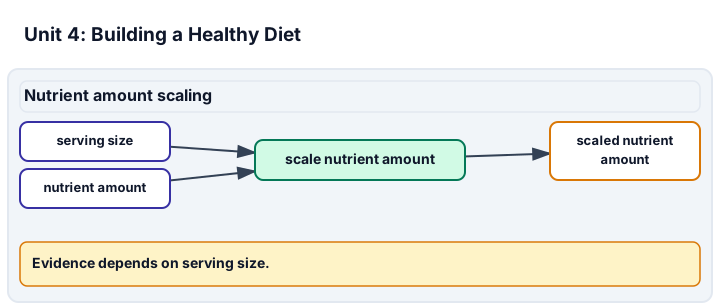
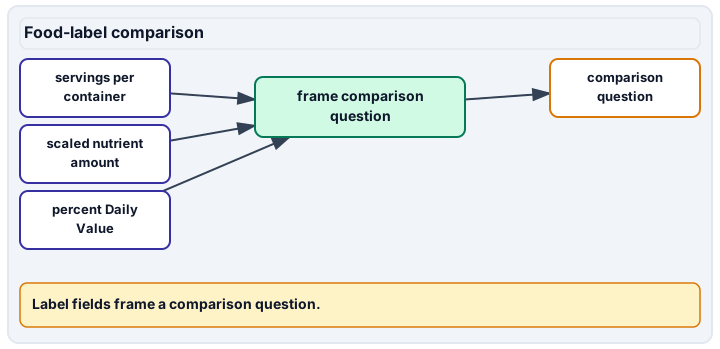
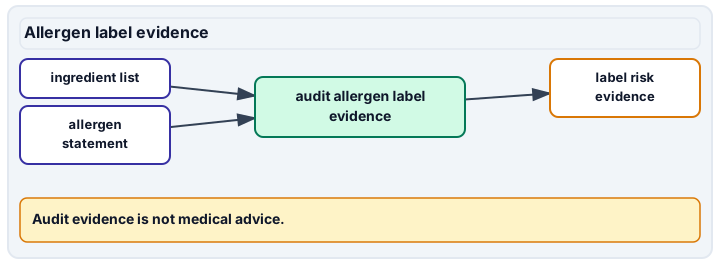
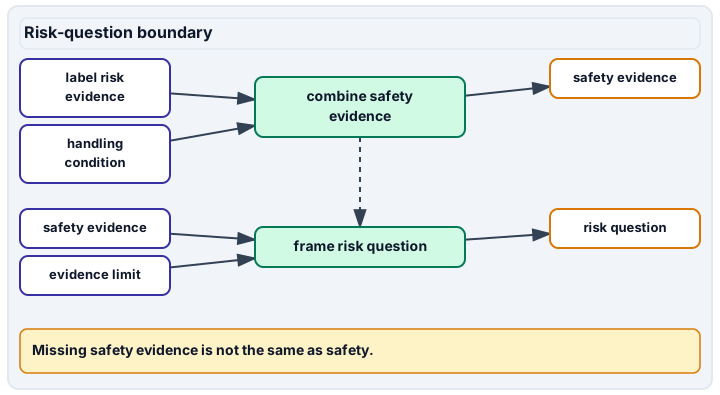
Diagram description
Food-label evidence includes serving size, servings per container, nutrient amount and percent Daily Value, all feeding a comparison question. The allergen and safety audit turns the ingredient list and allergen statement into label risk evidence, combines it with handling condition such as storage temperature or a shared scoop as safety evidence, then applies evidence limits to frame a risk question; missing safety evidence is not the same as safety.
Data, provenance, and assumptions
| Time | Temperature F | Action note |
|---|---|---|
| 8:00 | 38 | door closed |
| 10:00 | 43 | delivery unpacked slowly |
| 12:00 | 39 | door closed |
| 14:00 | 41 | leftovers labeled late |
| Step | Status | Risk note |
|---|---|---|
| ingredient label | missing | unknown allergen statement |
| shared scoop | used | cross-contact risk |
| container label | unclear | could be served to wrong group |
Paper investigation sequence and evidence record
Scope and safety: Health and nutrition work uses fictional, synthetic, de-identified, or educator-supplied public records. It is not medical advice, does not diagnose, screen, treat, or prescribe, and never grades a learner body, disclosure, food choice, mood, sleep, fitness, weight, or medical status. Students’ own health, diet, sleep, fitness, or mood data are never collected or graded. Any tasting, cooking, allergen exposure, or food handling requires educator approval and an opt-out alternative.
Materials and preparation
- [food-safety-allergen] Use the supplied food-safety-records, allergen-control-record records, assigned source sections, calculator and an accessible graph or diagram. No physical apparatus is required.
Procedure and schedule
- [food-safety-allergen] Question: How can a food-safety claim be evaluated without handling food or exposing anyone to allergens? Prerequisites: Can read a checklist and distinguish hazard, risk, and missing evidence.
- [food-safety-allergen] Variables: Temperature, label status, tool use, and container labeling are recorded variables. Controls: Use fictional records only; educator approval is required for any real food procedure. Replication: Audit a second scenario with changed records.
- [food-safety-allergen] Analysis: Identify risk-reduction steps and state what evidence is missing. Review: An educator reviews prerequisites, source interpretation, reasoning and accessibility before assessment. A paper response does not certify unobserved practical technique; approved hands-on work requires a separate record.
Record: Retain food-safety-allergen, the selected level, original inputs and first attempt, source/date, system and axes, units, assumptions, calculation/graph, uncertainty, correction and fresh transfer. Link only to the stated science criteria.
Worked model
[food-safety-allergen] Audit the fictional refrigerator-temperature and allergen-control notes for maximum temperature, minimum temperature, and preventable control failures.
Numerical calibration
- 43 F maximum recorded temperature
- 38 F minimum recorded temperature
- 3 control failures in transfer case
Attempt the assigned level
Try the tasks before reading the calibration. These are practice answers, not a secure examination; use a new dataset or changed assumption for the assessed transfer.
Foundation: typically grades 7-8
- [food-safety-allergen] Name two safety risks in the fictional records.
Check after your attempt
- [food-safety-allergen] The 43 F and 41 F readings are above the CDC 40 F refrigerator threshold; the shared scoop and missing allergen label are also risks.
High-school core: typically grades 9-10
- [food-safety-allergen] Explain why “no food is inherently unhealthy” has exceptions.
Check after your attempt
- [food-safety-allergen] Dose and context matter, but contamination, allergen cross-contact, and individual medical needs can make a food unsafe for a person or situation.
Honors extension: typically grades 11-12, with study-design reasoning
- [food-safety-allergen] Separate missing evidence from proven hazard in the allergen checklist.
Check after your attempt
- [food-safety-allergen] The missing label does not prove an allergen is present, but it prevents a safe decision; the shared scoop is a concrete cross-contact risk.
History, reading, and writing connection
Use CDC food-safety and FDA allergen-control information to audit a fictional food-handling record. State why safety, contamination, allergy, intolerance, and medical context are real exceptions to simple food-category slogans.
Write in your own words or use an approved accessible equivalent. Cite a specific assigned section or figure, identify its evidence, and state one limitation or counterargument. Use the AI practice contract only for permitted coaching, never to invent observations or write the assessed response.
Transfer to a new case
[food-safety-allergen] A changed scenario has missing ingredient label, reused cutting board, and unlabeled leftover container. How many control failures should be corrected before service?
Calibration: [food-safety-allergen] Three control failures. Correct labels, separate/clean tools, and identify leftovers before any serving decision.
Evidence to retain
[food-safety-allergen] Completion evidence is a written safety/allergen audit plus a practical paper task using supplied records. Observed food handling, if any, is separately approved.
Record units, calculations, source/date, uncertainty, and what is measured versus inferred. A simulation or supplied dataset must stay labeled as such. Health and nutrition work uses fictional, synthetic, de-identified, or educator-supplied public records. It is not medical advice, does not diagnose, screen, treat, or prescribe, and never grades a learner body, disclosure, food choice, mood, sleep, fitness, weight, or medical status. Students’ own health, diet, sleep, fitness, or mood data are never collected or graded. Any tasting, cooking, allergen exposure, or food handling requires educator approval and an opt-out alternative.
Return to all eight learning pathways. Print this unit page for the student lessons; the linked five-page packet remains the separate assessment companion.
Evidence this unit can actually support
Integration is reported separately and cannot lower the science grade or block a science demonstration pass. Science and practical criteria determine that pass. Supplied-data paper work, source evaluation, and an educator-approved practical are distinct records. Never grade a student's body, private disclosure, medical status, mood, sleep, fitness, diet, or weight.
- Science 2: Reading an ingredient list. The missing ingredient/allergen label is treated as missing safety evidence, not as proof that a food is safe or unsafe.
- Science 3: Evidence-based meal planning. The scenario shows that a defensible plan must include safety, allergen controls, contamination context, and opt-out-safe alternatives.
- Science 5: Anchor lab (food-safety/allergen audit & label analysis). The supplied food-safety/allergen records evidence paper analysis only; tasting, cooking, allergen exposure, or handling requires separate educator approval.
Case inventory, source, data, transfer, and limits. Keep the selected readiness level, original attempt, corrections, source/date, calculation, limitation, and transfer response. Public worked answers are practice, not secure assessor items.
Unit mastery rubric
| Criterion | Developing | Proficient | Mastery |
|---|---|---|---|
| Label literacy (serving size, % daily value, added sugar) | Reads a nutrition label as a single number and misses serving size entirely. | Finds the numbers on the label but cannot say what serving size or % daily value means. | Reads a nutrition label fluently — scaling by serving size, interpreting % daily value, and spotting added sugar. |
| Reading an ingredient list | Ignores the ingredient list or thinks a long list always means “bad.” | Reads the list but cannot use the order to judge what a food mostly is. | Reads an ingredient list critically, using the order-by-weight rule to tell what a food is mostly made of. |
| Evidence-based meal planning | Plans meals by copying a fad diet rather than any evidence. | Uses a plate model loosely but cannot justify the balance with evidence. | Plans from evidence, label facts, safety constraints, allergen controls, and context; does not prescribe a personal diet. |
| Debunking “detox” | Accepts that a “detox” cleanse rids the body of toxins. | Doubts detox claims but cannot explain what actually clears toxins. | Explains that the liver and kidneys already remove toxins, and shows why “detox” cleanses are a marketing myth. |
| Anchor lab (food-safety/allergen audit & label analysis) | Skips the supplied food-safety/allergen record or lists corrections without evidence. | Finds some control failures but cannot tie each correction to temperature, label, or cross-contact evidence. | Audits the supplied food-safety/allergen record and defends each correction with evidence; no tasting, cooking, allergen exposure, or food handling is assumed. |
| Integration (cross-domain) | Makes no supported connection between the source and the science. | Uses the source but needs help connecting evidence, writing, or limitations to the science. | Independently connects History, Reading, and Writing using a cited source, appropriate evidence, a limitation, and a scientific explanation. |
Integration is reported separately and cannot lower the science grade or block a science demonstration pass. Science and practical criteria determine that pass. Use the integration guide's evidence checklist for the separately reported criterion.
“The fictional log reaches 43 F and has an unlabeled ingredient plus shared scoop. I would correct the evidence gap and cross-contact risk before any service decision.”
“The food is ordinary, so allergies and temperature do not matter.”
You demonstrate this unit through the supplied food-safety/allergen audit and label analysis, defending each correction aloud — not a multiple-choice test. A criterion counts as mastered only when each correction is backed by temperature, label, or cross-contact evidence and you can justify the health science behind it. Mastery is demonstrated, not awarded.
A 5-page clipboard packet — unit overview, key terms, the mastery rubric, anchor examples, and a score sheet you can print and grade against.