Unit 05 · Physical Fitness & Exercise Science
Fitness science studies function and adaptation, not appearance. Use only fictional, synthetic, de-identified, or educator-supplied public records. Using supplied records instead of private data has no grade penalty or token charge. This is science literacy, not medical advice, personal diagnosis, or prescriptive dieting.
Student learning: Physical Fitness & Exercise Science
Choose the level by readiness, not age alone, and record it before instruction. Foundation, core, and honors tasks are study pathways, not an AP course or a promise of college credit. The instructor retains practical assessment and the published science rubric; integration is reported separately.
Prerequisites: [fitness-recovery] Can subtract and read a time series.
Suggested sequence: read and discuss the explanation; attempt the worked model; analyze the data at your selected level; check the answers; then complete the source-linked response and a fresh transfer question. These activities supplement, not replace, supervised practical work and the full-year schedule.
Assigned reading and focus
- CDC: Physical activity guidelines for children. [fitness-recovery] Use the moderate/vigorous activity definitions and breathing/heart-rate context to describe function without judging appearance.
- CDC: Physical activity guidelines for children. Use the moderate/vigorous activity definitions to interpret function without judging physique.
Learn the science
Grades 7-12; choose foundation, core, or honors/readiness by prerequisites and task complexity, not age alone.
[fitness-recovery] Fitness recovery as function evidence, not physique evidence. Fitness science studies function: endurance, strength, flexibility, recovery, and adaptation. A recovery curve can show how a fictional system returns toward baseline, but it cannot judge appearance, worth, or shape.
[fitness-recovery] Assumptions: The recovery record is synthetic. It is not a fitness test for any student and does not set exercise targets.
[fitness-recovery] Uncertainty: Recent sleep, hydration, illness, medication, stress, warm-up, sensor placement, and activity type can change recovery data.

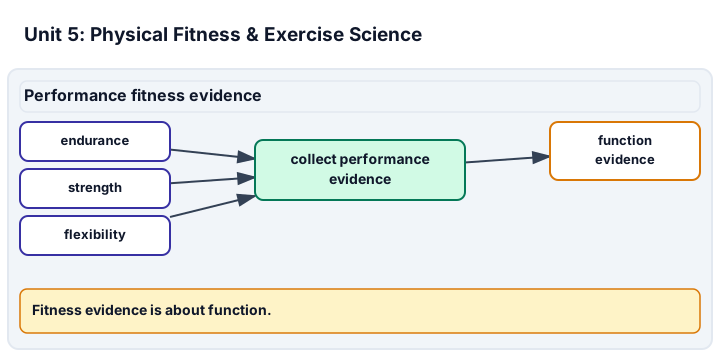
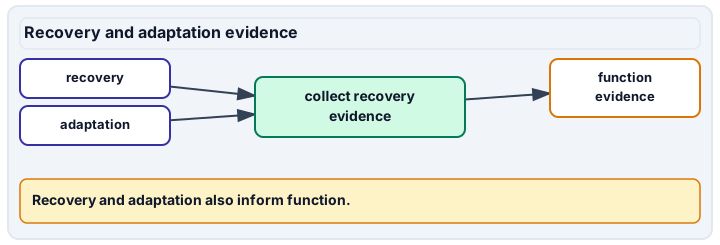
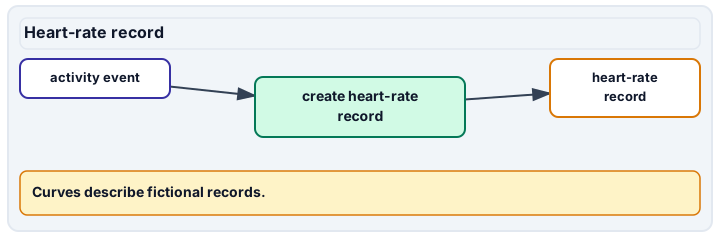
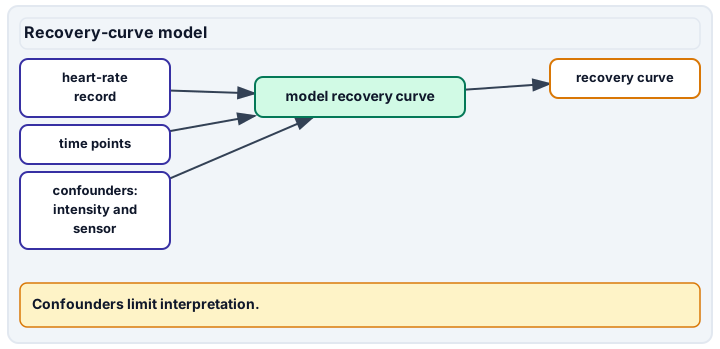
Diagram description
Endurance, strength and flexibility feed performance function evidence; recovery and adaptation also feed function evidence. A fictional activity event creates a heart-rate record over time points; those values produce a recovery curve, constrained by confounders such as intensity and sensor limits.
Data, provenance, and assumptions
| Minute after activity | Heart rate (beats/min) | Context |
|---|---|---|
| 0 | 142 | immediately after model activity |
| 1 | 126 | quiet standing |
| 2 | 112 | quiet standing |
| 3 | 102 | quiet standing |
| 4 | 96 | quiet standing |
Paper investigation sequence and evidence record
Scope and safety: Health and nutrition work uses fictional, synthetic, de-identified, or educator-supplied public records. It is not medical advice, does not diagnose, screen, treat, or prescribe, and never grades a learner body, disclosure, food choice, mood, sleep, fitness, weight, or medical status. Students’ own health, diet, sleep, fitness, or mood data are never collected or graded. Any tasting, cooking, allergen exposure, or food handling requires educator approval and an opt-out alternative.
Materials and preparation
- [fitness-recovery] Use the supplied fitness-recovery-record records, assigned source sections, calculator and an accessible graph or diagram. No physical apparatus is required.
Procedure and schedule
- [fitness-recovery] Question: What can a supplied recovery curve support, and what can it not judge? Prerequisites: Can subtract and read a time series.
- [fitness-recovery] Variables: Minute and heart rate are recorded; activity context is described but not personally performed. Controls: Use a supplied model curve, not student exercise records. Replication: Analyze a changed curve with the same method.
- [fitness-recovery] Analysis: Calculate change and identify confounders. Review: An educator reviews prerequisites, source interpretation, reasoning and accessibility before assessment. A paper response does not certify unobserved practical technique; approved hands-on work requires a separate record.
Record: Retain fitness-recovery, the selected level, original inputs and first attempt, source/date, system and axes, units, assumptions, calculation/graph, uncertainty, correction and fresh transfer. Link only to the stated science criteria.
Worked model
[fitness-recovery] Compute the drop from minute 0 to minute 4 and the average drop per minute.
Numerical calibration
- 46 beats/min total drop
- 11.5 beats/min per minute average
Attempt the assigned level
Try the tasks before reading the calibration. These are practice answers, not a secure examination; use a new dataset or changed assumption for the assessed transfer.
Foundation: typically grades 7-8
- [fitness-recovery] What happens to the synthetic heart rate over four minutes?
Check after your attempt
- [fitness-recovery] It decreases from 142 to 96 beats/min, moving toward recovery.
High-school core: typically grades 9-10
- [fitness-recovery] Calculate the total and average per-minute drop.
Check after your attempt
- [fitness-recovery] The total drop is 46 beats/min; over four intervals, the average drop is 11.5 beats/min per minute.
Honors extension: typically grades 11-12, with study-design reasoning
- [fitness-recovery] Name two confounders before comparing two recovery curves.
Check after your attempt
- [fitness-recovery] Starting intensity and sensor placement could differ; sleep, hydration, illness, or warm-up could also affect the curve.
History, reading, and writing connection
Use the CDC physical-activity definitions to describe functional intensity and recovery. Analyze supplied data only, and explain why appearance, body shape, and learner exercise records are outside this assessment.
Write in your own words or use an approved accessible equivalent. Cite a specific assigned section or figure, identify its evidence, and state one limitation or counterargument. Use the AI practice contract only for permitted coaching, never to invent observations or write the assessed response.
Transfer to a new case
[fitness-recovery] A changed curve drops from 150 to 108 over 4 minutes. What is the average drop per minute?
Calibration: [fitness-recovery] (150 - 108) / 4 = 10.5 beats/min per minute. It is a supplied curve, not a personal fitness grade.
Evidence to retain
[fitness-recovery] Completion evidence is interpretation of a supplied recovery curve and limits, with no personal fitness disclosure required.
Record units, calculations, source/date, uncertainty, and what is measured versus inferred. A simulation or supplied dataset must stay labeled as such. Health and nutrition work uses fictional, synthetic, de-identified, or educator-supplied public records. It is not medical advice, does not diagnose, screen, treat, or prescribe, and never grades a learner body, disclosure, food choice, mood, sleep, fitness, weight, or medical status. Students’ own health, diet, sleep, fitness, or mood data are never collected or graded. Any tasting, cooking, allergen exposure, or food handling requires educator approval and an opt-out alternative.
Return to all eight learning pathways. Print this unit page for the student lessons; the linked five-page packet remains the separate assessment companion.
Evidence this unit can actually support
Integration is reported separately and cannot lower the science grade or block a science demonstration pass. Science and practical criteria determine that pass. Supplied-data paper work, source evaluation, and an educator-approved practical are distinct records. Never grade a student's body, private disclosure, medical status, mood, sleep, fitness, diet, or weight.
- Science 1: Components of fitness. The case discusses functional recovery as one component-related record and does not use appearance, weight, or shape.
- Science 2: Heart rate & recovery. The total and average recovery-drop calculations directly evidence reading a synthetic heart-rate recovery curve.
- Science 3: How the body adapts to training. The response can name adaptation as a possible longer-term concept while stating that one supplied curve cannot prove training adaptation.
- Science 4: Measuring & interpreting fitness data. The interpretation identifies confounders such as starting intensity, sensor placement, sleep, hydration, illness, and warm-up before comparison.
- Science 5: Anchor lab (fitness data & recovery). Supplied recovery data evidence the analysis portion only; students’ own fitness or exercise records are never collected or graded.
Case inventory, source, data, transfer, and limits. Keep the selected readiness level, original attempt, corrections, source/date, calculation, limitation, and transfer response. Public worked answers are practice, not secure assessor items.
Unit mastery rubric
| Criterion | Developing | Proficient | Mastery |
|---|---|---|---|
| Components of fitness | Thinks fitness is a single thing rather than several distinct components. | Names one or two components but cannot distinguish what each one measures. | Distinguishes cardiovascular endurance, strength, and flexibility, and explains what each component measures. |
| Heart rate & recovery | Cannot interpret the supplied heart-rate record. | Reads values but cannot explain change or measurement conditions. | Interprets an approved recovery dataset or measurement model, including units, timing, and limits; does not diagnose fitness from one result. |
| How the body adapts to training | Believes the body stays the same no matter the activity. | Knows the body adapts but cannot describe how or why. | Explains how the body adapts to regular activity — a stronger heart, better endurance — and why change takes consistent time. |
| Measuring & interpreting fitness data | Treats a supplied fitness-function record as a body-size verdict. | Reads data but slips into appearance judgment. | Interprets supplied fitness-function data with confounders and limits; does not judge physique, weight, appearance, or shape. |
| Anchor lab (fitness data & recovery) | Records no evidence from the approved task. | Records values but cannot explain the recovery pattern. | Uses a supplied recovery curve or educator-approved alternative; learner exercise disclosure is never required. |
| Integration (cross-domain) | Makes no supported connection between the source and the science. | Uses the source but needs help connecting evidence, writing, or limitations to the science. | Independently connects History, Reading, and Writing using a cited source, appropriate evidence, a limitation, and a scientific explanation. |
Integration is reported separately and cannot lower the science grade or block a science demonstration pass. Science and practical criteria determine that pass. Use the integration guide's evidence checklist for the separately reported criterion.
Assigned alternative: interpret a fictional recovery record
No personal exercise, heart-rate measurement, fitness ranking, or medical disclosure is required. These synthetic values illustrate a time-series calculation, not a normal range, diagnosis, or recommended exercise target.
| Minutes after time zero | Heart rate (beats/minute) |
|---|---|
| 0 | 120 |
| 1 | 104 |
| 2 | 92 |
| 3 | 84 |
Task: graph the readings, calculate the total decrease and average signed rate over three minutes, and identify why this one record cannot diagnose fitness or be compared fairly with an unrelated protocol.
Submit the graph, calculations and a limitation. The supplied-record alternative has no grade penalty or token charge; it does not certify that a practical exercise or measurement was performed.
“The synthetic curve drops 46 beats/min over 4 minutes, or 11.5 beats/min per minute on average. That describes function in a model, not a person’s worth or physique.”
“The lower number proves this person is healthier.”
Analyze the approved recovery record or measurement model and explain the science and uncertainty. Use supplied or fictional data without a grade penalty or token charge. Any optional personal activity requires the instructor's safety review and consent; AI does not prescribe or approve it.
A 5-page clipboard packet — unit overview, key terms, the mastery rubric, anchor examples, and a score sheet you can print and grade against.