Unit 06 · Mental Health & Stress
Stress and sleep can be studied as non-clinical patterns with help-seeking boundaries. Use only fictional, synthetic, de-identified, or educator-supplied public records. Using supplied records instead of private data has no grade penalty or token charge. This is science literacy, not medical advice, personal diagnosis, or prescriptive dieting.
Student learning: Mental Health & Stress
Choose the level by readiness, not age alone, and record it before instruction. Foundation, core, and honors tasks are study pathways, not an AP course or a promise of college credit. The instructor retains practical assessment and the published science rubric; integration is reported separately.
Prerequisites: [sleep-stress-boundaries] Can average a small time series and explain association versus cause.
Suggested sequence: read and discuss the explanation; attempt the worked model; analyze the data at your selected level; check the answers; then complete the source-linked response and a fresh transfer question. These activities supplement, not replace, supervised practical work and the full-year schedule.
Assigned reading and focus
- CDC: About sleep. [sleep-stress-boundaries] Use the sections on sleep benefits, quality, and when to talk to a healthcare provider; keep classroom work non-diagnostic.
- CDC: About sleep. Use sleep benefits and quality sections while keeping classroom analysis non-diagnostic.
Learn the science
Grades 7-12; choose foundation, core, or honors/readiness by prerequisites and task complexity, not age alone.
[sleep-stress-boundaries] Sleep and stress pattern analysis with non-clinical boundaries. Stress and sleep can be discussed as physiology and habits without diagnosing anyone. A classroom analysis uses fictional or de-identified time series and points to trusted adults, school counselors, healthcare providers, or local emergency services when help is needed.
[sleep-stress-boundaries] Assumptions: The table is fictional. Students do not submit their sleep, mood, stress, medication, or mental-health data.
[sleep-stress-boundaries] Uncertainty: A five-day pattern is short and report-like. Association between hours and rating does not prove cause or diagnose a sleep disorder or mental-health condition.

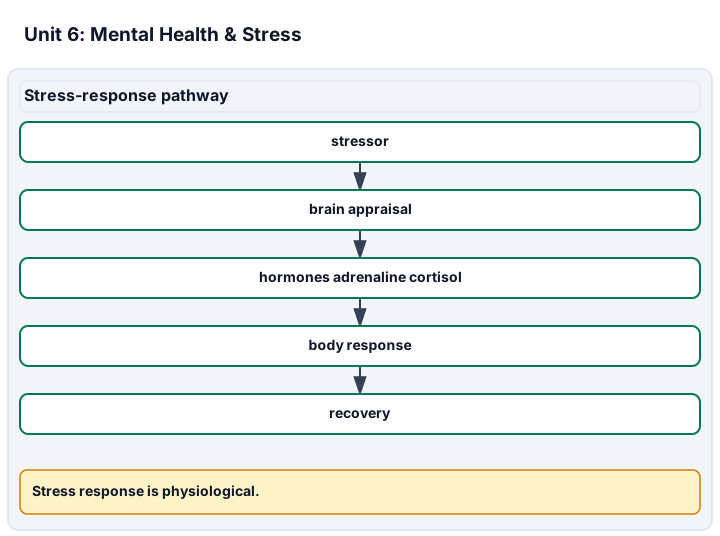
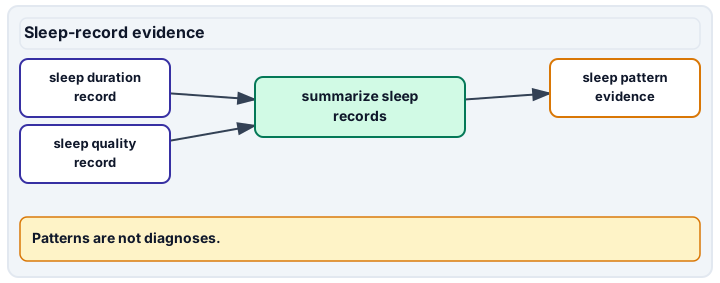
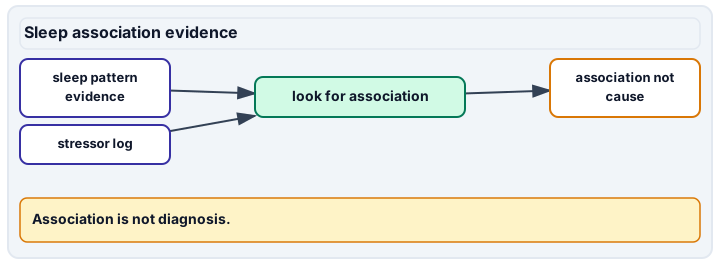
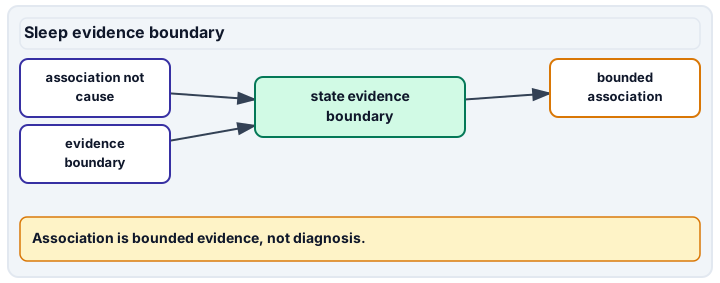
Diagram description
A stressor is appraised by the brain, hormone signals such as adrenaline and cortisol relate to body response, and recovery follows the response as demand ends. Sleep duration and sleep quality records form sleep pattern evidence; stressor logs feed an association-not-cause pattern, bounded by evidence limits.
Data, provenance, and assumptions
| Day | Sleep hours | Stress rating 1-5 | Context |
|---|---|---|---|
| Mon | 6.5 | 4 | project week |
| Tue | 7 | 3 | ordinary day |
| Wed | 6 | 4 | late screen use |
| Thu | 7.5 | 2 | routine day |
| Fri | 8 | 2 | routine day |
Paper investigation sequence and evidence record
Scope and safety: Health and nutrition work uses fictional, synthetic, de-identified, or educator-supplied public records. It is not medical advice, does not diagnose, screen, treat, or prescribe, and never grades a learner body, disclosure, food choice, mood, sleep, fitness, weight, or medical status. Students’ own health, diet, sleep, fitness, or mood data are never collected or graded. Any tasting, cooking, allergen exposure, or food handling requires educator approval and an opt-out alternative.
Materials and preparation
- [sleep-stress-boundaries] Use the supplied sleep-stress-fictional records, assigned source sections, calculator and an accessible graph or diagram. No physical apparatus is required.
Procedure and schedule
- [sleep-stress-boundaries] Question: How can sleep and stress data be interpreted without collecting private information or diagnosing? Prerequisites: Can average a small time series and explain association versus cause.
- [sleep-stress-boundaries] Variables: Fictional sleep hours and stress rating are variables; personal identity is absent. Controls: Use supplied fictional records and approved help-seeking language. Replication: Compare another de-identified or fictional summary.
- [sleep-stress-boundaries] Analysis: Calculate averages, describe association, and state non-clinical limits. Review: An educator reviews prerequisites, source interpretation, reasoning and accessibility before assessment. A paper response does not certify unobserved practical technique; approved hands-on work requires a separate record.
Record: Retain sleep-stress-boundaries, the selected level, original inputs and first attempt, source/date, system and axes, units, assumptions, calculation/graph, uncertainty, correction and fresh transfer. Link only to the stated science criteria.
Worked model
[sleep-stress-boundaries] Compute average hours and average stress rating, then state the boundary: the pattern is a prompt for questions, not a diagnosis.
Numerical calibration
- 7 hours average
- 3 rating average
- 1.6 hours difference in changed case
Attempt the assigned level
Try the tasks before reading the calibration. These are practice answers, not a secure examination; use a new dataset or changed assumption for the assessed transfer.
Foundation: typically grades 7-8
- [sleep-stress-boundaries] What is the average sleep in the fictional record?
Check after your attempt
- [sleep-stress-boundaries] The average is 7.0 hours. It does not describe a real student.
High-school core: typically grades 9-10
- [sleep-stress-boundaries] What relationship might you notice, and what can you not conclude?
Check after your attempt
- [sleep-stress-boundaries] Lower sleep days have higher stress ratings in this fictional record, but the association does not prove cause or diagnose anyone.
Honors extension: typically grades 11-12, with study-design reasoning
- [sleep-stress-boundaries] Design a better nonprivate study question.
Check after your attempt
- [sleep-stress-boundaries] Use de-identified class-sized fictional records, define sleep quality and stress rating before analysis, and avoid names or clinical labels.
History, reading, and writing connection
Use the CDC sleep page to interpret fictional sleep/stress data. Keep the work non-clinical: no diagnosis, no private records, no grading of mood, and appropriate help-seeking through trusted adults, school counselors, healthcare providers, or local emergency services.
Write in your own words or use an approved accessible equivalent. Cite a specific assigned section or figure, identify its evidence, and state one limitation or counterargument. Use the AI practice contract only for permitted coaching, never to invent observations or write the assessed response.
Transfer to a new case
[sleep-stress-boundaries] A de-identified summary reports 8.1 hours on routine days and 6.5 on project days. What is the difference?
Calibration: [sleep-stress-boundaries] 1.6 hours. The comparison suggests a question; it is not a diagnosis or proof of cause.
Evidence to retain
[sleep-stress-boundaries] Completion evidence is non-clinical interpretation of fictional data, clear opt-out boundaries, and appropriate help-seeking language.
Record units, calculations, source/date, uncertainty, and what is measured versus inferred. A simulation or supplied dataset must stay labeled as such. Health and nutrition work uses fictional, synthetic, de-identified, or educator-supplied public records. It is not medical advice, does not diagnose, screen, treat, or prescribe, and never grades a learner body, disclosure, food choice, mood, sleep, fitness, weight, or medical status. Students’ own health, diet, sleep, fitness, or mood data are never collected or graded. Any tasting, cooking, allergen exposure, or food handling requires educator approval and an opt-out alternative.
Return to all eight learning pathways. Print this unit page for the student lessons; the linked five-page packet remains the separate assessment companion.
Evidence this unit can actually support
Integration is reported separately and cannot lower the science grade or block a science demonstration pass. Science and practical criteria determine that pass. Supplied-data paper work, source evaluation, and an educator-approved practical are distinct records. Never grade a student's body, private disclosure, medical status, mood, sleep, fitness, diet, or weight.
- Science 1: Understanding the stress response. The response frames stress as a body response to demand and avoids diagnostic labels or personal disclosure.
- Science 2: The role of sleep. The CDC-backed explanation uses sleep quantity/quality concepts while keeping the fictional time series non-clinical.
- Science 3: Healthy coping & seeking help. The work points to trusted adults, school counselors, healthcare providers, or local emergency services without inventing hotline numbers.
- Science 4: Interpreting sleep & stress data. The average sleep/stress calculations support an association-and-limits interpretation, not diagnosis or causation.
- Science 5: Anchor lab (stress & sleep data investigation). The fictional record evidences supplied-data analysis only; personal sleep, mood, stress, medication, or health logs are not required for grading.
Case inventory, source, data, transfer, and limits. Keep the selected readiness level, original attempt, corrections, source/date, calculation, limitation, and transfer response. Public worked answers are practice, not secure assessor items.
Unit mastery rubric
| Criterion | Developing | Proficient | Mastery |
|---|---|---|---|
| Understanding the stress response | Cannot describe what happens in the body during stress, or treats stress as simply a personal weakness. | Names the stress response but cannot explain the biology behind it. | Explains the stress response as a normal biological reaction — the body releasing hormones like adrenaline and cortisol to meet a demand — neutrally, without judgment. |
| The role of sleep | Thinks sleep is wasted time and cannot say why the body needs it. | Knows sleep matters but cannot connect it to how the body and mind recover. | Explains why sleep is essential — how it lets the body and brain rest, recover, and help regulate mood and stress. |
| Healthy coping & seeking help | Cannot name a healthy way to cope, or does not know who to turn to when things feel like too much. | Lists a coping strategy or two but is unsure when or how to ask for help. | Describes healthy coping strategies and explains when and how to reach a trusted adult, school counselor, healthcare provider, or local emergency services, using non-clinical language. |
| Interpreting sleep & stress data | Cannot identify a pattern in the supplied record. | Identifies a pattern but overstates its meaning. | Interprets fictional or de-identified sleep/stress records, separating association from cause and avoiding diagnosis. |
| Anchor lab (stress & sleep data investigation) | Records no evidence from the approved task. | Records values but cannot explain the analysis. | Documents and analyzes the approved dataset honestly; a fictional or de-identified record fully satisfies the task without personal disclosure. |
| Integration (cross-domain) | Makes no supported connection between the source and the science. | Uses the source but needs help connecting evidence, writing, or limitations to the science. | Independently connects History, Reading, and Writing using a cited source, appropriate evidence, a limitation, and a scientific explanation. |
Integration is reported separately and cannot lower the science grade or block a science demonstration pass. Science and practical criteria determine that pass. Use the integration guide's evidence checklist for the separately reported criterion.
Assigned alternative: a fictional time series
This synthetic record fully supports the data-analysis task without sharing personal sleep, feelings, symptoms, or health information. It describes one fictional person over six days, not six independent participants. The demand categories are supplied context, not a clinical stress scale.
| Day | Sleep duration (hours) | Reported demand |
|---|---|---|
| 1 | 6 | High |
| 2 | 7 | Moderate |
| 3 | 8 | Low |
| 4 | 6.5 | High |
| 5 | 7.5 | Moderate |
| 6 | 8 | Low |
Task: graph duration over time, calculate the overall mean, and compare the high-demand and low-demand days. Write one supported pattern and two reasons it does not establish a causal direction or diagnosis. Missing values would be marked missing, not invented.
Submit your analysis and limitations using the unit's approved science reference. Using the supplied record has no grade penalty or token charge. Ask a trusted adult or qualified professional about real concerns; this exercise does not evaluate the learner's mental health.
“The fictional record averages 7.0 sleep hours and stress rating 3.0. Lower-sleep days also show higher stress ratings here, but that is association, not diagnosis or proof of cause.”
“Two high-demand days prove what is happening to the student.”
Explain the science using an approved fictional or de-identified dataset and supportive follow-up questions. Students' own sleep, stress, mood, or health records are never collected or graded; using the supplied record has no grade penalty or token charge. Assess scientific understanding, not feelings, symptoms, composure, or willingness to share private experiences.
A 5-page clipboard packet — unit overview, key terms, the mastery rubric, anchor examples, and a score sheet you can print and grade against.