Unit 07 · Disease, Immunity & Prevention
Immunity, spread, and prevention claims need mechanisms, denominators, and limits. Use only fictional, synthetic, de-identified, or educator-supplied public records. Using supplied records instead of private data has no grade penalty or token charge. This is science literacy, not medical advice, personal diagnosis, or prescriptive dieting.
Student learning: Disease, Immunity & Prevention
Choose the level by readiness, not age alone, and record it before instruction. Foundation, core, and honors tasks are study pathways, not an AP course or a promise of college credit. The instructor retains practical assessment and the published science rubric; integration is reported separately.
Prerequisites: [immunity-prevention] Can compute percentages and define immunity terms.
Suggested sequence: read and discuss the explanation; attempt the worked model; analyze the data at your selected level; check the answers; then complete the source-linked response and a fresh transfer question. These activities supplement, not replace, supervised practical work and the full-year schedule.
Assigned reading and focus
- CDC: Types of immunity. [immunity-prevention] Use active and passive immunity definitions and antibody specificity.
- CDC: About flu. [immunity-prevention] Use the transmission and contagiousness sections to connect prevention to spread patterns.
- CDC: Types of immunity. Use active/passive immunity definitions and antibody specificity for mechanism claims.
Learn the science
Grades 7-12; choose foundation, core, or honors/readiness by prerequisites and task complexity, not age alone.
[immunity-prevention] Immunity and prevention with denominators. The immune system includes defenses and memory. Disease spread depends on exposure, timing, susceptibility, and prevention; rates require denominators.
[immunity-prevention] Assumptions: The classroom model is synthetic and simplified. It is not outbreak surveillance and does not identify anyone.
[immunity-prevention] Uncertainty: Small groups, exposure differences, testing definitions, and unmeasured behavior can change apparent attack rates.

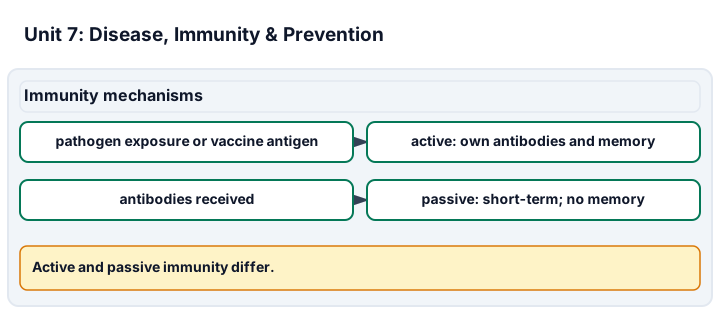
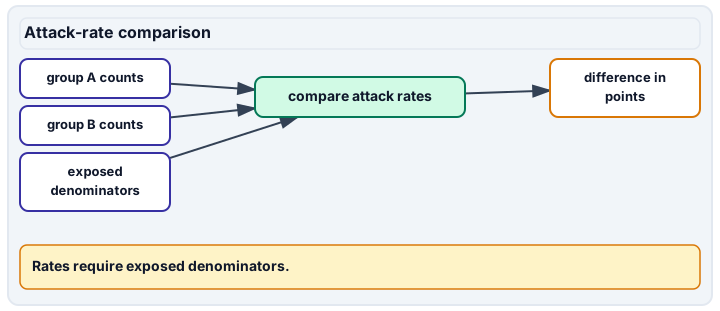
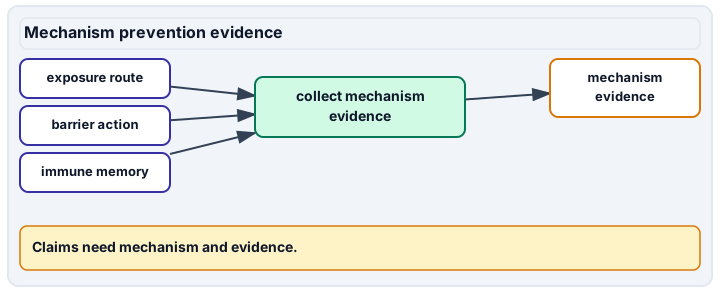
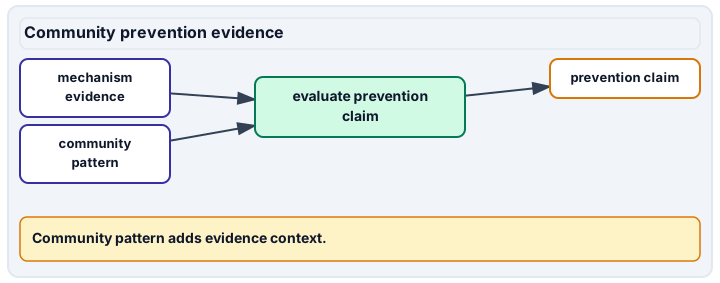
Diagram description
Pathogen exposure or a vaccine antigen leads to active immunity, in which the body makes its own antibodies and immune memory after innate defenses and antigen recognition; received antibodies give passive, short-term protection without memory. Attack rates require cases and exposed denominators for each group before an absolute difference. Prevention claims are evaluated from exposure route, barrier action, immune memory and community pattern only.
Data, provenance, and assumptions
| Group | Exposed count | Became sick in model | Prevention note |
|---|---|---|---|
| A | 24 | 9 | crowded, no stay-home rule |
| B | 24 | 4 | ventilation and stay-home rule |
Paper investigation sequence and evidence record
Scope and safety: Health and nutrition work uses fictional, synthetic, de-identified, or educator-supplied public records. It is not medical advice, does not diagnose, screen, treat, or prescribe, and never grades a learner body, disclosure, food choice, mood, sleep, fitness, weight, or medical status. Students’ own health, diet, sleep, fitness, or mood data are never collected or graded. Any tasting, cooking, allergen exposure, or food handling requires educator approval and an opt-out alternative.
Materials and preparation
- [immunity-prevention] Use the supplied immunity-classroom-model records, assigned source sections, calculator and an accessible graph or diagram. No physical apparatus is required.
Procedure and schedule
- [immunity-prevention] Question: How do immunity concepts and denominators change a prevention claim? Prerequisites: Can compute percentages and define immunity terms.
- [immunity-prevention] Variables: Exposed count, model cases, and prevention note are variables. Controls: Use synthetic model groups with equal denominators. Replication: Use a changed denominator and case count.
- [immunity-prevention] Analysis: Calculate attack rates and compare absolute differences. Review: An educator reviews prerequisites, source interpretation, reasoning and accessibility before assessment. A paper response does not certify unobserved practical technique; approved hands-on work requires a separate record.
Record: Retain immunity-prevention, the selected level, original inputs and first attempt, source/date, system and axes, units, assumptions, calculation/graph, uncertainty, correction and fresh transfer. Link only to the stated science criteria.
Worked model
[immunity-prevention] Compute attack rates for two groups and their absolute difference.
Numerical calibration
- 37.5 % attack rate group A
- 16.7 % attack rate group B
- 20.8 percentage-point difference
Attempt the assigned level
Try the tasks before reading the calibration. These are practice answers, not a secure examination; use a new dataset or changed assumption for the assessed transfer.
Foundation: typically grades 7-8
- [immunity-prevention] What is an antibody according to the source?
Check after your attempt
- [immunity-prevention] It is a disease-specific protein the body produces to neutralize or destroy toxins or disease-carrying organisms.
High-school core: typically grades 9-10
- [immunity-prevention] Compute the two model attack rates.
Check after your attempt
- [immunity-prevention] Group A: 9/24 = 37.5%. Group B: 4/24 = 16.7%.
Honors extension: typically grades 11-12, with study-design reasoning
- [immunity-prevention] Why is the absolute difference more honest than a slogan?
Check after your attempt
- [immunity-prevention] It gives the denominator-based percentage-point change and still leaves room for confounders and model limits.
History, reading, and writing connection
Use CDC immunity and flu information to connect immune memory, transmission, and prevention. Explain denominators and avoid treating one model as proof for all real-world settings.
Write in your own words or use an approved accessible equivalent. Cite a specific assigned section or figure, identify its evidence, and state one limitation or counterargument. Use the AI practice contract only for permitted coaching, never to invent observations or write the assessed response.
Transfer to a new case
[immunity-prevention] A changed model has 6 cases out of 30 and 3 cases out of 30. What is the absolute difference?
Calibration: [immunity-prevention] 20% minus 10% = 10 percentage points. The model supports comparison, not certainty about real people.
Evidence to retain
[immunity-prevention] Completion evidence is a denominator-based prevention explanation and a limit statement, not a medical recommendation.
Record units, calculations, source/date, uncertainty, and what is measured versus inferred. A simulation or supplied dataset must stay labeled as such. Health and nutrition work uses fictional, synthetic, de-identified, or educator-supplied public records. It is not medical advice, does not diagnose, screen, treat, or prescribe, and never grades a learner body, disclosure, food choice, mood, sleep, fitness, weight, or medical status. Students’ own health, diet, sleep, fitness, or mood data are never collected or graded. Any tasting, cooking, allergen exposure, or food handling requires educator approval and an opt-out alternative.
Return to all eight learning pathways. Print this unit page for the student lessons; the linked five-page packet remains the separate assessment companion.
Evidence this unit can actually support
Integration is reported separately and cannot lower the science grade or block a science demonstration pass. Science and practical criteria determine that pass. Supplied-data paper work, source evaluation, and an educator-approved practical are distinct records. Never grade a student's body, private disclosure, medical status, mood, sleep, fitness, diet, or weight.
- Science 1: How the immune system defends the body. The source-backed explanation defines antibodies and active/passive immunity with specificity rather than broad immune slogans.
- Science 2: How diseases spread. The synthetic model uses exposed counts and cases to describe spread patterns with denominators.
- Science 3: Evidence-based prevention. The attack-rate comparison supports a prevention discussion with absolute differences and stated model limits.
- Science 4: Modeling disease transmission. The equal-denominator model can evidence rate calculations and confounder discussion, not real outbreak surveillance.
- Science 5: Anchor lab (immunity & disease-transmission modeling). The supplied model evidences paper modeling only; any live simulation or prevention demonstration needs separate educator approval.
Case inventory, source, data, transfer, and limits. Keep the selected readiness level, original attempt, corrections, source/date, calculation, limitation, and transfer response. Public worked answers are practice, not secure assessor items.
Unit mastery rubric
| Criterion | Developing | Proficient | Mastery |
|---|---|---|---|
| How the immune system defends the body | Cannot say how the body protects itself from germs. | Names a defense or two but cannot explain how they work together. | Explains how the immune system defends the body — barriers like skin, white blood cells that fight invaders, and the memory that follows an infection or a vaccine. |
| How diseases spread | Cannot describe how an illness passes from one person to another. | Names a way disease spreads but cannot connect it to prevention. | Explains the main ways diseases spread — contact, droplets, contaminated food or water — and links each route to how it can be interrupted. |
| Evidence-based prevention | Cannot name an evidence-based way to prevent disease. | Lists a prevention step but cannot explain the evidence behind it. | Uses evidence-based prevention mechanisms with denominators and stated limits, avoiding overclaiming from a model. |
| Modeling disease transmission | Cannot show or predict how an illness moves through a group. | Runs a transmission model but cannot interpret what it shows. | Models spread with rates, controls, and confounders; separates nutritional deficiency, infection, and immune memory. |
| Anchor lab (immunity & disease-transmission modeling) | Skips the modeling activity or runs it without recording results. | Completes the model but cannot explain the pattern in the data. | Completes the immunity & disease-transmission model, records the data carefully, and explains how prevention measures change how far and fast the disease spreads. |
| Integration (cross-domain) | Makes no supported connection between the source and the science. | Uses the source but needs help connecting evidence, writing, or limitations to the science. | Independently connects History, Reading, and Writing using a cited source, appropriate evidence, a limitation, and a scientific explanation. |
Integration is reported separately and cannot lower the science grade or block a science demonstration pass. Science and practical criteria determine that pass. Use the integration guide's evidence checklist for the separately reported criterion.
“The synthetic model has 37.5% in group A and 16.7% in group B, an absolute difference of about 20.8 percentage points. That supports a prevention comparison with limits.”
“The prevention rule proves nobody will get sick.”
You demonstrate this unit by modeling how a disease spreads through a population and defending your prevention reasoning aloud — not a multiple-choice test. A criterion counts as mastered only when you can run the model with the supplied synthetic data and justify the science behind each prevention step. Prevention here is presented as evidence, never as personal medical advice. Mastery is demonstrated, not awarded.
A 5-page clipboard packet — unit overview, key terms, the mastery rubric, anchor examples, and a score sheet you can print and grade against.