Unit 08 · Health Decisions, Media & Consumer Science
Health claims need source evaluation, study design, denominators, and risk interpretation. Use only fictional, synthetic, de-identified, or educator-supplied public records. Using supplied records instead of private data has no grade penalty or token charge. This is science literacy, not medical advice, personal diagnosis, or prescriptive dieting.
Student learning: Health Decisions & Media
Choose the level by readiness, not age alone, and record it before instruction. Foundation, core, and honors tasks are study pathways, not an AP course or a promise of college credit. The instructor retains practical assessment and the published science rubric; integration is reported separately.
Prerequisites: [claim-quality] Can compute percentage risk and distinguish correlation from causation.
Suggested sequence: read and discuss the explanation; attempt the worked model; analyze the data at your selected level; check the answers; then complete the source-linked response and a fresh transfer question. These activities supplement, not replace, supervised practical work and the full-year schedule.
Assigned reading and focus
- MedlinePlus: Evaluating health information. [claim-quality] Use the questions about who runs a site, purpose, funding, review, sources, dates, and privacy.
- NIH NCCIH: Know the Science. [claim-quality] Use the warning about anecdotes and excessive claims as a lens for health media.
- MedlinePlus: Evaluating health information. Use the evaluation questions about source, purpose, funding, review, evidence, date, and privacy.
Learn the science
Grades 7-12; choose foundation, core, or honors/readiness by prerequisites and task complexity, not age alone.
[claim-quality] Health-claim evidence quality and risk interpretation. A health claim needs a source, denominator, comparison group, and design limits. Relative risk can sound large when the absolute risk is small, and correlation alone does not establish cause.
[claim-quality] Assumptions: The record is synthetic. It is designed for risk arithmetic and study-quality critique, not consumer advice.
[claim-quality] Uncertainty: A small or biased study, weak outcome definition, confounding, missing funding information, or short follow-up can lower evidence quality.

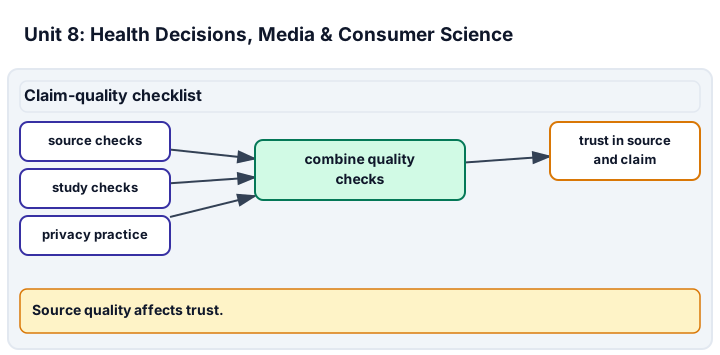
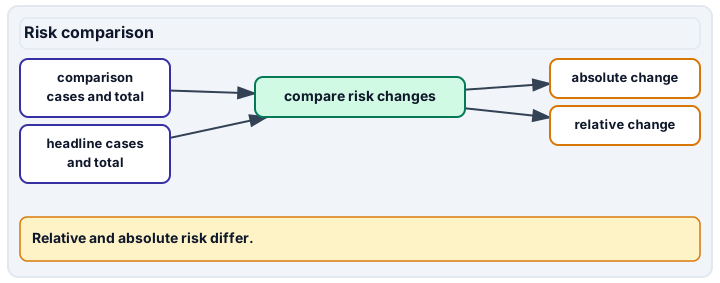
Diagram description
Claim quality is evaluated from source, author credentials, funding, date, cited study, study design and privacy practice before trust in source and claim is inferred; the diagram groups those as source checks, study checks and privacy practice. Risk comparison computes each group's risk from cases and totals, then computes absolute and relative change using the comparison group as the reference.
Data, provenance, and assumptions
| Group | Total participants | Outcome cases | Design note |
|---|---|---|---|
| comparison | 1000 | 20 | observational group |
| headline | 1000 | 10 | observational group |
Paper investigation sequence and evidence record
Scope and safety: Health and nutrition work uses fictional, synthetic, de-identified, or educator-supplied public records. It is not medical advice, does not diagnose, screen, treat, or prescribe, and never grades a learner body, disclosure, food choice, mood, sleep, fitness, weight, or medical status. Students’ own health, diet, sleep, fitness, or mood data are never collected or graded. Any tasting, cooking, allergen exposure, or food handling requires educator approval and an opt-out alternative.
Materials and preparation
- [claim-quality] Use the supplied claim-risk-record records, assigned source sections, calculator and an accessible graph or diagram. No physical apparatus is required.
Procedure and schedule
- [claim-quality] Question: What evidence quality checks should come before accepting a health claim? Prerequisites: Can compute percentage risk and distinguish correlation from causation.
- [claim-quality] Variables: Total participants, outcome cases, comparison group, source purpose, and design note. Controls: Use the same synthetic risk table and source-evaluation checklist. Replication: Evaluate a changed synthetic risk table and a new source note.
- [claim-quality] Analysis: Compute absolute risk, relative change, and evidence-quality limits. Review: An educator reviews prerequisites, source interpretation, reasoning and accessibility before assessment. A paper response does not certify unobserved practical technique; approved hands-on work requires a separate record.
Record: Retain claim-quality, the selected level, original inputs and first attempt, source/date, system and axes, units, assumptions, calculation/graph, uncertainty, correction and fresh transfer. Link only to the stated science criteria.
Worked model
[claim-quality] Compute risks in each group, then compare absolute and relative risk reduction.
Numerical calibration
- 2 % comparison risk
- 1 % headline-group risk
- 50 % relative risk reduction
Attempt the assigned level
Try the tasks before reading the calibration. These are practice answers, not a secure examination; use a new dataset or changed assumption for the assessed transfer.
Foundation: typically grades 7-8
- [claim-quality] Ask two questions before trusting a health website.
Check after your attempt
- [claim-quality] Who runs it? What is its purpose? You can also ask about funding, review process, sources, dates, and privacy.
High-school core: typically grades 9-10
- [claim-quality] Compute the two absolute risks.
Check after your attempt
- [claim-quality] Comparison risk is 2%; headline-group risk is 1%. The absolute difference is 1 percentage point.
Honors extension: typically grades 11-12, with study-design reasoning
- [claim-quality] Explain how a “50% lower risk” headline can still need caution.
Check after your attempt
- [claim-quality] The relative reduction is 50%, but the absolute difference is 1 percentage point and the design is observational with possible confounding.
History, reading, and writing connection
Use MedlinePlus and NIH NCCIH guidance to evaluate a health claim. Calculate absolute and relative risk and judge study quality without turning the result into medical advice.
Write in your own words or use an approved accessible equivalent. Cite a specific assigned section or figure, identify its evidence, and state one limitation or counterargument. Use the AI practice contract only for permitted coaching, never to invent observations or write the assessed response.
Transfer to a new case
[claim-quality] A new headline reports 4 cases out of 800 versus 8 out of 800. What are the absolute risks and relative reduction?
Calibration: [claim-quality] 0.5% versus 1.0%; the relative reduction is 50%, but the absolute difference is 0.5 percentage points.
Evidence to retain
[claim-quality] Completion evidence is an evidence-based health-claim evaluation plus a practical nutrition/food-safety task from supplied records.
Record units, calculations, source/date, uncertainty, and what is measured versus inferred. A simulation or supplied dataset must stay labeled as such. Health and nutrition work uses fictional, synthetic, de-identified, or educator-supplied public records. It is not medical advice, does not diagnose, screen, treat, or prescribe, and never grades a learner body, disclosure, food choice, mood, sleep, fitness, weight, or medical status. Students’ own health, diet, sleep, fitness, or mood data are never collected or graded. Any tasting, cooking, allergen exposure, or food handling requires educator approval and an opt-out alternative.
Return to all eight learning pathways. Print this unit page for the student lessons; the linked five-page packet remains the separate assessment companion.
Evidence this unit can actually support
Integration is reported separately and cannot lower the science grade or block a science demonstration pass. Science and practical criteria determine that pass. Supplied-data paper work, source evaluation, and an educator-approved practical are distinct records. Never grade a student's body, private disclosure, medical status, mood, sleep, fitness, diet, or weight.
- Science 1: Reading a health claim critically. The source-evaluation checklist asks who runs the source, purpose, funding, review, dates, privacy, and evidence before trusting a claim.
- Science 2: Correlation vs. causation. The observational risk table requires identifying confounding and design limits before treating a correlation as causal.
- Science 3: Spotting marketing vs. evidence. The absolute-versus-relative risk comparison shows how persuasive wording can outrun the actual denominator-based evidence.
- Science 4: Supplements vs. whole food. The evidence-quality critique can flag supplement-style or miracle-cure claims as needing source support; it does not prescribe product use.
- Science 5: Anchor lab (health-claim media-analysis case study). The synthetic risk record supports the paper media-analysis task; any real-claim assignment must use educator-approved sources and student-authored evaluation.
Case inventory, source, data, transfer, and limits. Keep the selected readiness level, original attempt, corrections, source/date, calculation, limitation, and transfer response. Public worked answers are practice, not secure assessor items.
Unit mastery rubric
| Criterion | Developing | Proficient | Mastery |
|---|---|---|---|
| Reading a health claim critically | Accepts a health claim at face value and cannot say what would make it trustworthy. | Senses a claim needs checking but cannot name what evidence to look for. | Evaluates a health claim by source, purpose, funding, review, date, privacy, study design, denominators, and confounding. |
| Correlation vs. causation | Treats any headline linking two things as proof that one causes the other. | Has heard “correlation is not causation” but cannot apply it to a real headline. | Separates correlation, causation, absolute risk, relative risk, and practical significance. |
| Spotting marketing vs. evidence | Cannot tell an advertisement apart from an evidence-based recommendation. | Notices persuasion but cannot point to the specific tactic being used. | Separates marketing language from evidence — naming the tactic (testimonials, vague “studies show,” fear appeals) and what real support would look like instead. |
| Supplements vs. whole food | Assumes a supplement can simply replace the nutrients in a balanced diet. | Knows whole food matters but cannot explain what a supplement leaves out. | Explains why supplements can’t replace a balanced diet — whole food carries fiber, a mix of nutrients, and things we haven’t isolated — and treats “a pill fixes it” as a red flag. |
| Anchor lab (health-claim media-analysis case study) | Skips the case study or summarizes a claim without evaluating it. | Analyzes a claim but stops before weighing the evidence behind it. | Works a health-claim media-analysis case study end to end — tracing the claim to its source, weighing the evidence, and reaching an evidence-based verdict. |
| Integration (cross-domain) | Makes no supported connection between the source and the science. | Uses the source but needs help connecting evidence, writing, or limitations to the science. | Independently connects History, Reading, and Writing using a cited source, appropriate evidence, a limitation, and a scientific explanation. |
Integration is reported separately and cannot lower the science grade or block a science demonstration pass. Science and practical criteria determine that pass. Use the integration guide's evidence checklist for the separately reported criterion.
“The synthetic risks are 2% and 1%. The relative reduction is 50%, but the absolute difference is 1 percentage point and the observational design leaves confounding.”
“The headline says 50% lower risk, so the product works.”
You demonstrate this unit through a health-claim media-analysis case study — taking a real headline or advertisement apart and defending an evidence-based verdict aloud — not a multiple-choice test. A criterion counts as mastered only when you can both analyze the claim and justify how you told evidence from marketing. Mastery is demonstrated, not awarded.
A 5-page clipboard packet — unit overview, key terms, the mastery rubric, anchor examples, and a score sheet you can print and grade against.