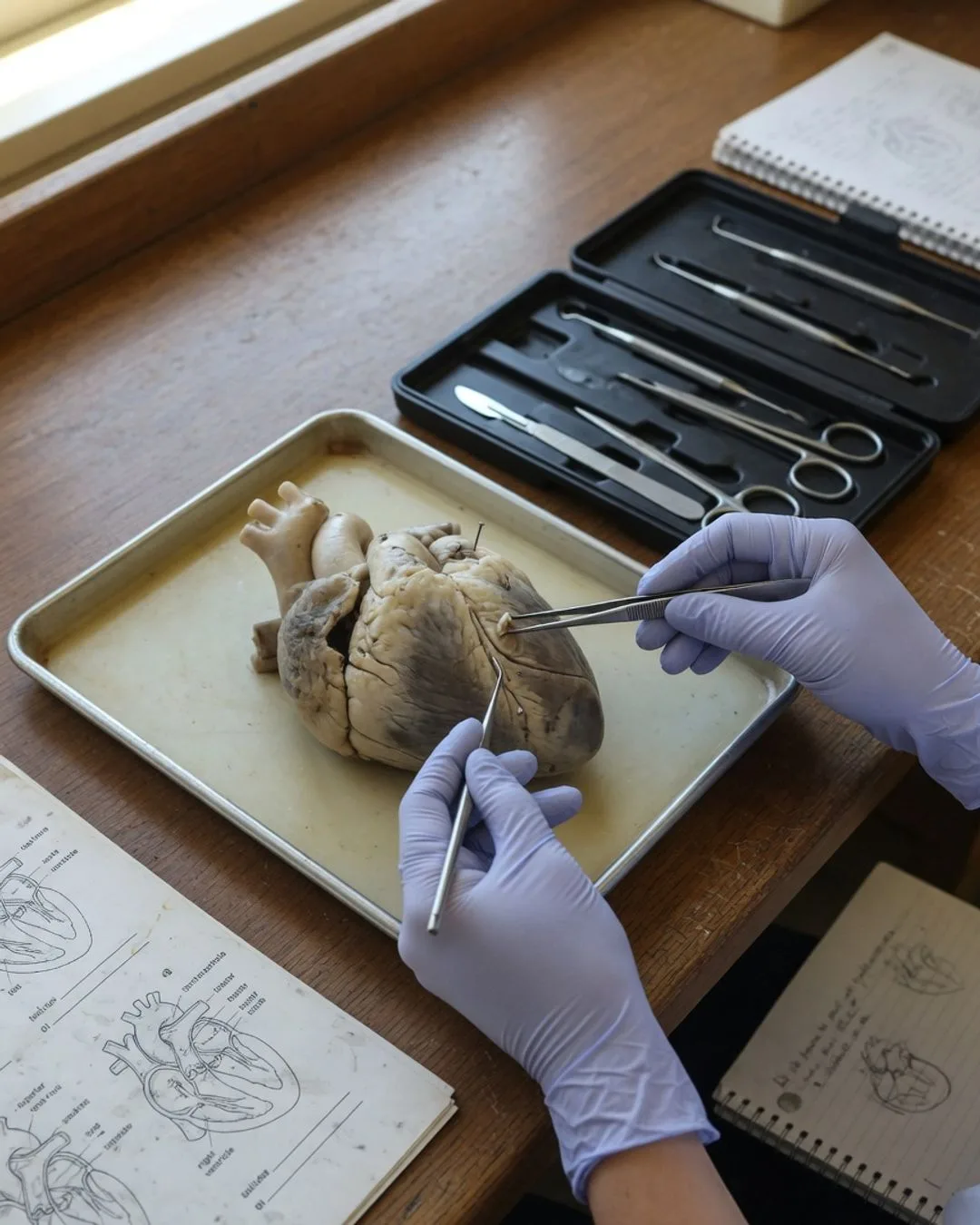
Ask a student who has only read about the heart what it does, and they will give you a definition. Ask a student who has held one — opened a preserved specimen and traced the path with a probe — and they will tell you about the thick left wall, the papery valves that snapped shut under a fingertip, the surprising heft of it in the pan. The first student has a sentence. The second has an experience — and the experience is what the sentence was always trying to point at.
That gap is the whole reason this course is built the way it is. Human anatomy is the study of a structure you carry with you everywhere and can almost never see — folded inside, layered, working the whole time you ignore it. A flat plate in a textbook makes it look simple and finished. The danger is that the subject collapses into label-memorizing: a student learns to name a bone or a valve without ever believing there is a real, working body those names point at.
The bench makes the abstraction physical
The job of the laboratory is to drag the hidden up into the open. You cannot feel a diagram, but you can hold a real femur and feel exactly where the muscle pulled and the weight came down. You cannot hear a paragraph about the cardiac cycle, but you can press a stethoscope to a chest and hear the two heart sounds close one after the other, the valves shutting in order. You cannot argue with a picture of a reflex, but you can tap below a knee and watch the leg kick before its owner decided anything at all.
This is what we mean when we say the course is lab-led, not textbook-led. The reading does not come first, with the lab as a garnish to confirm it. The bench comes first. The question is posed where it actually lives (on a model, over a specimen, on a living pulse), and the textbook is the tool we reach for to explain what we just saw. A student who has traced blood through the four chambers of a heart is ready to be told about circulation. A student who has only been told about circulation is ready to forget it.
The diagram on the page is a claim about a living body. The lab is where the student finds out the claim is true.
What the bench teaches that the page cannot
Beyond making concepts concrete, the laboratory teaches a set of things a textbook structurally cannot, because they are not simply facts. They are judgments and habits that only form under real conditions:
- That measurement is hard. Finding a pulse and counting it honestly, reading a blood pressure off a cuff and gauge, focusing a slide until the tissue resolves, watching your two readings disagree — these teach humility about data that no labeled diagram ever will.
- That bodies don't read the textbook. The specimen never looks exactly like the plate. The model is idealized; the real one has quirks. Learning to reason about why a living body departs from the tidy picture is core to actually knowing anatomy.
- That technique is knowledge. How you hold the probe, where you place the stethoscope bell, how you rack the focus, how you handle a specimen — the answer depends on the doing, and the doing can only be learned by doing.
The two-day rhythm
Practically, this conviction becomes a schedule. The course runs on a two-day rhythm. One day is the Concept Day: the idea is introduced and worked through on paper — the four basic tissues, the cardiac cycle, the reflex arc. The next is the Lab Day, where that same idea is made physical at the bench and written into a real lab notebook in the student's own hand. Between the two days, the student works at home, and that gap is not dead time. It is where the concept and the experience knit together into something that lasts.
We are not against the textbook; a serious human anatomy course needs a rigorous one, and this course has it. We are against the textbook going first and the bench going second, because we have watched what that produces: a student who can recite the definition of a reflex and has never once tapped a tendon and watched the leg answer on its own. Put the bench first, and anatomy stops being a vocabulary list. It becomes a thing the student has actually seen work, which is the only kind of anatomy anyone remembers.