Antonie van Leeuwenhoek described microorganisms using carefully made lenses in the 1670s. Robert Hooke had already named the compartments he saw in cork in 1665. Neither observation alone established all of modern cell theory. The Unit 02 assignment supplies OpenStax Biology 2e 4.1 and 4.3, specified figures, original questions and worked scale calculations for comparing these claims.
A draper who ground his own lenses
Leeuwenhoek was not a famous scientist. He was a cloth merchant (a draper) in the Dutch city of Delft. Drapers used little magnifying glasses to count the threads in cloth, and Leeuwenhoek got very good at making them. He learned to grind tiny glass beads into lenses so strong they could magnify an object hundreds of times, far more than anyone else's microscope at the time. Then he pointed them at everything he could find.
What he saw astonished him. A single drop of pond water was crowded with tiny creatures swimming around — he called them “animalcules,” little animals. Scrapings from his own teeth were full of moving specks: the first bacteria a human ever saw. Rainwater, blood, a sliver of plant — each one held life or structure too small for the eye. A whole living world had been all around people for all of history, and no one had known it was there.
The same careful looking a student does at the microscope today is the same act that, three and a half centuries ago, revealed that we share our world with creatures we cannot see.
History: a new science is born
Leeuwenhoek's discoveries opened up a brand-new science — microbiology, the study of living things too small to see. Before him, people had no idea bacteria existed, so they had no way to understand what made food spoil or people sick. His careful observations, repeated by others over the next two hundred years, slowly led to the germ theory of disease and to the whole idea that all living things are built from cells. One patient man with a homemade lens started a chain of discovery that is still going. That is the History spoke: every big idea in this course was discovered by a real person who had to convince a doubtful world.
Reading and writing: a sourced evidence note
Leeuwenhoek communicated observations in letters. This assignment does not assume a letter has been supplied: read the named Cell Theory and Microscopy sections in OpenStax 4.1, then examine the captioned images. Submit a Hooke/Leeuwenhoek/later-cell-theory timeline and an evidence note distinguishing historical reports, modern images, synthetic scale records and any actual observation separately made with an approved prepared slide. State one instrument limitation and cite the specific section or figure.
That is why this course keeps a real lab notebook. Leeuwenhoek's letters worked because they were exact (what he saw, how big it looked, how it moved), not because they were fancy. Good scientific writing is honest writing, and a student learns it by doing it.
- History has context. Separate the date of an observation from the date of a later explanation and acknowledge contributions beyond one observer.
- Reading means a specified source. An open-textbook section or agency report can be examined critically; an unprovided title is not an assignment.
- Writing means your own reasoning. Cite the evidence, calculate where needed, and state a limitation. Never relabel supplied data as something you observed.
Measurement, and the thread through the year
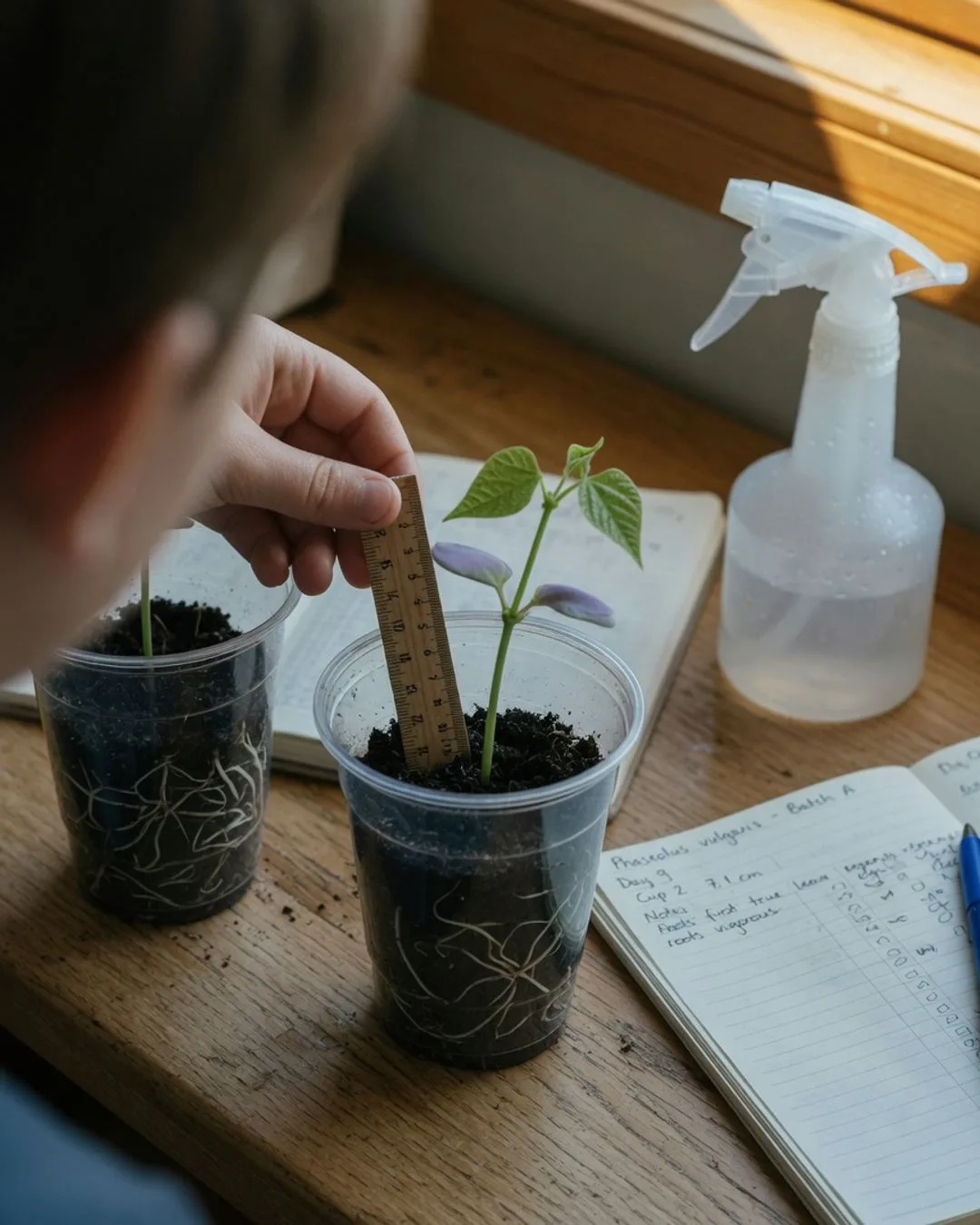
There is one more thread, and Leeuwenhoek shows it too: measurement. To convince anyone, he could not just say “small.” He compared his creatures to a grain of sand or a strand of hair, so others could picture the size. That is exactly what students do with a microscope: figure out how much a lens magnifies, use a scale to judge how big a cell really is, and measure how a seedling grows a little each day. Measurement is not a math class bolted on — it is how you turn “I saw something small” into evidence anyone can check.
That is what integration means here. Not a science lesson with a history fact stapled on the end, but one true story — a draper, a lens, and a hidden world — held up to the light until a student can see how History, Reading, Writing, and Measurement were never really separate subjects at all. The core spokes, History, Reading, and Writing, are included in every unit; a measurement lane runs underneath; and each unit reaches for its own real story — Mendel and his peas, Darwin and his finches, Linnaeus and his names, Rachel Carson and her warning. The integration guide supplies all eight source-to-output pathways. In Unit 04, retain the defined Pp x Pp pea-cross assumptions and probabilistic counts, not family traits. In Unit 07, compare Yellowstone source claims, dates, populations, weather, predation and hydrology rather than crediting wolves alone with reshaping rivers.
Worked calibration: a 40 mm displayed cell divided by a 20 mm bar representing 50 micrometres gives 100 micrometres. Doubling both displayed lengths leaves the answer unchanged. This supports scale reasoning, not a microscope-handling pass. Integration is separately reported and cannot lower the science grade or block a practical pass.