Why life science is taught this way.
Six short essays for parents and guides. The first two explain the core of the method; the next three address common family questions; the sixth explains how a course like this approaches learning in the age of AI.
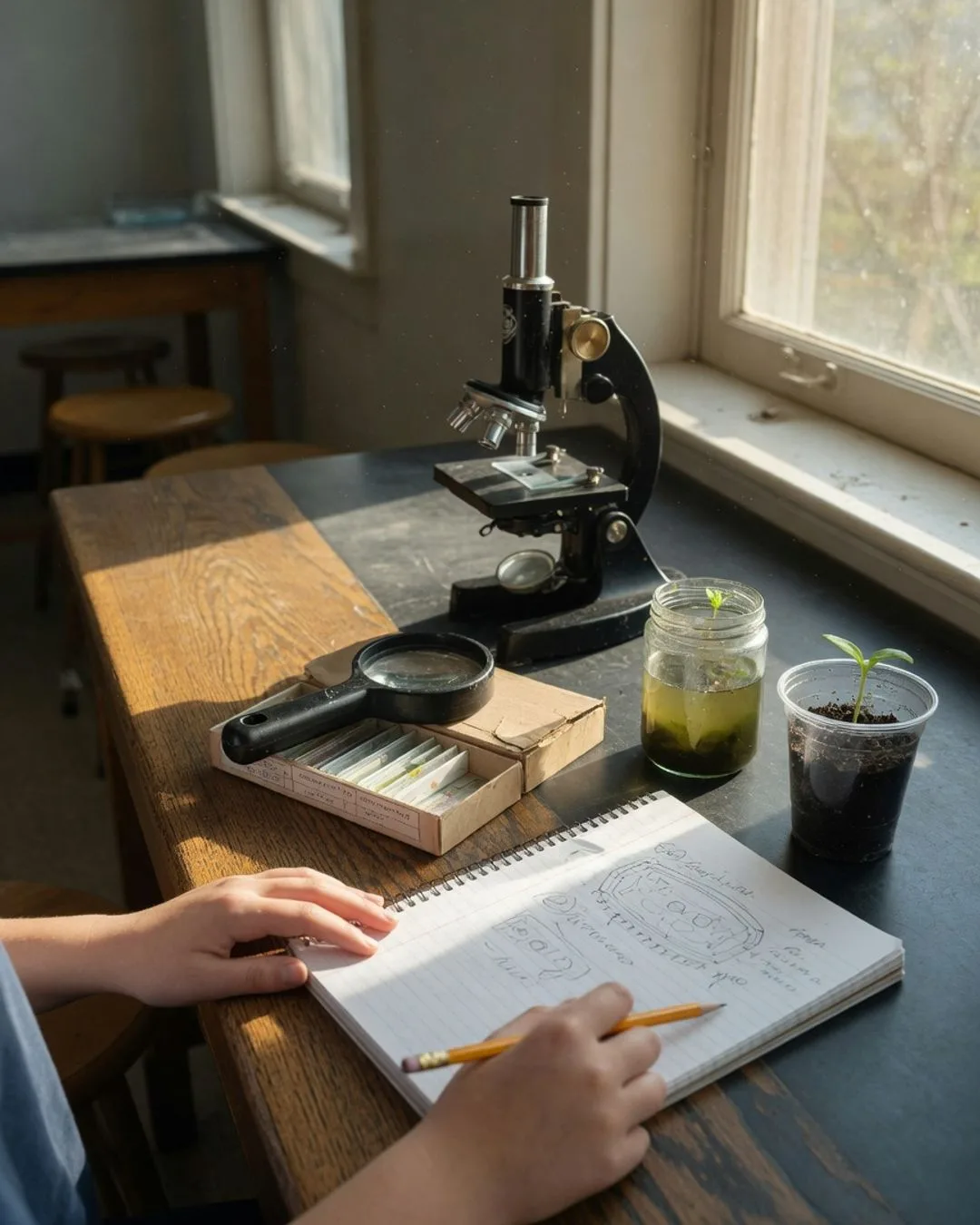
The method
Why life science is taught at the bench.
Life science is invisible on the page. What a microscope, a hand lens, and a jar of pond water teach that no textbook can, and why "lab-led, not textbook-led" is the whole game.
Cram, pass, forget in life science.
Why body systems and food-web ideas fade especially fast without mastery, and what "Learn → Master → Retain" replaces the test-and-move-on model with.
The demonstrations
The microscope cell defense.
The single moment that captures the whole course: a student at the microscope, a cell in focus, and a guide asking "find it, name the parts, and tell me what each one does."
Observing carefully, measuring honestly.
Using a hand lens and a microscope, sketching what you actually see, and measuring growth over time, and why an observation you can’t back up isn’t worth much.
Integration & AI
Integration: Leeuwenhoek and the microscopic world.
Compare Hooke’s cork, Leeuwenhoek’s microorganisms and later cell theory through assigned sources, scale calculations and an evidence note that distinguishes observation from inference.
AI-proof by design.
We teach students to use AI thoughtfully while assessing the skills they must demonstrate themselves. This essay explains how the two approaches support each other.