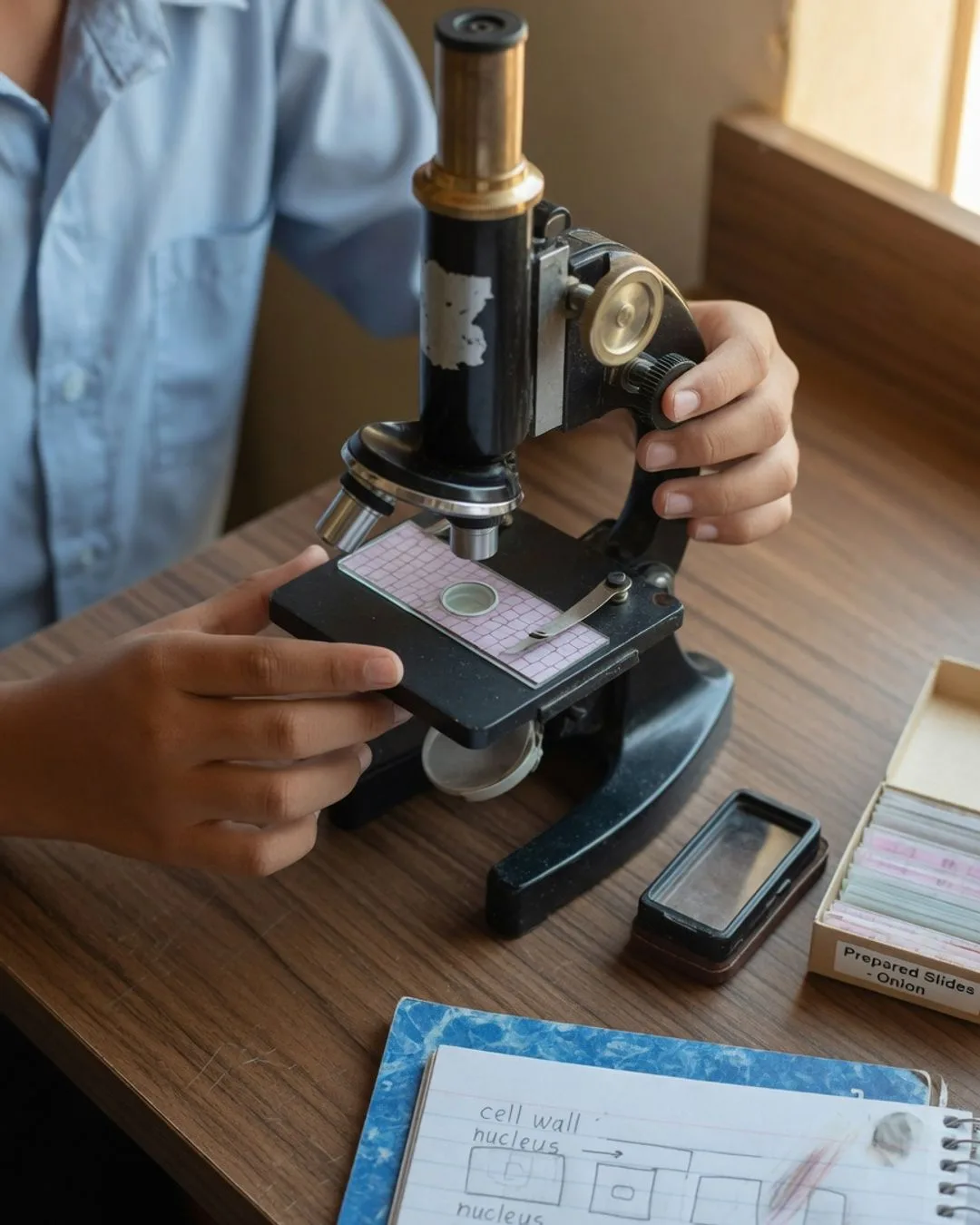
Partway through the year, after students have studied living things and the cells they are made of, the course arrives at a moment we build everything toward: the microscope cell defense. A student sits at the bench with a microscope, a prepared slide, and a guide. They find the cells, bring them into sharp focus, and point out each part. Then the guide begins to ask: What is that part called? What does it do? How do you know this is a plant cell and not an animal cell?
It is, on purpose, an oral exam conducted over a live microscope. And it is the clearest single picture of what this whole course is for.
Why a defense, and not a worksheet
A worksheet hands the student a diagram with the parts already labeled and asks them to match words to arrows. That is a memory task, and memory is the thinnest slice of what really understanding a cell demands. The defense asks something harder and truer: find the cells yourself on a real slide that won't look exactly like the picture in the book; focus them with your own hands; and then explain, out loud, what each part is for. That is hard to bluff. Either you know why the green specks are chloroplasts and what they do, or you sit there and you don't.
Use AI to help you study for the defense. You still have to sit at the microscope, find the cells, and explain each part in your own words.
What the guide is actually listening for
The defense isn't a recitation. A guide is listening for three things, and the rubric makes them explicit:
- Technique under control. Did the student place the slide correctly, start on low power, and turn the focus knob slowly until the cells were sharp — or did they leave the view blurry and guess at what they were seeing?
- Naming the supported parts. Can the student identify features actually resolved in the approved prepared slide, explain the evidence and leave others unresolved? A cell diagram does not prove that every labeled organelle is visible here.
- The job of each part, defended. Not just the right name, but what the part actually does: the membrane holds the cell together and controls what goes in and out, the nucleus stores the instructions, the chloroplasts make food from sunlight.
That third one is where mastery and memorization separate. A memorized label has no give in it; the moment the guide asks "why does a plant cell have a wall but your cheek cell doesn't?" it collapses. Real understanding flexes. It can answer the question it wasn't expecting, because it knows what each part is actually for.
Why this is the assessment that survives the next decade
There is a practical reason the microscope cell defense sits at the center of the course, and it has to do with the world students are walking into. A take-home worksheet can be generated. A multiple-choice exam can be gamed. But no tool can sit at the microscope for a student, find the cells with their eyes, and explain the slide in front of them in real time. The microscope cell defense is built around the student’s own work, not because we banned anything, but because showing what you know is very hard to outsource.
Years from now, most students will not remember the exact slide they looked at. They will remember sitting at the bench, turning the knob until the cells jumped into focus, and explaining them to a person who kept asking why. What we are really teaching is the confidence that comes from understanding something well enough to explain it.