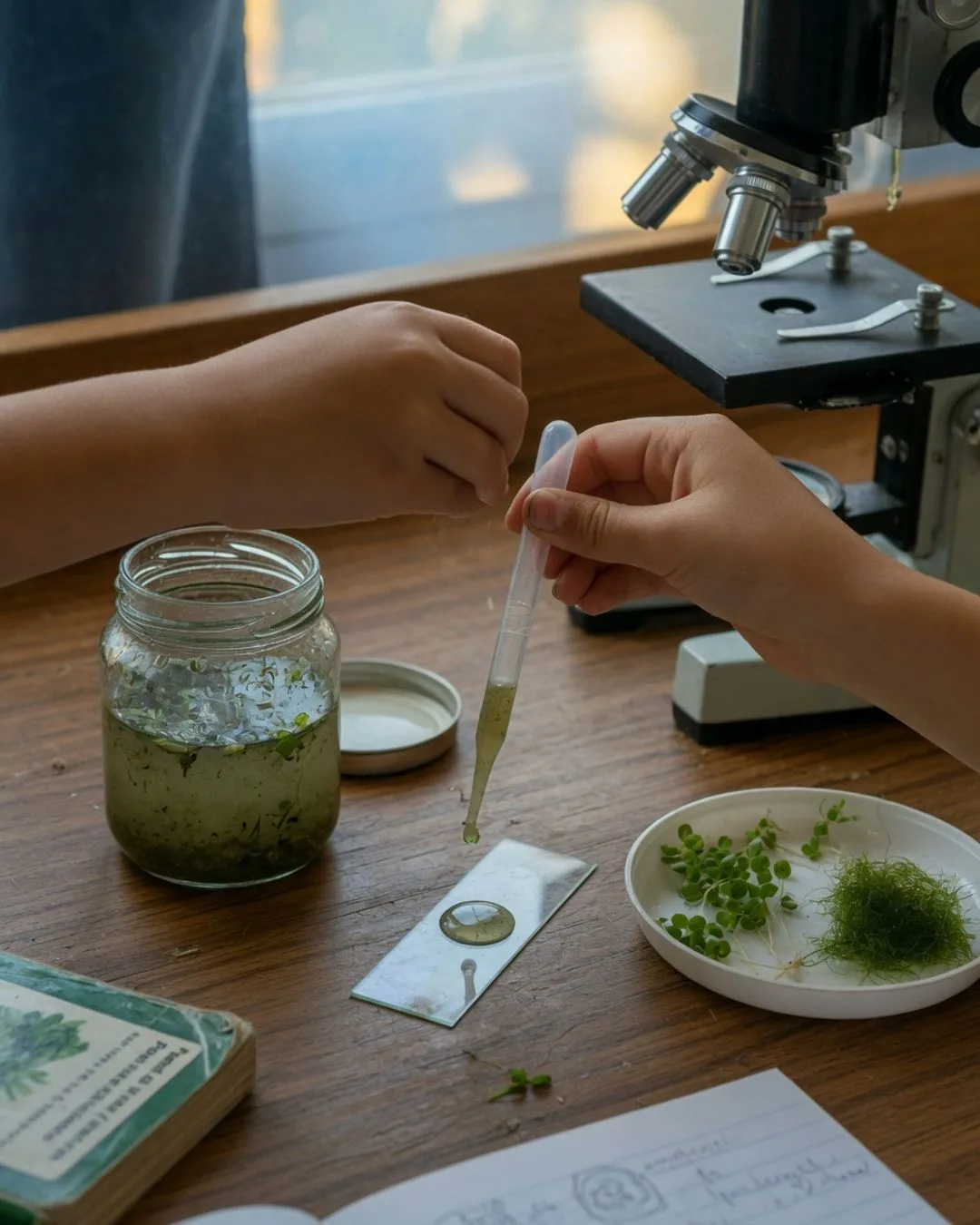
Ask a student who has only read about cells what a cell is, and they will give you a definition. Ask a student who has looked at one under a microscope, and they will tell you about the little box-shaped walls of an onion skin, or the tiny green dots in a leaf, or the speck that darted across the slide and turned out to be alive. The first student has a sentence. The second has a memory, and the memory is what the sentence was always trying to point at.
That gap is the whole reason this course is built the way it is. Life science is full of things you can actually observe — cells, seeds sprouting, a worm turning away from light, a food web playing out in a jar — but a textbook can hide all of it behind long lists of words. The danger is that the subject turns into memorizing labels: a student learns to spell “mitochondria” without ever believing there is a real, living thing behind the word.
The bench makes it real
The job of the lab is to turn words into things you can see for yourself. You cannot picture a cell from a definition, but you can peel a thin layer from an onion, lay it on a slide, and watch rows of tiny boxes snap into focus under the microscope. You cannot feel what “living” means from a list, but you can put pond water under the lens and watch something swim, stop, and change direction on its own. You cannot understand “growth” from a chart, but you can measure a bean seedling on Monday and again on Friday and see for yourself how much taller it got.
This is what we mean when we say the course is lab-led, not textbook-led. The reading does not come first, with the lab tacked on to confirm it. The bench comes first. The question is asked where it actually lives (under the microscope, in a jar of pond water, beside a growing seedling), and the textbook is the tool we reach for to explain what we just saw. A student who has watched a single cell drift across the slide is ready to be told what cells are. A student who has only been told what cells are is ready to forget it.
The word on the page is a claim about something real. The lab is where the student finds out the claim is true.
What the bench teaches that the page cannot
Beyond making ideas concrete, the lab teaches a set of things a textbook simply cannot, because they are not facts to memorize — they are habits and judgments that only grow under real conditions:
- That careful looking is hard. Focusing the microscope until the cells are sharp, deciding whether that speck is alive or just dust, noticing your two sketches don't match — these teach a respect for evidence that no worked example ever will.
- That living things don't read the textbook. The pond sample is empty the day you need it. The seedling leans the wrong way. The cells look nothing like the neat diagram in the book. Learning to reason about why the real thing differs from the tidy picture is a scientist's core skill.
- That technique is knowledge. How you place the slide, how you adjust the focus, how gently you handle a living thing, how you hold the hand lens — the answer depends on the doing, and the doing can only be learned by doing.
The two-day rhythm
In practice, this belief becomes a schedule. The course runs on a two-day rhythm. One day is the Concept Day: the idea is introduced and worked through together — what a cell is, how a food web moves energy, how a trait passes from parent to offspring. The next is the Experiment Day, where that same idea is made real at the bench and written into a real lab notebook in the student's own hand. Between the two days, the student works at home, and that gap is not dead time. It is where the idea and the experience knit together into something that lasts.
We are not against the textbook; a good life science course needs a solid one, and this course has it. We are against the textbook going first and the bench going second, because we have watched what that produces: a student who can recite the definition of a cell and has never once seen one under a lens. Put the bench first, and life science stops being a vocabulary list. It becomes a thing the student has actually watched happen, which is the only kind of life science anyone remembers.