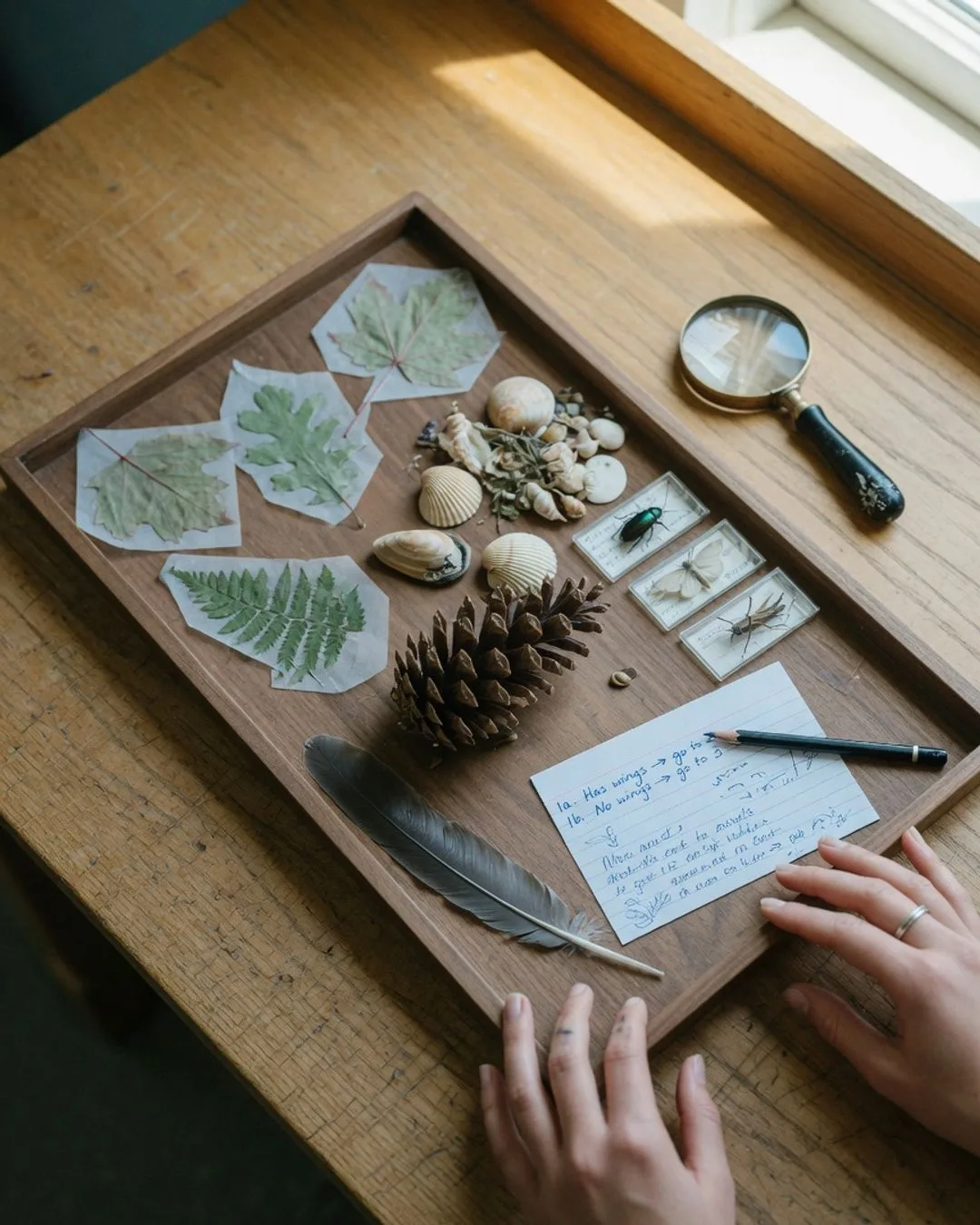
Hand a beginner a leaf and they will write “a green leaf” and move on. Hand a careful observer the same leaf and they will tell you it has jagged edges, three main veins, a pale underside, and a small hole chewed near the tip — and they will keep those details separate from any guess about what made the hole. The difference is not sharper eyes. It is the habit of writing down what is actually there.
Learning to observe and record honestly is one of the quiet, foundational skills of the whole course, and it is worth slowing down to teach on its own. It is not flashy. It does not make anything pop or sprout. But a student who cannot observe carefully cannot do life science, because everything that comes later (every food web, every comparison, every conclusion) is only as good as the observations it was built from.
Your notes are an honesty system
Students often treat their lab notes as a chore — something to scribble so the guide can see they did the work. They are nothing of the kind. A good record is a way of stating exactly what you know and no more. When you write “the seedling grew about two centimeters this week,” you are being honest that you measured to the nearest centimeter and “about” is the truth. Write “the seedling grew 2.37 centimeters” with a school ruler and you are claiming an exactness the ruler never gave you. The habit of drawing a labeled sketch and writing a plain, honest note is what keeps the whole record trustworthy: your conclusions can be no surer than the observations they came from.
What you saw is not what you think
The two get mixed together all the time, and the lab exists in part to teach the student that they are not the same thing at all:
- An observation is what your eyes actually take in — the mold is fuzzy and gray, the worm curled away from the light, the water turned cloudy.
- An inference is what you think it means — the mold is growing, the worm doesn't like light, something is living in the water. Inferences can be right or wrong, and the only way to check is to go back to the observations.
- The tricky cases are the ones where a guess sneaks into the record dressed as a fact — “the plant is dying” written down when all you really saw was “three leaves turned yellow.”
A student who learns this stops trusting a conclusion just because it sounds right, and starts asking the better question: what did I actually see, and what am I only guessing?
Labeled sketches and simple measurement
Some of this is practice: drawing what you see instead of what you expect, labeling the parts you can name, measuring a stem to the nearest centimeter, counting how many of something rather than saying “a lot.” But the deeper lesson is that small habits add up. A sketch that leaves out the veins, a count that skips a few, a note that says “big” instead of a number — none of them ruins the day by itself, but together they turn a record into something no one can trust or repeat. A careful record does the opposite. It says, in effect, “here is exactly what I saw, drawn and counted and measured, so anyone could check it.”
An observation written down as a conclusion is not a careful record. It is a guess wearing the costume of one.
Doing it right when there's a lot to record
It is one thing to sketch a single leaf carefully with all afternoon to do it. It is another to keep good notes when there are ten specimens to sort, a seedling to measure, and a partner waiting. That is on purpose. In the real practice of life science, observations pile up fast, and care that falls apart the moment things get busy was never really owned. So the course asks students to observe well and keep up, not because speed is the point, but because a habit you can only manage slowly and alone is a habit you only half-have.