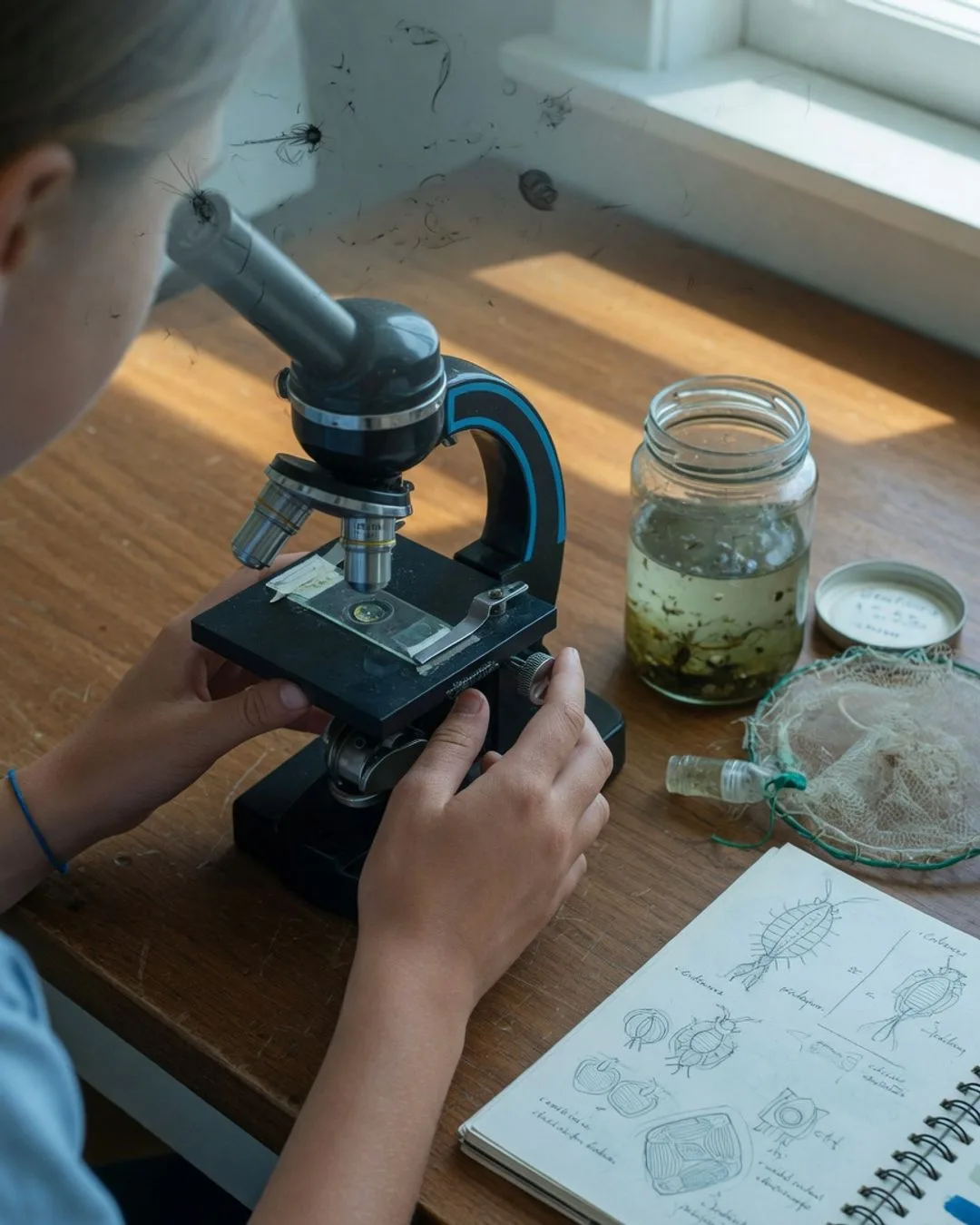
Ask a student who has only read about marine biology what plankton is, and they will give you a definition. Ask a student who has pulled a net through the water and drawn a single drop under the microscope what plankton is, and they will tell you about the moment the water they thought was empty turned out to be crowded with diatoms and copepods darting across the field. The first student has a sentence. The second has an experience, and the experience is what the sentence was always trying to point at.
That gap is the whole reason this course is built the way it is. Marine biology, more than almost any other high-school science, studies a world you cannot simply walk out and observe. Most of the ocean is deep, dark, and offshore; the majority of it has never been seen by human eyes at all. The danger is that the subject collapses into a slideshow of animals and vocabulary: a student learns to label a diagram of a fish without ever holding one, keying it out, or watching how it is built to move through water.
The bench makes the ocean physical
The job of the laboratory is to drag a piece of that hidden ocean up onto the bench where you can hold it. You cannot visit the deep sea, but you can pull a plankton net through a jar of sample water and find, under the microscope, the same drifting community that feeds the entire ocean. You cannot see salinity, but you can float a hydrometer in a cylinder of seawater, read the scale, and understand in your fingertips that this water is denser than fresh. You cannot watch a tide from your desk, but you can work through a specimen tray (a barnacle, a mussel, a sea star) and read on each one exactly how it is built to survive being submerged and exposed twice a day.
This is what we mean when we say the course is lab-led, not textbook-led. The reading does not come first, with the lab as a garnish to confirm it. The bench comes first. The question is posed where it actually lives (under the microscope, over a specimen tray, at the edge of a tide pool), and the textbook is the tool we reach for to explain what we just saw. A student who has watched a sea star grip a tray and evert its stomach is ready to be told how echinoderms are built. A student who has only been told about echinoderms is ready to forget them.
The diagram on the page is a claim about something real. The lab is where the student finds out the claim is alive.
What the bench teaches that the page cannot
Beyond making concepts concrete, the laboratory teaches a set of things a textbook structurally cannot, because they are not simply facts. They are judgments and habits that only form under real conditions:
- That measurement is hard. Reading a refractometer to the right part per thousand, deciding where the shadow line really falls on the scale, watching your two salinity trials disagree — these teach humility about data that no worked example ever will.
- That organisms don't read the textbook. The specimen is a little bigger than the key says. The color is off. A "reliable" field mark is missing on this particular individual. Learning to reason about why the real animal departs from the ideal description is a marine biologist's core skill.
- That technique is knowledge. How you focus the scope, how you handle a wet specimen, how you spread a fin to count its rays, how you work a dichotomous key — the answer depends on the doing, and the doing can only be learned by doing.
The two-day rhythm
Practically, this conviction becomes a schedule. The course runs on a two-day rhythm. One day is the Concept Day: the idea is introduced and worked through on paper — the ocean zones, the plankton food web, the body plan of a phylum. The next is the Experiment Day, where that same idea is made physical at the bench and written into a real lab notebook in the student's own hand. Between the two days, the student works at home, and that gap is not dead time. It is where the concept and the experience knit together into something that lasts.
We are not against the textbook; a serious marine biology course needs a rigorous one, and this course has it. We are against the textbook going first and the bench going second, because we have watched what that produces: a student who can recite the definition of an invertebrate and has never once turned a live one over in their hands to see how it is put together. Put the bench first, and marine biology stops being a vocabulary list. It becomes a thing the student has actually seen alive, which is the only kind of marine biology anyone remembers.