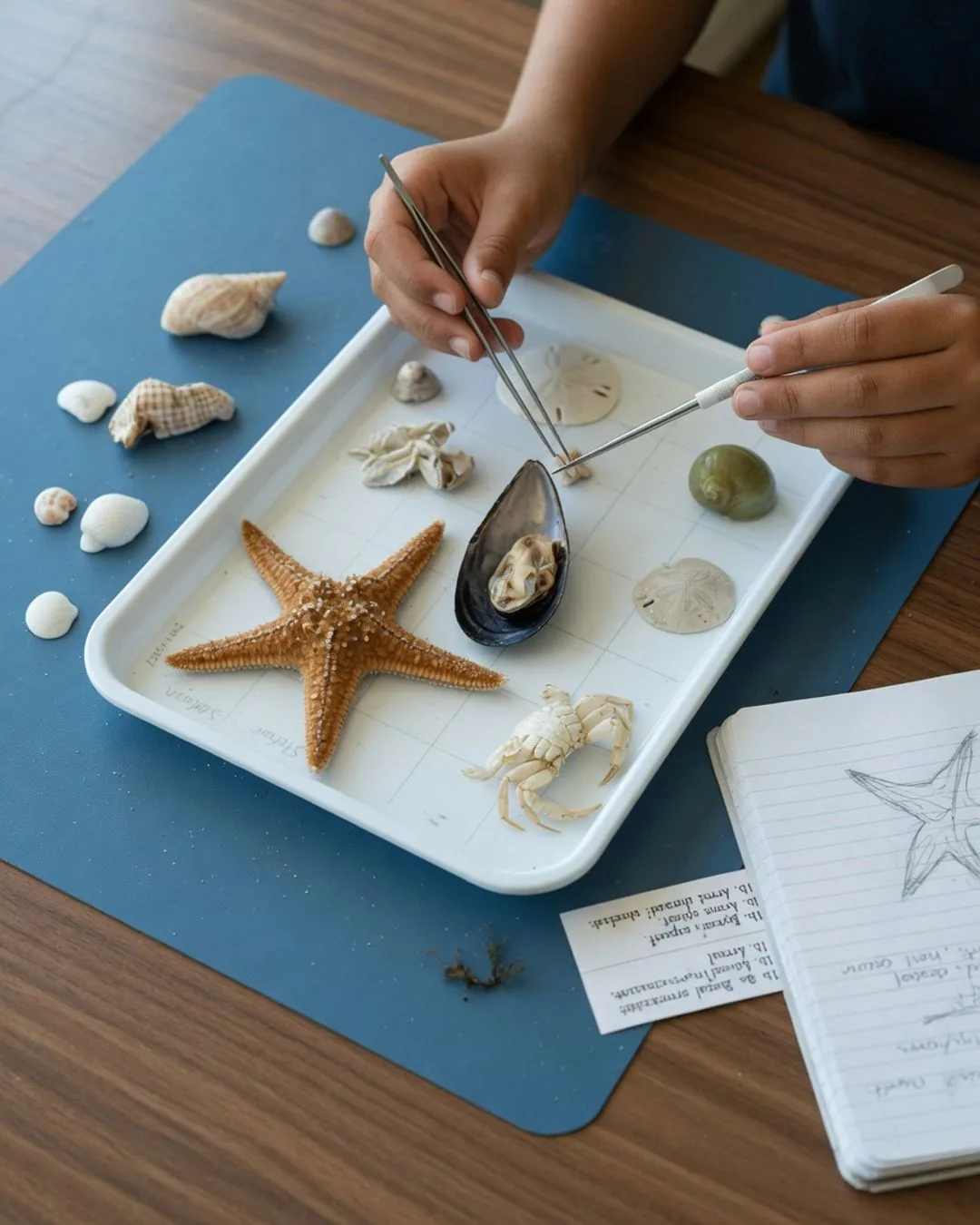
Late in the year, after students have worked through invertebrates, fish and sharks, and the marine reptiles, birds, and mammals, the course arrives at a moment we build everything else toward: the specimen-identification defense. A student stands at the bench with an unknown specimen, a dichotomous key, a hand lens, and a guide. They work the key to a name. Then the guide begins to ask: Why that identification? Which features did you key on, and which did you rule out? What are these structures for, and where does this animal sit in the classification?
It is, quite deliberately, an oral exam conducted over a real animal. And it is the clearest single picture of what this whole course is for.
Why a defense, and not a worksheet
A labeling worksheet hands the student a diagram and asks them to match names to arrows. That is a recognition task, and recognition is the thinnest slice of what identification actually demands. The defense asks something harder and truer: key out a real specimen that won't match the picture exactly; decide with your own eyes which features are diagnostic and which are noise; and then reason out loud about whether your name means anything. That is hard to bluff. Either you know why those gill slits and that cartilaginous skeleton make it a shark and not a bony fish, or you stand there and you don't.
Use AI to help you study for the defense. You still have to hold the specimen, work the key, and explain the classification in your own words.
What the guide is actually listening for
The defense isn't a recitation. A guide is listening for three things, and the rubric makes them explicit:
- Identification under control. Did the student work the dichotomous key couplet by couplet, use the hand lens, check the diagnostic features against the specimen — or did they guess the name from a general impression and hope it counted?
- Adaptation reasoning. Can the student explain what the structures are for — why a streamlined body and that fin shape suit an open-water predator, why a flattened body and upward-facing eyes suit life on the bottom?
- The classification, defended. Not just the right name, but why it belongs there: the phylum, the class, and the shared features (a notochord, radial symmetry, a mantle) that place this animal on that branch of the tree of life.
That third one is where mastery and memorization separate. A memorized species list has no give in it; the moment the guide asks "why is a dolphin grouped with you and me and not with the tuna beside it?" it collapses. Real understanding flexes. It can answer the question it wasn't expecting, because it knows what the classification is actually built on — and it knows that whales and dolphins are mammals, not fish.
Why this is the assessment that survives the next decade
There is a practical reason the specimen-identification defense sits at the center of the course, and it has to do with the world students are walking into. A take-home problem set can be generated. A multiple-choice exam can be gamed. But no tool can hold the specimen for a student, work the key with their eyes, and reason about the animal in front of them in real time. The specimen-identification defense is built around the student’s own work, not because we banned anything, but because students must demonstrate competence themselves.
Years from now, most students will not remember the exact species name of the specimen they keyed out. They will remember standing at the bench, turning the animal over, tracing a diagnostic feature with one finger, and explaining to a person who kept asking why. What we are really teaching is the confidence that comes from understanding something well enough to explain it.