Unit 08 · Micrography: Drawing, Scale & Imaging
The ladder ends where the record begins: a scientific drawing of what you actually saw. This module teaches the conventions of a microscopy drawing — a sharp pencil, clean leader lines to labels, no shading, a title, and a stated total magnification — plus drawing in correct proportion and adding a scale bar derived from your measured field of view. Mastery here is not something you can explain your way into. An instructor watches you observe and draw, and the page beside the scope is the proof.
Student learning: Make images and drawings repeatable, scaled and honest
Choose the level by readiness, not age alone, and record it before instruction. Foundation, core, and honors tasks are study pathways, not an AP course or a promise of college credit. The instructor retains practical assessment and the published science rubric; integration is reported separately.
Prerequisites: Scale ratios, pixel measurements, observation/artifact distinction, and image-integrity rules.
Suggested sequence: read and discuss the explanation; attempt the worked model; analyze the data at your selected level; check the answers; then complete the source-linked response and a fresh transfer question. These activities supplement, not replace, supervised practical work and the semester schedule.
Assigned reading and focus
- NCBI PMC: Image integrity and standards. Read the image-processing standard that images should not be processed in ways that misinterpret original data and that original data should be available on request.
- NCBI PMC: Images in scientific writing. Read the discussion of image resolution and formats; connect it to preserving scale and avoiding quality loss.
- OpenStax Biology 2e, 4.1: Studying Cells. Read the Cell Theory paragraphs: Robert Hooke named the box-like structures he observed in cork "cells" in his 1665 publication Micrographia. Use that published observation as this unit's history anchor.
Learn the science
A micrograph or drawing is evidence only when the scale, source, processing and limits are recorded. A scale bar represents specimen distance; after proportional resizing it still labels the same specimen distance, but pixel measurements must be recalibrated.
Cropping can focus attention but can also remove context. Honest records say what was cropped, resized or adjusted and retain the original when possible.
The PMC image-quality source uses image resolution to mean pixel density such as dpi. That is useful for publication quality, but it is different from optical resolution at the microscope, which is the ability to distinguish nearby specimen details.
Observation and artifact remain distinct. A drawing should show what is actually visible at the stated setup, not what the learner expects from a textbook diagram.

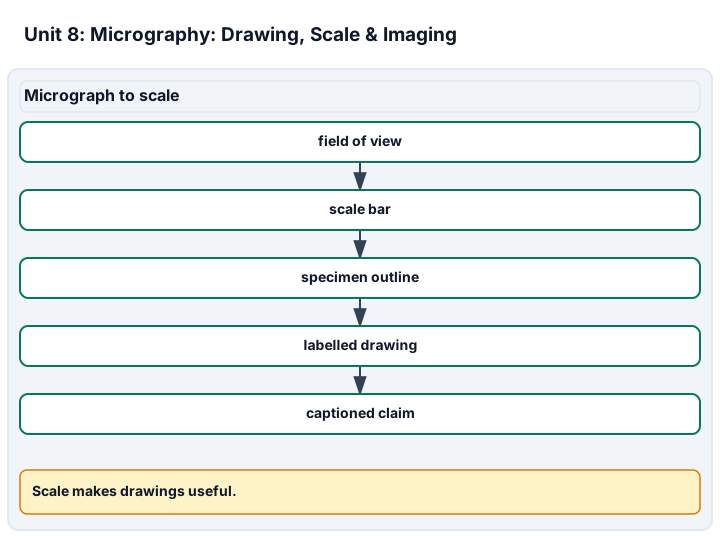
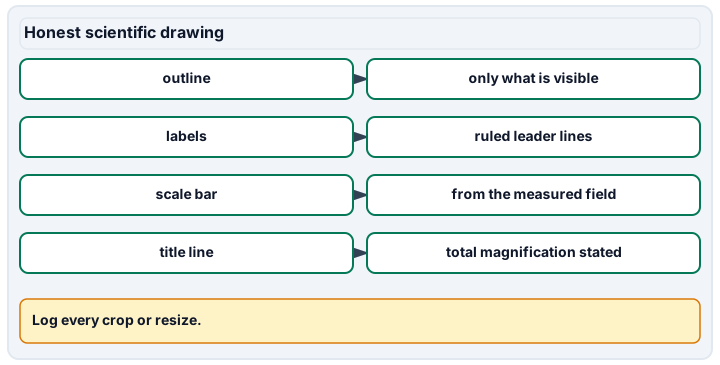
Diagram description
Micrograph to scale moves from field of view to scale bar, specimen outline, labelled drawing and captioned claim. Honest scientific drawing states that outlines show only visible structures, labels use ruled leaders, scale bars come from measured fields and title lines state total magnification.
Data, provenance, and assumptions
| Quantity | Value | Unit / meaning |
|---|---|---|
| Scale bar label | 50 | micrometres |
| Scale bar length | 125 | pixels |
| Cell length before resizing | 180 | pixels |
| Resize factor | 0.5 | display image is half as many pixels wide |
Worked model
The original scale is 50/125 = 0.4 micrometres per pixel. A 180-pixel cell is 72 micrometres. After proportional 50% resizing, the label still represents 50 micrometres, but the displayed bar is fewer pixels and pixel-based measuring needs the resized scale.
Numerical calibration
- 0.4 micrometres/pixel
- 72 micrometres
- 62.5 display pixels after resizing
Attempt the assigned level
Try the tasks before reading the calibration. These are practice answers, not a secure examination; use a new dataset or changed assumption for the assessed transfer.
Foundation: typically grades 7-8
- Explain what a scale bar labels.
- Calculate micrometres per pixel from the original image.
Check after your attempt
- It labels a real specimen distance represented by the bar, not a decorative line.
- 50 micrometres / 125 pixels = 0.4 micrometres per pixel.
High-school core: typically grades 9-10
- Calculate the cell length and explain what resizing changes.
- State one image edit that must be disclosed.
Check after your attempt
- 180 pixels times 0.4 micrometres/pixel = 72 micrometres. Proportional resizing keeps specimen distance but changes pixel counts.
- Cropping, resizing, brightness/contrast adjustment or local edits must be recorded when used.
Honors/readiness extension: quantitative calibration and image-integrity reasoning
- Explain why local image edits can violate evidence integrity.
- Design an independently repeatable size or count estimate for a supplied image.
Check after your attempt
- Local edits can make one region look different from the original data and mislead interpretation if undisclosed.
- Keep the original image/source, scale calibration, measurement rule, repeated counts or measurements, crop/resize record and uncertainty.
History, reading, and writing connection
History: OpenStax Biology 4.1 reports that Robert Hooke named the box-like structures he observed in cork "cells" in his 1665 publication Micrographia. Use that published observation and the NCBI image-integrity sources to explain why scientific images and drawings are data: state what image edits were made, retain the original when possible, and avoid adjustments that would misinterpret the original data.
Write in your own words or use an approved accessible equivalent. Cite a specific assigned section or figure, identify its evidence, and state one limitation or counterargument. Use the AI practice contract only for permitted coaching, never to invent observations or write the assessed response.
Transfer to a new case
A cropped image still shows the 50 micrometre scale bar, but the original field edges are gone. What must the caption disclose?
Calibration: Disclose that the image was cropped, state whether resizing was proportional, keep the scale-bar label tied to specimen distance, and retain the original or source record for context.
Evidence to retain
Retain calibrated image or drawing, source/original, scale calculation, crop/resize/edit log, artifact notes, and one independently repeatable size or count estimate.
Record units, calculations, source/date, uncertainty, and what is measured versus inferred. A simulation or supplied dataset must stay labeled as such. Use only educator-approved slides, specimens, stains, reagents and images. Review SDS information before approved stains, handle slides and coverslips through the approved sharps procedure, and do not culture, amplify or improvise work with unknown microorganisms.
Return to all eight learning pathways. Print this unit page for the student lessons; the linked five-page packet remains the separate assessment companion.
Evidence boundary for this unit
A calibrated drawing or image and repeatable size/count estimate complete the evidence. Supplied-image work remains distinct from an observed microscope practical.
Retain calibrated image or drawing, source/original, scale calculation, crop/resize/edit log, artifact notes, and one independently repeatable size or count estimate.
- Science 2: Drawing what you see. Observed drawing or micrograph of the student's own field, plus the observation/artifact distinction.
- Science 5: Adding a scale bar. Scale bar and calculation, edit log and repeatable size/count estimate.
Course investigation inventory. Completion evidence is a calibrated, honestly documented image or drawing, plus an independently repeatable size or count estimate when the unit calls for one. Supplied-image paper work is distinct from an observed microscope practical.
Unit mastery rubric
| Criterion | Developing | Proficient | Mastery |
|---|---|---|---|
| Drawing conventions | Sketches loosely with a dull pencil, shading, and no title or labels. | Uses labels but shades the drawing, crosses leader lines, or leaves off the title. | Draws with a sharp pencil, clean unshaded outlines, ruled leader lines to each label, and a clear title. |
| Drawing what you see | Draws the textbook picture instead of the specimen in the eyepiece. | Draws from the scope but “corrects” it toward what was expected. | Draws or images the student's own field at the scope (observed), showing only visible evidence and separating observed structures from preparation or imaging artifacts. |
| Proportion & placement | Draws structures at wildly wrong relative sizes or positions. | Gets the overall shape but misjudges the size of one part against another. | Renders each structure in correct proportion and position relative to the others in the field. |
| Stating total magnification | Leaves off the magnification or guesses at it. | Records a magnification but from the wrong objective or without the eyepiece. | States the total magnification by multiplying the eyepiece and objective powers used for the drawing. |
| Adding a scale bar | Adds no scale bar, or draws one with no basis. | Draws a scale bar but cannot show how its length was derived. | Adds a calibrated, labeled scale bar with its calculation shown and documents resizing, cropping and image edits honestly enough for another person to repeat the estimate. |
| Integration (cross-domain) | Makes no supported connection between the source and the science. | Uses the source but needs help connecting evidence, writing, or limitations to the science. | Independently connects History, Reading, and Writing using a cited source, appropriate evidence, a limitation, and a scientific explanation. |
Integration is reported separately and cannot lower the science grade or block a science demonstration pass. Science and practical criteria determine that pass. Use the integration guide's evidence checklist for the separately reported criterion.
The original 50 micrometre bar measured 125 pixels, so the scale is 0.4 micrometres/pixel and the cell is 72 micrometres. I disclosed the crop and did not erase a bubble artifact.
I stretched the picture to fit the page, copied the textbook cell shape, and left the scale bar unchanged without saying what changed.
A calibrated drawing or image and repeatable size/count estimate complete the evidence. Supplied-image work remains distinct from an observed microscope practical.
A 5-page clipboard packet — unit overview, key terms, the mastery rubric, anchor examples, and a score sheet you can print and grade against.