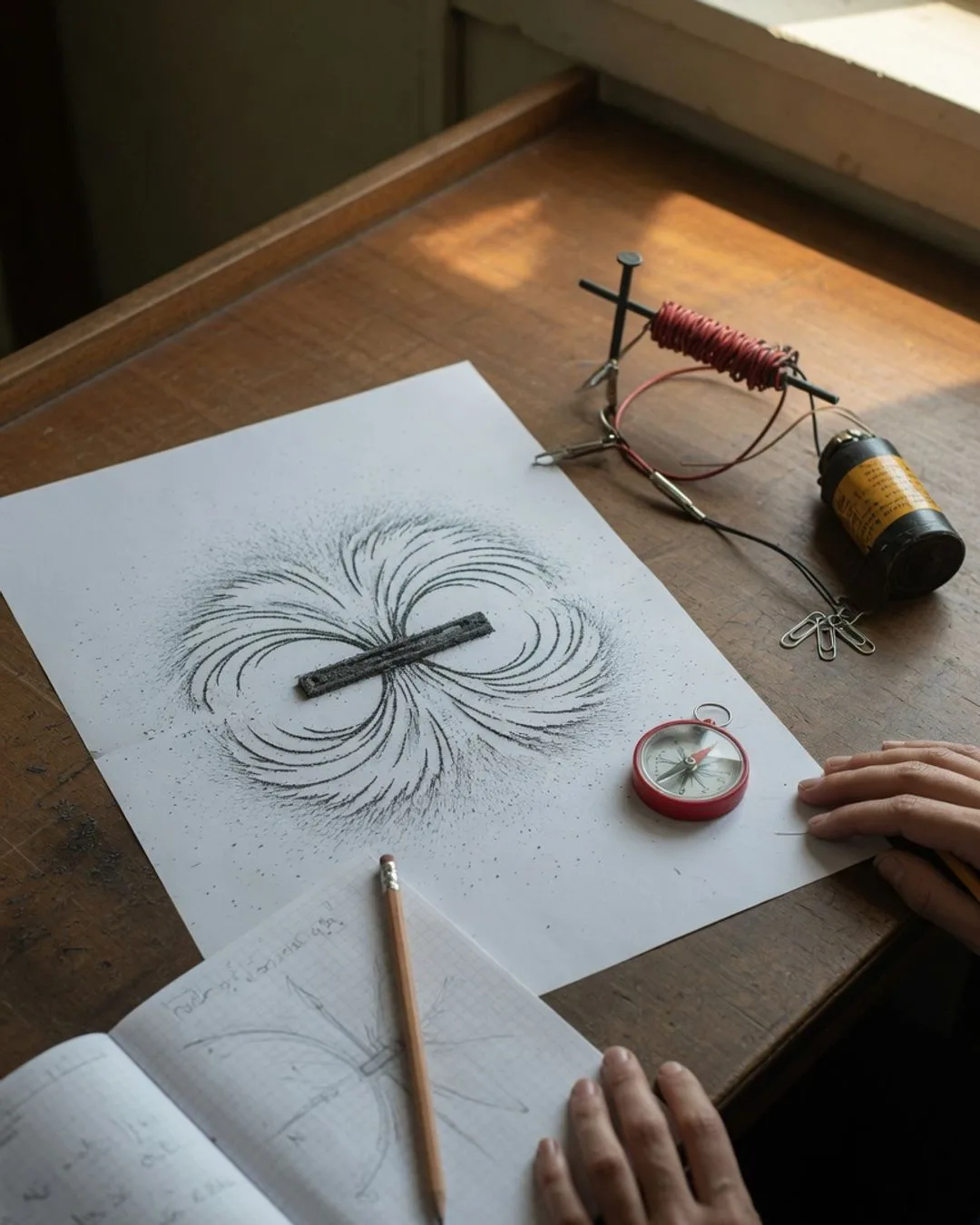
Every Bright Minds course has one unit where the walls between subjects come down on purpose — where the science refuses to stay in the science box and pulls in history, reading, writing, and math because it cannot be honestly told without them. In this course, that unit is built around Michael Faraday and his discovery of electromagnetic induction: how a moving magnet makes electricity flow. It is the physical science analog of the cholera map that anchors our biology course — a single real person whose story turns out to touch everything.
The discovery first
The discovery looks almost simple when you do it at the bench. Take a coil of wire, push a bar magnet through the middle of it, and a current flows — you can watch a meter's needle jump. Pull the magnet back out, and the current flows the other way. Hold the magnet still, and nothing happens at all. It is the motion that matters. Before Faraday worked this out in 1831, the only way to make electricity was a battery, and almost no one suspected that magnetism and electricity were two sides of one thing.
What makes Faraday a perfect anchor for this unit is that understanding his discovery leans on nearly everything the course teaches at once. It is a problem about electricity — a current needs a complete loop, the same rule a student learns wiring a battery, a switch, and a bulb. It is a problem about magnets — a bar magnet has an invisible field, the one you map with iron filings on a sheet of paper. And it is a problem about forces and motion — moving the magnet is what does the work. Faraday saw all of it, and he saw it without the heavy mathematics most scientists of his day relied on. He thought in pictures, in what he called lines of force.
The same simple loop a student wires at the bench — battery, wire, bulb — is the loop Faraday used to light the path to every power plant, every motor, and every switch in the modern world.
The self-taught boy
Faraday did not start in a laboratory. He was born poor in London in 1791, and at fourteen he was apprenticed to a bookbinder. That could have been the end of the story. Instead, he read the books he was hired to bind (an encyclopedia article on electricity, a small science book written for beginners) and he was hooked. He saved up to attend public science lectures, took careful notes, bound those notes into a book of his own, and mailed them to the famous scientist who had given the talks. It earned him a job washing bottles at the Royal Institution. From there, with almost no formal schooling and barely any mathematics, he became the greatest experimentalist of his age.
History, reading, and writing
That is the thread this unit follows out into the other subjects. Faraday's discovery did not stay in his notebook. Generators and motors (machines built directly on electromagnetic induction) powered the second half of the Industrial Revolution and, within a single lifetime, wired the world for electric light. That is history: you cannot tell the story of the modern electric age without starting in his lab.
And the way Faraday worked reaches into the parts of school that are not usually filed under science:
- History. One curious experiment (a magnet moving through a coil) grew, over decades, into power stations, electric trains, and the light in the room where you are reading this. Ideas scale, and a serious education traces how.
- Reading and writing. Faraday kept meticulous diaries of every experiment, numbered and dated, so anyone could follow his thinking — the ancestor of the lab notebook you keep in this course. He also became a spellbinding public teacher, whose Christmas Lectures for young people are still famous today. Clear science and clear writing were the same skill for him.
- Applied math. You do not need heavy math to follow Faraday, but you do need the everyday kind: reading a circuit, comparing ratios, keeping a tidy data table. The math is a tool for seeing the pattern — exactly what it was for him.
And back to the bench
The thread runs full circle, back to where it started — a student at the bench with a battery, a coil, and a magnet. When you wire a simple circuit in the Electricity & Magnetism unit and watch a bulb light in a complete loop, or wrap wire around an iron nail and build an electromagnet that lifts a chain of paper clips, you are repeating, by hand, the experiments that made the modern world. Faraday's greatness was not that he was born knowing things. It was that he stayed curious, wrote everything down, and tested every idea against the real world — which is exactly what this course asks of you.
That is what integration means here. Not a science lesson with a history anecdote stapled on, but a single life held up to the light until a student can see, through it, how science, history, reading, writing, and math were never really separate subjects at all. The core spokes, History, Reading, and Writing, are included in every unit; an applied-math lane (basic circuits, ratios, reading a data table) runs underneath; and each unit reaches for the elective spokes its story earns — here, the history of the electric revolution and the self-taught life that started it. The integration guide lays out the full model.