Why physical science is taught this way.
Six short essays for parents and guides. The first two explain the core of the method; the next three address common family questions; the sixth explains how a course like this approaches learning in the age of AI.
The method
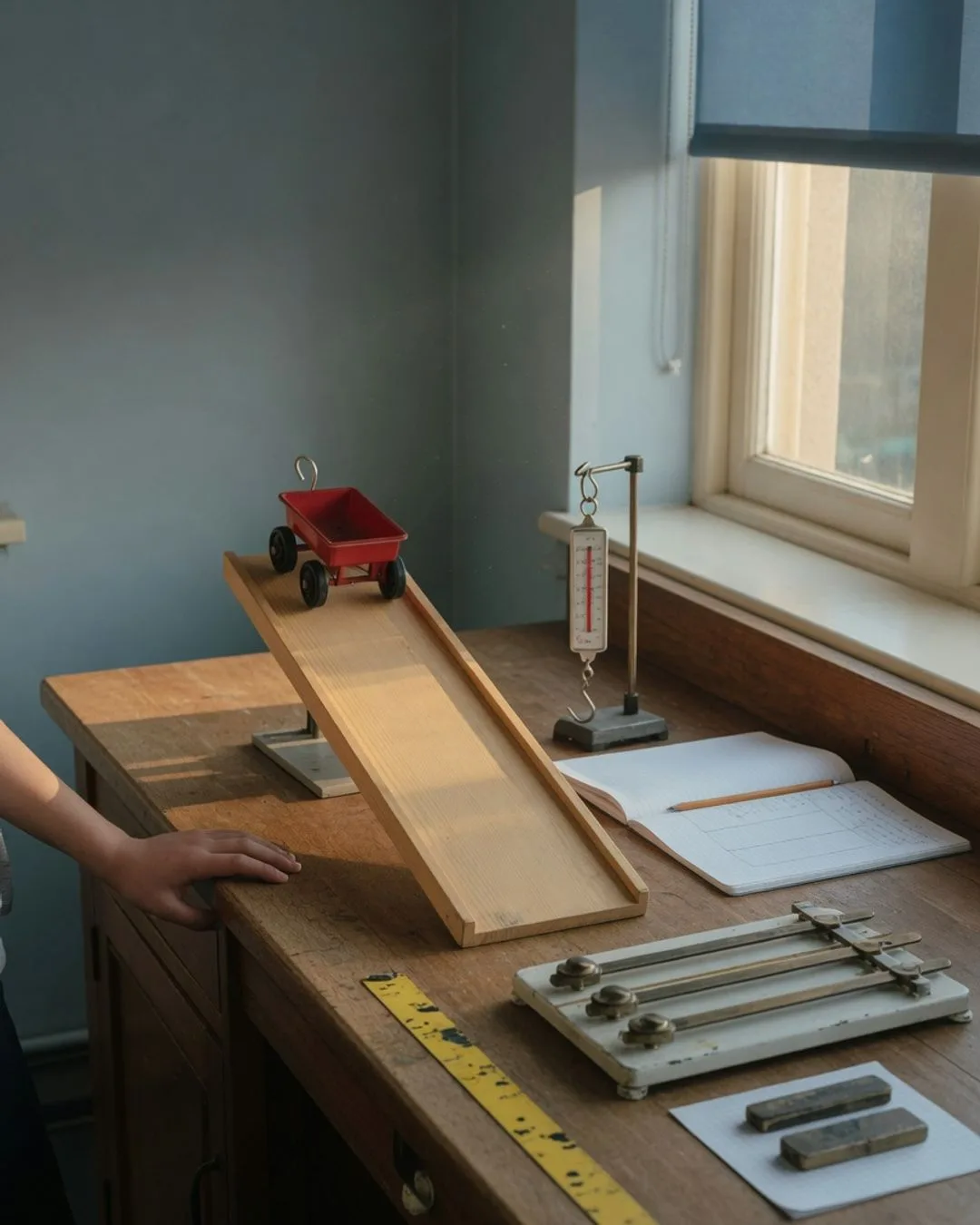
Why physical science is taught at the bench.
Physical science is hard to feel from a textbook. What a balance, a ramp, and a working circuit teach that reading never can — and why "lab-led, not textbook-led" is the whole idea.
Cram, pass, forget in physical science.
Why ideas like forces, energy, and physical versus chemical change fade fast when you cram, and what "Learn → Master → Retain" puts in place of the test-and-move-on model.
The demonstrations
The build-and-test defense.
The single moment that captures the whole course: a student with a working device they built, real measurements in hand, and a guide asking "defend your design, your data, and your math."
Measurement under uncertainty.
Reading a scale, estimating between the marks, precision versus accuracy, and honest error, and why a measurement without its uncertainty doesn't really mean anything.
Integration & AI
Integration: Faraday and the electric age.
A bookbinder's apprentice with almost no schooling, Michael Faraday taught himself science, discovered how magnets make electricity, and helped light the modern world — the story that anchors our Electricity & Magnetism unit.
AI-proof by design.
We teach students to use AI thoughtfully while assessing the skills they must demonstrate themselves. This essay explains how the two approaches support each other.