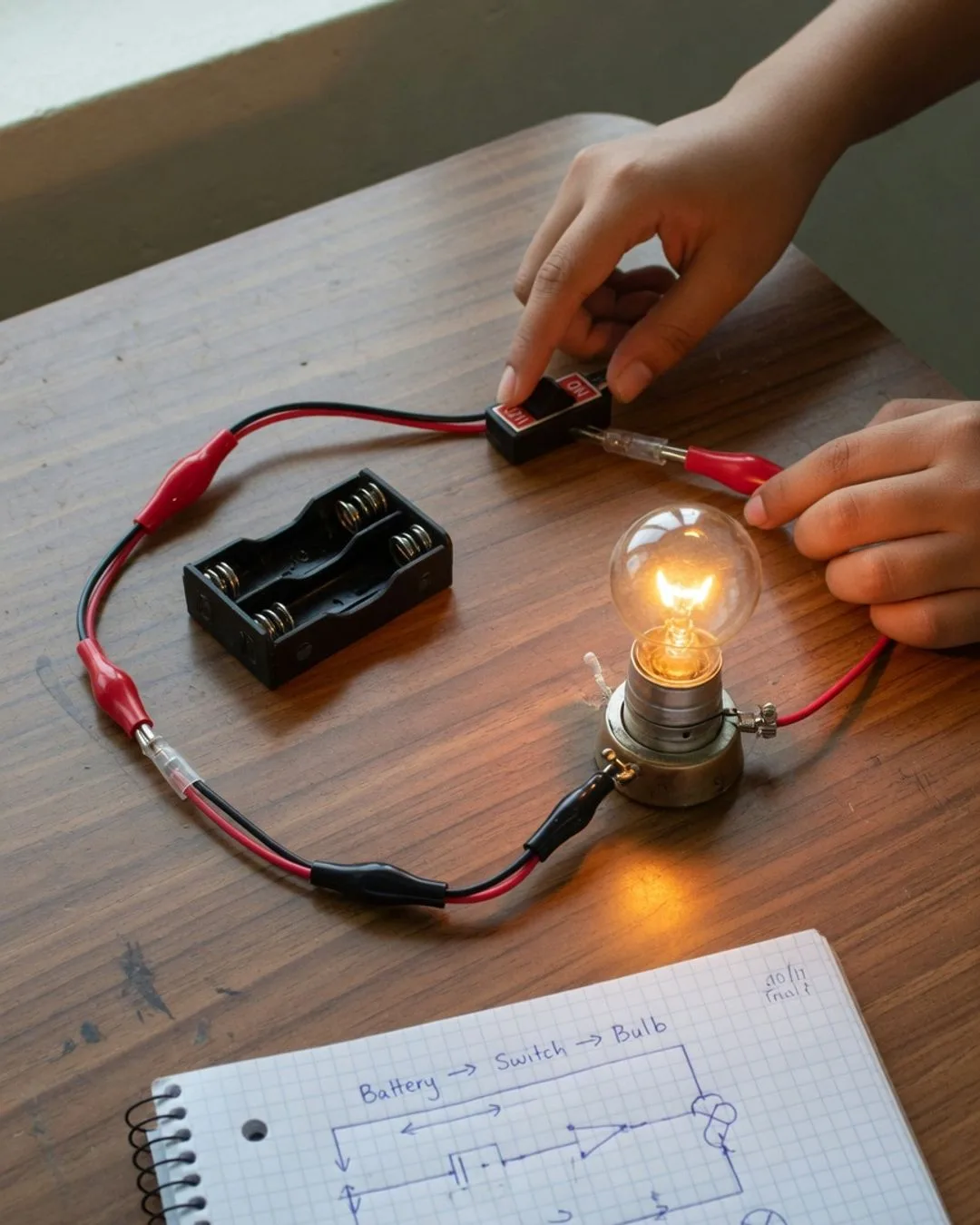
Partway through the year, after students have measured motion on a ramp, traced energy from one form to another, and wired their first circuits, the course arrives at a moment we build everything else toward: the build-and-test defense. A student sits at the bench with a real device they put together — a working circuit, a ramp, a lever, or a wave setup — a few measurements, and a guide. They show that the device works. Then the guide begins to ask: Why did you build it this way? How do you know your measurement is right? What would happen if you changed one part — and why?
It is, quite deliberately, an oral exam held over a working device the student built with their own hands. And it is the clearest single picture of what this whole course is for.
Why a defense, and not a worksheet
A worksheet hands the student a finished diagram and asks them to label it. That is a memory task, and memory is the thinnest slice of what building actually demands. The defense asks something harder and truer: put the device together yourself, on a real bench where a wire can come loose or a cart can drag; measure how it actually behaves; and then reason out loud about whether your design and your numbers hold up. That is hard to bluff. Either you know why the bulb only lights when the loop is complete, or you stand there and you don't.
Use AI to help you study for the defense. You still have to build the device, take the measurement, and explain in your own words why it works.
What the guide is actually listening for
The defense isn't a recitation. A guide is listening for three things, and the rubric makes them explicit:
- A device that actually works. Did the student build a complete, working setup (a circuit that lights, a ramp that gives a clean run, a lever that balances) or did they hand-wave past the parts that didn't quite go together?
- Design reasoning. Can the student explain why they built it this way — why the switch goes there, why the ramp needs to be smooth, why a longer lever arm makes the load easier to lift?
- The data, defended. Not just a number, but why it can be trusted: how they measured it, how many times they repeated it, and how close their trials came to agreeing.
That third one is where mastery and memorization separate. A memorized answer has no give in it; the moment the guide asks "what if we added a second battery?" or "what if the ramp were steeper?" it collapses. Real understanding flexes. It can answer the question it wasn't expecting, because it knows what the device is actually doing.
Why this is the assessment that survives the next decade
There is a practical reason the build-and-test defense sits at the center of the course, and it has to do with the world students are walking into. A take-home problem set can be generated. A multiple-choice exam can be gamed. But no tool can sit at the bench for a student, wire the circuit with their hands, and reason about the device in front of them in real time. The build-and-test defense is built around the student’s own work, not because we banned anything, but because students must demonstrate competence themselves.
Years from now, most students will not remember the exact speed of the cart or the reading on the meter. They will remember sitting at the bench, closing the switch, watching the bulb come on, and explaining to a person who kept asking why. What we are really teaching is the confidence that comes from understanding something well enough to explain it.