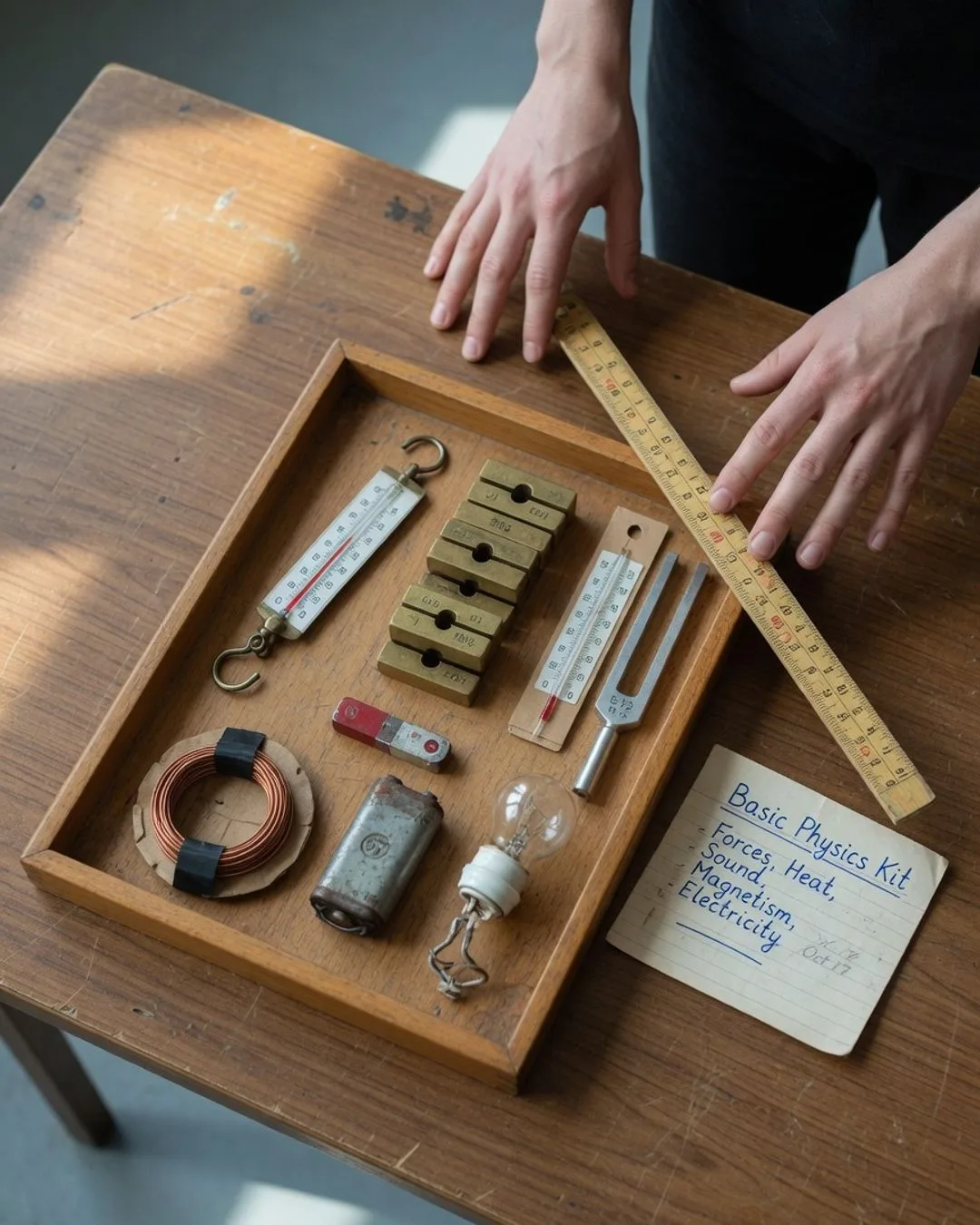
Hand a beginner a digital scale and they will copy down every digit it shows, all the way to the last flickering one, and call it the truth. Hand a careful measurer the same scale and they will tell you which of those digits mean something and which are just the tool twitching, and they will know the difference because they understand that every instrument has a limit, and writing down more than the tool can really tell you is a small kind of lie.
Learning to measure honestly is one of the quiet, foundational skills of the whole course, and it is worth slowing down to practice on its own. It is not flashy. It does not make a spark or a bang. But a student who cannot measure cannot do physical science, because every result that follows (every speed, every force, every temperature) is only as good as the numbers it was built from.
Reading between the marks
Beginners often think a measurement is just "read the number off the tool." Real measuring is more careful than that. When you read a ruler, the object almost never ends exactly on a line — it lands between the millimeter marks, and your job is to estimate that last little bit by eye. When you write down 24.6 cm, you are saying the first digits are certain and the last one is your best guess between the marks. Write 24.632 cm off a plain ruler and you are claiming to see detail the ruler never had — you are reporting confidence you do not actually have. Good measuring means writing down exactly what the tool can tell you, and not one digit more.
Precision is not accuracy
The two words get used interchangeably in ordinary speech, and the laboratory exists in part to teach the student that they are not the same thing at all:
- Precision is how closely your repeated measurements agree with each other. Three timed runs of a cart that all land within a tenth of a second are precise — even if the stopwatch was started a little late every time.
- Accuracy is how close you are to the true value. You can be right on average but jumpy trial-to-trial, or steady every time but consistently off.
- The tricky cases are the dangerous ones: data that looks beautifully consistent but is quietly wrong, because a scale that wasn't zeroed or a habit in how you read it is repeating the same mistake very reliably.
A student who internalizes this stops trusting a number just because the trials agreed, and starts asking the better question: agree with what, and compared to what?
Reading the tool, and where error comes from
Some of this is a habit of the body: getting your eye straight across from the mark so you don't read it from an angle and add a phantom millimeter, starting and stopping the stopwatch cleanly, knowing that the last digit is always an estimate. But the deeper lesson is that small errors add up. A little uncertainty in your distance and a little in your time don't stay small and separate when you use them to work out a speed — they travel into the final answer. The best defense is simple: take the measurement more than once. If your three tries land close together, you can trust the number; if they scatter, the spread is telling you how far off it might be.
A measurement reported with no sense of how far off it might be is not a careful number. It is a guess in a nicer outfit.
Doing it right when the clock is running
It is one thing to read a ruler carefully with all afternoon to do it. It is another to do it correctly during a timed run, when the cart is already moving and the next reading is coming up fast. That is on purpose. In the real practice of physical science, measurement almost always happens under a little pressure, and care that vanishes the moment things speed up was never really owned. So the course asks students to measure well and measure promptly, not because speed is the point, but because a skill you can only do slowly and undisturbed is a skill you only half-have.