Ask a student who has only read about physics what acceleration is, and they will give you a definition. Ask a student who has measured it what acceleration is, and they will tell you about the moment the cart broke free down the ramp, or the photogate clocked a speed they didn't expect, or the graph bent where the force changed. The first student has a sentence. The second has an experience, and the experience is what the sentence was always trying to point at.
That gap is the whole reason this course is built the way it is. Physics, more than any other high-school science, lives at a level you cannot observe directly. Biology has organisms you can see and dissect. Physics has motion you can watch and time, but the quantities driving that motion, force and energy and momentum, are forever invisible in themselves; you only ever see what they do. The danger is that the subject collapses into symbol-pushing: a student learns to rearrange an equation without ever believing that anything real is being described.
The bench makes the abstraction physical
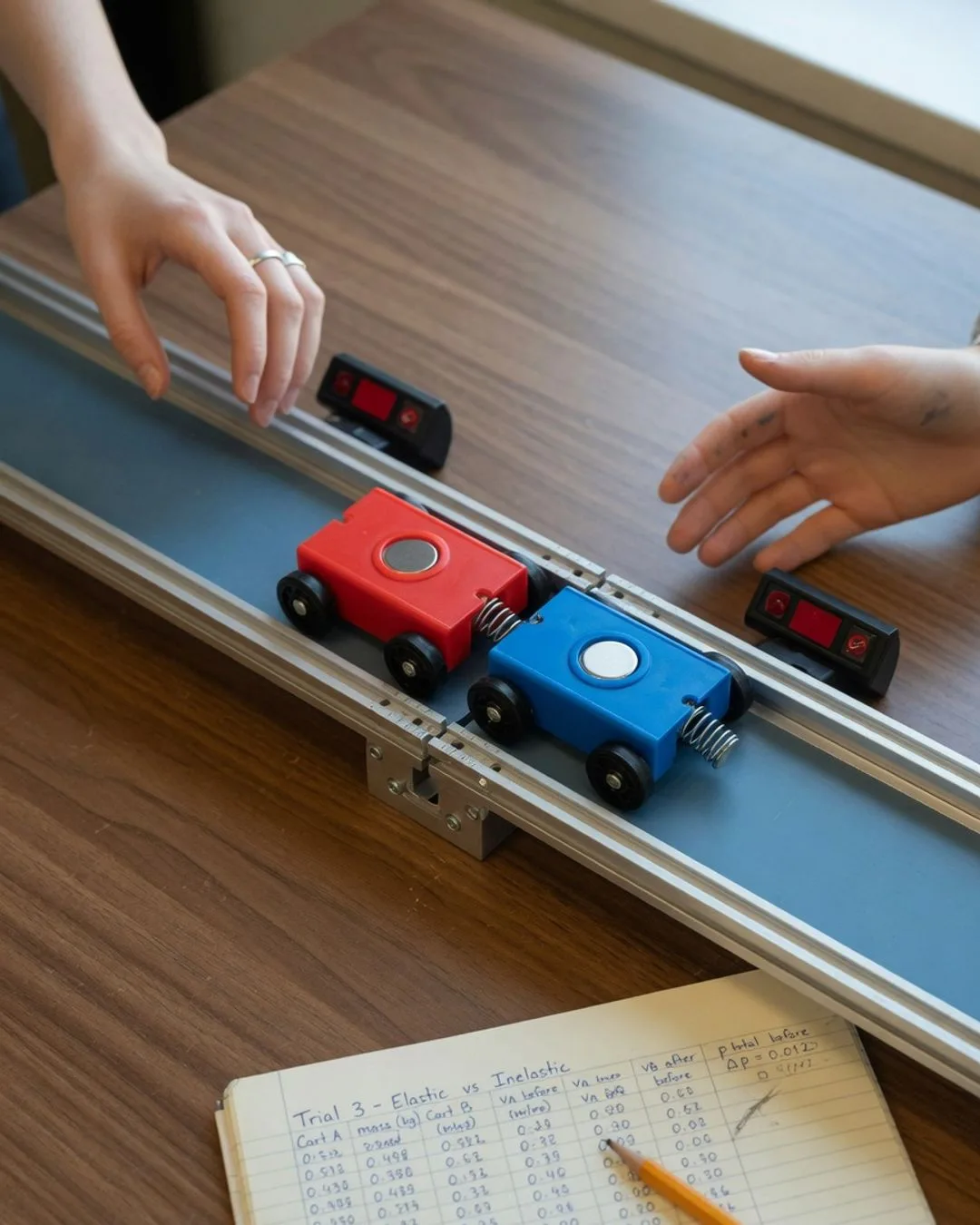
The job of the laboratory is to drag the invisible up into the visible. You cannot see acceleration, but you can send a cart through two photogates on a track and read, from the times alone, exactly how fast it is gaining speed. You cannot see the energy in a moving object, but you can lift a mass up a ramp, let it go, and watch that stored energy reappear as motion at the bottom, and measure that the books balance. You cannot see momentum, but you can run two carts into each other and know, from the speeds before and after, that a precise, conserved quantity has just passed from one to the other.
This is what we mean when we say the course is lab-led, not textbook-led. The reading does not come first, with the lab as a garnish to confirm it. The bench comes first. The question is posed where it actually lives (on a track, at a pendulum, on a force table), and the textbook is the tool we reach for to explain what we just saw. A student who has watched a cart refuse to stop until something pushes back is ready to be told about Newton's first law. A student who has only been told about Newton's first law is ready to forget it.
The equation on the page is a claim about something real. The lab is where the student finds out the claim is true.
What the bench teaches that the page cannot
Beyond making concepts concrete, the laboratory teaches a set of things a textbook structurally cannot, because they are not simply facts. They are judgments and habits that only form under real conditions:
- That measurement is hard. Reading a stopwatch to a hundredth of a second, deciding exactly when the cart crossed the mark, watching your two trials disagree — these teach humility about data that no worked example ever will.
- That the world doesn't read the textbook. Friction is never quite zero. The track isn't perfectly level. The pendulum loses a little energy each swing. Learning to reason about why the real result departs from the ideal one is a physicist's core skill.
- That technique is knowledge. How you align the photogates, how you release the mass, how long you let the motion settle, how you hold the meter stick — the answer depends on the doing, and the doing can only be learned by doing.
The two-day rhythm
Practically, this conviction becomes a schedule. The course runs on a two-day rhythm. One day is the Concept Day: the idea is introduced and worked through on paper — Newton's second law, the work–energy theorem, conservation of momentum. The next is the Experiment Day, where that same idea is made physical at the bench and written into a real lab notebook in the student's own hand. Between the two days, the student works at home, and that gap is not dead time. It is where the concept and the experience knit together into something that lasts.
We are not against the textbook; a serious physics course needs a rigorous one, and this course has it. We are against the textbook going first and the bench going second, because we have watched what that produces: a student who can recite the definition of momentum and has never once felt a loaded cart shove back against their hand. Put the bench first, and the physics stops being a vocabulary list. It becomes a thing the student has actually seen happen, which is the only kind of physics anyone remembers.