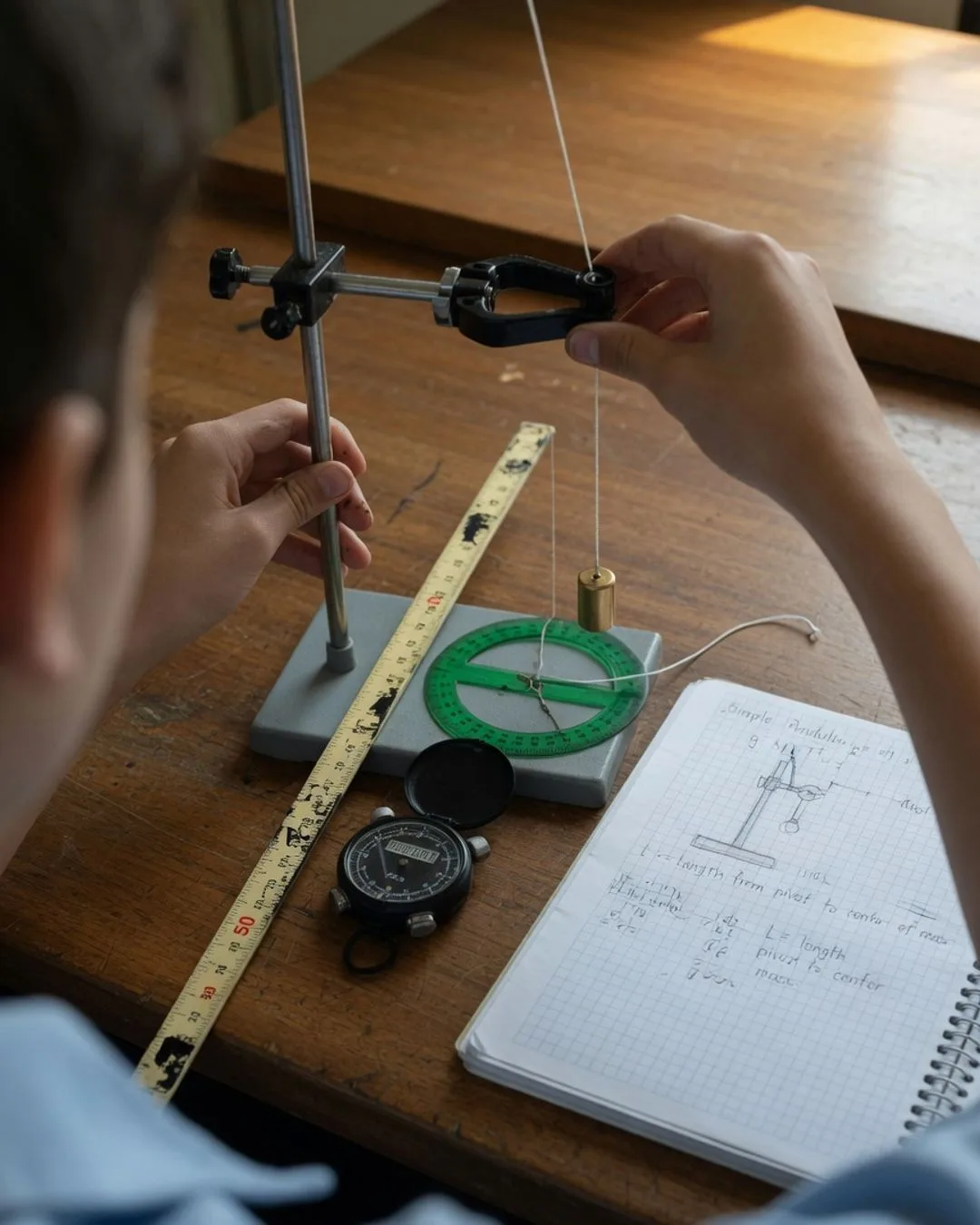
Partway through the year, after students have worked through kinematics, forces, and energy, the course arrives at a moment we build everything else toward: the apparatus build-and-defense. A student stands at the bench with a rig they designed and assembled themselves — a pendulum to measure g, say, or a cart-and-track to measure friction — a notebook of data, and a guide. They present the measurement. Then the guide begins to ask: Why that design? How did you time it, and how many trials? Show me the calculation — and tell me your uncertainty, and why it's that big.
It is, quite deliberately, an oral exam conducted over apparatus the student built. And it is the clearest single picture of what this whole course is for.
Why a defense, and not a worksheet
A worksheet hands the student clean numbers and asks them to plug into a formula. That is an arithmetic task, and arithmetic is the thinnest slice of what measurement actually demands. The defense asks something harder and truer: build the apparatus yourself, on real equipment that won't behave exactly like the textbook; read the instruments with your own eyes; and then reason out loud about whether your number means anything. That is hard to bluff. Either you know why you timed ten swings instead of one, or you stand there and you don't.
Use AI to help you plan the experiment. You still have to build the rig, take the data, and explain the uncertainty in your own words.
What the guide is actually listening for
The defense isn't a recitation. A guide is listening for three things, and the rubric makes them explicit:
- Design under control. Did the student choose a length and mass that made the effect measurable, isolate the one variable they were testing, and control the obvious confounds — or did they cobble something together and hope?
- Data discipline. Can the student explain why they repeated trials, timed many periods at once to shrink reaction-time error, and how they spotted and handled an outlier instead of quietly deleting it?
- The result, defended. Not just the right value of g, but why it's right and how far off it could be: the measured quantities, how their uncertainties propagate, and the significant figures that survive.
That third one is where mastery and memorization separate. A memorized plug-and-chug has no give in it; the moment the guide asks "what would change if you doubled the length?" it collapses. Real understanding flexes. It can answer the question it wasn't expecting, because it knows what the measurement is actually counting.
Why this is the assessment that survives the next decade
There is a practical reason the apparatus defense sits at the center of the course, and it has to do with the world students are walking into. A take-home problem set can be generated. A multiple-choice exam can be gamed. But no tool can build the rig for a student, run it with their hands, and reason about the sources of error in front of them in real time. The apparatus defense is built around the student’s own work, not because we banned anything, but because students must demonstrate competence themselves.
Years from now, most students will not remember the exact value of g they measured. They will remember standing at the bench with a rig they built, watching the stopwatch, and explaining to a person who kept asking why. What we are really teaching is the confidence that comes from understanding something well enough to explain it.