Teaching examples, not student testimonials. The sample week, model notebook, and demonstration prompts illustrate the intended learning process; they do not report an enrolled student's results. Current program status and next steps.
Look inside the Physics pack.
No sign-up, no email required. Here is a sample week, a real rubric, a model lab-notebook entry, and a sample demonstration. These are the materials themselves, not a brochure. Every sample links to the full artifact it’s drawn from.
One week, two days on the physics.
The course meets two days a week for about two hours a day, across roughly 32 weeks. Here is week one of Unit 1 — Kinematics: the student measures motion for real before a single equation is memorized.
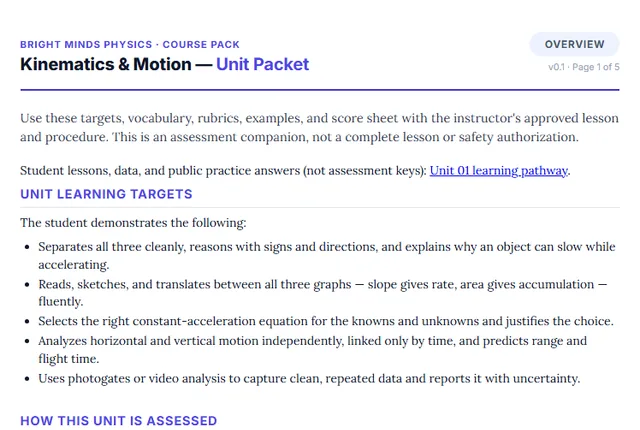
- Motion graphs (x–t, v–t, a–t)
- Sign & direction of acceleration
- Reading: Galileo’s inclined planes
- Photogate timing technique
- Repeat trials & average
- Report data with uncertainty
How “mastered” is actually judged.
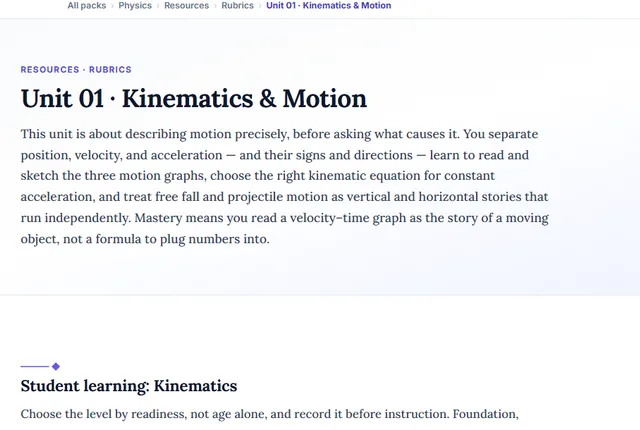
Every skill is scored at one of three levels against a published standard, without points or grading on a curve. Here is one criterion from the Kinematics rubric — lab technique: timing & motion capture, shown as a parent or guide would read it:
| Level | What it looks like — “Capture clean motion data” |
|---|---|
| Developing | Records times sloppily and ignores reaction-time error — one hurried run, no sense of how far off it might be. |
| Proficient | Collects usable data but does not repeat trials or average, so a single bad run can swing the whole result. |
| Mastery | Uses photogates or video analysis to capture clean, repeated data and reports it with an honest uncertainty — and can say which measurement limits the precision. |
The artifact a student builds, keeps, and defends.
The lab notebook is the primary record of a student's work, written in pen at the bench and explained aloud. Here is one model Experiment Day, showing how each section is recorded. Notice the crossed-out timing slip and the honest sources of error.
| Length (cm) | Period (s) |
|---|---|
| 20 | 0.90 |
| 40 | 1.27 |
| 60 | 1.55 |
| 80 | 1.80 |
- Dated & titled entries
- A testable question & hypothesis
- Units on every number
- Significant figures, honestly reported
- Calculations shown, not just answers
- Written in pen during the lab; errors crossed out, not erased
- Error analysis with direction & size
The moment that can’t be faked.
Three times a year, a student performs and defends a demonstration, standing with their own work and reasoning aloud while an adult asks unscripted follow-ups. In the timed prediction-and-test, they predict where a projectile lands from their own measurements, then run it live and account for the difference.
“Launch speed measured 3.1 m/s and the table is 0.92 m high, so it should land about 1.34 m out. It hit 1.28 m — the 6 cm short is air drag plus my release timing.”
A passing answer from the timed prediction-and-test defense — reasoning from real measurements and owning the error, not reciting a formula.
The whole pack, ready for a binder.
Everything here is available to read online. Every rubric, checklist, and guide also has a print-ready packet version, formatted 8.5×11 for a clipboard or a three-ring binder. You assemble the student’s binder from the pack itself; there’s nothing else to buy to hold it in your hands. We’ve put them all in binder order on one page: Assemble the Physics binder →
Seen enough to start?
The whole Physics pack is open to read and print. Open it and begin, or ask us a question first. A real person answers.