Unit 08 · Fluids & Pressure
The year closes by applying forces and energy to fluids — liquids and gases that flow and push. This unit defines density and pressure, shows how pressure grows with depth, and uses Archimedes' principle to predict what floats and what sinks. It finishes with Pascal's principle and the ideas behind fluid flow. Mastery means you can predict whether an object floats before you drop it in, and explain why from the fluid it displaces.
Student learning: Fluids & Pressure
Choose the level by readiness, not age alone, and record it before instruction. Foundation, core, and honors tasks are study pathways, not an AP course or a promise of college credit. The instructor retains practical assessment and the published science rubric; integration is reported separately.
Prerequisites: [pressure-hydraulics] Use pressure as force per area, density, depth, area/volume conversion and simple work calculations. [buoyancy-models] Use mass/volume density, force balance, displaced volume, fractions and Newton’s second law. [continuity-bernoulli] Use area times velocity, squared speed, energy per volume, signed height change and common pressure references.
Suggested sequence: read and discuss the explanation; attempt the worked model; analyze the data at your selected level; check the answers; then complete the source-linked response and a fresh transfer question. These activities supplement, not replace, supervised practical work and the full-year schedule.
Assigned reading and focus
- OpenStax University Physics Volume 1, 14.1 Fluids, Density, and Pressure. [pressure-hydraulics] Read density, pressure and pressure increase with depth. Distinguish pressure from force and gauge pressure from an absolute reference.
- OpenStax University Physics Volume 1, 14.3 Pascal’s Principle and Hydraulics. [pressure-hydraulics] Read the ideal hydraulic area ratio and displacement relation. An increased output force is not free energy or increased work.
- OpenStax University Physics Volume 1, 14.4 Archimedes’ Principle and Buoyancy. [buoyancy-models] Read Archimedes’ principle, floating equilibrium and apparent weight. Distinguish the submerged/displaced volume from the entire object volume.
- OpenStax University Physics Volume 1, 14.5 Fluid Dynamics. [continuity-bernoulli] Read volume flow rate and continuity. Use the same incompressible stream before comparing cross-sectional velocities.
- OpenStax University Physics Volume 1, 14.6 Bernoulli’s Equation. [continuity-bernoulli] Read pressure, kinetic and gravitational terms along a streamline. Retain elevation and stated loss/pump assumptions instead of repeating “faster always means lower pressure.”
- MacTutor, University of St Andrews: Archimedes. Read the account of the works on floating bodies and distinguish those works from later anecdotes. Compare the assigned modern buoyancy equation with the source’s historical claims.
Learn the science
Choose a readiness level before instruction. Foundation scaffolds do not by themselves satisfy every Mastery criterion. The assigned college text may also present calculus; these tasks use the stated algebraic models and geometric areas. Source/model reasoning and approved practical observation remain different evidence.
[pressure-hydraulics] Pressure references and the hydraulic force-distance trade. Pressure is normal force per area. In a stationary constant-density fluid, pressure increases by rho g depth below a reference surface. Gauge pressure measures relative to the ambient reference; absolute pressure adds that reference. An ideal same-height hydraulic pair transmits the applied pressure increment, giving Fout/Fin = Aout/Ain. Incompressible volume conservation requires Ain xin = Aout xout, so the larger force travels a smaller distance.
[pressure-hydraulics] Assumptions: The tank is open to the stated uniform atmosphere and contains stationary incompressible fluid with constant density and g. The hydraulic example is separate: pistons are at equal height with equal ambient pressure, negligible piston weight/friction and no leakage. Forces refer to the additional applied load after baseline pressures balance. All quantities are paper inputs, not a pressure-system design.
[pressure-hydraulics] Uncertainty: Real fluids can vary in density; real pistons have seal friction, weight, leakage and height differences. Pressure-force calculations require the loaded area and the correct reference. Ideal equal work does not establish real efficiency, structural strength or safe operation at the modeled pressures.
[buoyancy-models] Displaced volume, floating equilibrium and apparent weight. For a body in a constant-density fluid, buoyancy equals the weight of displaced fluid: rho g Vdisplaced. An unsupported body floating at rest has buoyancy equal to its weight; only enough volume submerges to supply that force. A fully immersed dense body can require an upward support force equal to weight minus buoyancy. If support is removed, the initial net force determines acceleration before drag grows.
[buoyancy-models] Assumptions: Use rigid bodies with fixed volume in a stationary incompressible fluid. Neglect air buoyancy, surface tension and drag for the initial acceleration. The light body floats freely; the heavy body is first fully immersed and held at rest by an upward support. These are separate stated conditions, not contradictory buoyancy formulas.
[buoyancy-models] Uncertainty: Volume, fluid density, trapped air, body deformation and contact forces matter in real measurements. Greater depth increases both top and bottom pressures; for a fixed-volume fully immersed body in constant-density fluid, the net buoyancy does not grow simply because absolute pressure is larger. This model does not assess floating stability or a real vessel.
[continuity-bernoulli] Flow continuity, height and the limits of a pressure prediction. For steady incompressible flow with no branch or leak, A1 v1 = A2 v2. Ideal Bernoulli accounting along one streamline gives P + rho v^2/2 + rho g z constant when relevant losses and added mechanical energy are negligible. The terms are energy per volume, in Pa. A narrower section can raise speed, while elevation and energy additions/losses also affect pressure. The assumptions, not a slogan, determine the prediction.
[continuity-bernoulli] Assumptions: Use steady incompressible flow along the same streamline with no branch, leak or pump between sections. Density is constant, section velocities represent the supplied ideal profile, and the ideal prediction neglects viscous losses. Both pressures use the same gauge reference and z uses one common vertical datum. The separate reported downstream pressure is a synthetic comparison, not a verified instrument measurement.
[continuity-bernoulli] Uncertainty: A pressure residual can reflect losses, sensor offsets, wrong flow/elevation inputs or failure of the assumed steady model. It does not identify viscosity or a unique mechanism by itself. Flow-dependent losses need their own model; do not carry an old residual unchanged into a different geometry. No pipe, pump or pressure-device construction is assigned.

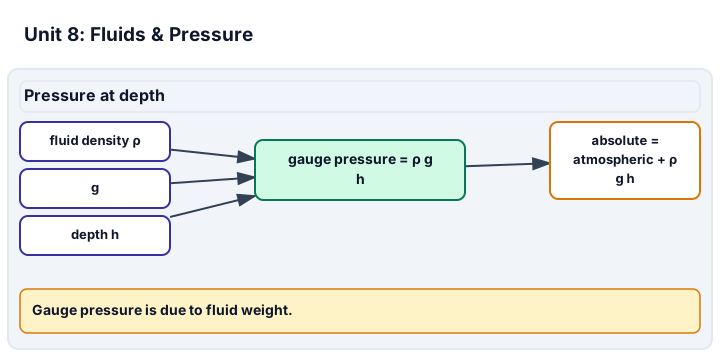
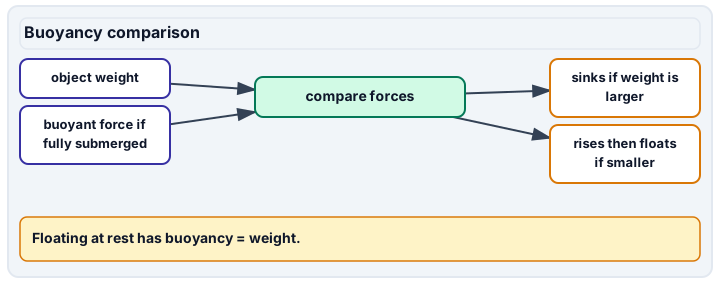
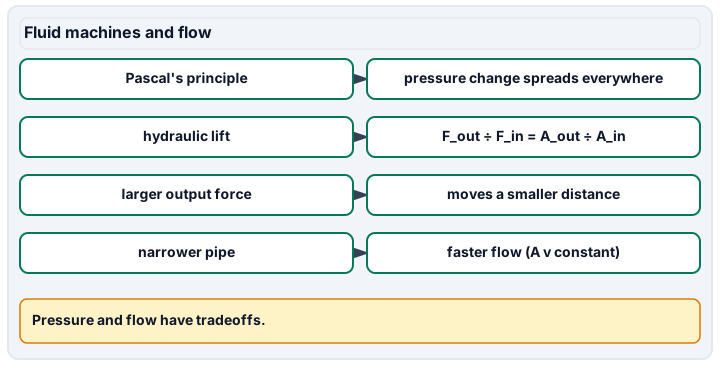
Diagram description
Pressure at depth uses density, g and depth for gauge pressure and adds atmospheric pressure for absolute pressure. Buoyancy comparison compares object weight to full-submergence buoyant force. Fluid machines and flow states Pascal's principle, hydraulic area ratio, distance tradeoff and continuity.
Data, provenance, and assumptions
| Quantity | Value | Unit / meaning |
|---|---|---|
| rho | 1000 | kg/m^3 |
| g | 9.81 | m/s^2 |
| depth | 3 | m below free surface |
| Patm | 101300 | Pa absolute at the surface |
| Quantity | Value | Unit / meaning |
|---|---|---|
| Ain | 0.0005 | m^2 |
| Aout | 0.01 | m^2 |
| Fin | 100 | N additional input force |
| xin | 0.2 | m input travel |
| Quantity | Value | Unit / meaning |
|---|---|---|
| rho | 1000 | kg/m^3 |
| g | 9.81 | m/s^2 |
| Body | Mass (kg) | Complete volume (m^3) |
|---|---|---|
| Light body | 0.6 | 0.001 |
| Heavy body | 1.5 | 0.001 |
| Quantity | Value | Unit / meaning |
|---|---|---|
| rho | 1000 | kg/m^3 |
| g | 9.81 | m/s^2 |
| A1 | 0.004 | m^2 upstream |
| v1 | 1.5 | m/s upstream |
| A2 | 0.001 | m^2 downstream |
| z1 | 0 | m datum |
| z2 | 1 | m above datum |
| P1 | 150000 | Pa gauge upstream |
| P2reported | 115315 | Pa gauge; synthetic comparison |
Paper investigation sequence and evidence record
Scope and safety: These are supplied-data and paper-model investigations, not laboratory procedures. No launches, high-speed rotors, elevated loads, pressurized vessels, hydraulic builds or improvised apparatus are assigned. An educator must approve any actual practical, equipment, facilities and accessible alternative separately. Synthetic records do not certify hands-on skill or performed lab hours; public answers are nonsecure practice.
Materials and preparation
- [pressure-hydraulics] Use the supplied pressure-inputs, hydraulic-inputs records, assigned source sections, calculator and an accessible graph or diagram. No physical apparatus is required.
- [buoyancy-models] Use the supplied buoyancy-fluid, buoyancy-bodies records, assigned source sections, calculator and an accessible graph or diagram. No physical apparatus is required.
- [continuity-bernoulli] Use the supplied flow-inputs records, assigned source sections, calculator and an accessible graph or diagram. No physical apparatus is required.
Procedure and schedule
- [pressure-hydraulics] Question: Which pressure differences change force, and how does ideal hydraulic volume conservation constrain output work? Prerequisites: Use pressure as force per area, density, depth, area/volume conversion and simple work calculations.
- [pressure-hydraulics] Variables: Change the ambient pressure only in the tank transfer; compare piston areas in the separate ideal hydraulic model. Controls: Retain constant density, surface reference, same-height pistons and matched ambient pressures within their respective models. Replication: Check pressure and work through independent ledgers; there are no repeated pressure or piston measurements in these inputs.
- [pressure-hydraulics] Analysis: Compute hydrostatic difference before adding the reference; calculate hydraulic force and travel from pressure and volume, then verify energy. Review: An educator reviews prerequisites, source interpretation, reasoning and accessibility before assessment. A paper response does not certify unobserved practical technique; approved hands-on work requires a separate record.
- [buoyancy-models] Question: Which volume belongs in a buoyancy equation for a freely floating versus a fully immersed supported object? Prerequisites: Use mass/volume density, force balance, displaced volume, fractions and Newton’s second law.
- [buoyancy-models] Variables: Compare the stated support and immersion conditions; the transfer changes both body mass and fluid density explicitly. Controls: Retain rigid volume, constant-density fluid and the neglect of drag only for the initial acceleration calculation. Replication: Reconcile density and force approaches for the same synthetic inputs; no real displaced-fluid volumes or repeat weighings are supplied.
- [buoyancy-models] Analysis: Choose the displaced volume from the physical condition, calculate buoyancy, close the force ledger and distinguish initial acceleration from a terminal-speed problem. Review: An educator reviews prerequisites, source interpretation, reasoning and accessibility before assessment. A paper response does not certify unobserved practical technique; approved hands-on work requires a separate record.
- [continuity-bernoulli] Question: How much pressure change follows from the stated flow and height, and what remains unknown when a comparison value differs? Prerequisites: Use area times velocity, squared speed, energy per volume, signed height change and common pressure references.
- [continuity-bernoulli] Variables: Compare section area, elevation and the fictional reported pressure; the transfer changes downstream area only. Controls: Retain one streamline, steady incompressible flow, common pressure datum and no pump for the ideal prediction. Replication: The model plus one fictional comparison is not a set of independent measurements or a validated loss correlation.
- [continuity-bernoulli] Analysis: Apply continuity first, calculate both kinetic and elevation pressure terms, compare the residual and state which missing evidence would discriminate explanations. Review: An educator reviews prerequisites, source interpretation, reasoning and accessibility before assessment. A paper response does not certify unobserved practical technique; approved hands-on work requires a separate record.
Record: Retain pressure-hydraulics, the selected level, original inputs and first attempt, source/date, system and axes, units, assumptions, calculation/graph, uncertainty, correction and fresh transfer. Link only to the stated science criteria. Retain buoyancy-models, the selected level, original inputs and first attempt, source/date, system and axes, units, assumptions, calculation/graph, uncertainty, correction and fresh transfer. Link only to the stated science criteria. Retain continuity-bernoulli, the selected level, original inputs and first attempt, source/date, system and axes, units, assumptions, calculation/graph, uncertainty, correction and fresh transfer. Link only to the stated science criteria.
Worked model
[pressure-hydraulics] Tank gauge pressure is 1000(9.81)(3) = 29430 Pa; absolute pressure is 101300 + 29430 = 130730 Pa. In the separate hydraulic model, pressure increment is 100/0.0005 = 200000 Pa and output force is 2000 N. Volume balance gives output travel 0.01 m. Input and output work are both 20 J. [buoyancy-models] The light body has density 600 kg/m^3 and floats with 0.6 of its volume submerged: Vdisplaced = 0.6/1000 = 0.0006 m^3. The heavy body displaces 0.001 m^3 when fully immersed, receiving 9.81 N buoyancy. Its weight is 14.715 N, so upward support is 4.905 N. Immediately after support removal, downward acceleration is 4.905/1.5 = 3.27 m/s^2 before drag. [continuity-bernoulli] Volume flow is 0.004(1.5) = 0.006 m^3/s and downstream speed 6 m/s. Ideal P2 = 150000 + 0.5(1000)(1.5^2 - 6^2) + 1000(9.81)(0 - 1) = 123315 Pa gauge. The reported synthetic value is 8000 Pa lower. That is a pressure/energy-per-volume residual, not automatic proof of one specific loss mechanism.
Numerical calibration
- 29430 Pa
- 130730 Pa absolute
- 200000 Pa additional pressure
- 2000 N
- 0.01 m
- 20 J
- 110730 Pa absolute under the lower atmosphere
- 0.6 fraction submerged
- 0.0006 m^3
- 9.81 N upward
- 4.905 N support force
- 3.27 m/s^2 initial downward
- 0.875 fraction submerged in the new fluid
- 0.006 m^3/s
- 6 m/s
- 123315 Pa gauge
- 8000 Pa or J/m^3
- 136815 Pa gauge in the new ideal geometry
Attempt the assigned level
Try the tasks before reading the calibration. These are practice answers, not a secure examination; use a new dataset or changed assumption for the assessed transfer.
Foundation
- [pressure-hydraulics] Explain the difference between pressure and force, identify the tank pressure reference, and predict whether a wider output piston increases distance as well as force.
- [buoyancy-models] Compare the two body densities with the fluid and distinguish floating from a heavy body held fully immersed. Explain why object weight is not automatically the buoyant force in both cases.
- [continuity-bernoulli] Explain why the same incompressible volume rate gives a larger speed in a narrower section, and name the three different energy-per-volume terms in the ideal equation.
Check after your attempt
- [pressure-hydraulics] Pressure is force per area, not force alone. The open tank surface has the given atmospheric absolute pressure and zero gauge pressure. A larger ideal output piston increases force but decreases displacement for the same moved fluid volume.
- [buoyancy-models] Densities are 600 and 1500 kg/m^3 versus fluid density 1000. The light body can float with partial immersion; the heavy one needs support to remain stationary when fully immersed. Only a freely floating equilibrium has buoyancy equal to weight with no additional vertical support.
- [continuity-bernoulli] With no accumulation, branch or leak, the same volume crosses each section per second, so smaller area requires larger speed. Bernoulli accounts for pressure, kinetic and gravitational energy per volume; ignoring height or energy additions can give an incorrect pressure comparison.
High-school core: typically grades 9-10
- [pressure-hydraulics] Calculate tank gauge and absolute pressure, then independently calculate the hydraulic pressure increment, output force and output travel. Do not mix the two separate examples.
- [buoyancy-models] Calculate the light body’s displaced volume and the heavy body’s buoyancy and support force. Draw complete vertical force balances for the two stated conditions.
- [continuity-bernoulli] Calculate flow rate, downstream speed and ideal downstream gauge pressure while retaining the one-meter elevation increase. Check the units of every term.
Check after your attempt
- [pressure-hydraulics] The tank values are 29430 Pa gauge and 130730 Pa absolute. The hydraulic pressure increment is 200000 Pa, output force 2000 N and travel 0.01 m. The hydraulic increment is not the pressure at the bottom of the separate tank.
- [buoyancy-models] The light body displaces 0.0006 m^3 and has buoyancy equal to its 5.886 N weight. The heavy body has buoyancy 9.81 N and needs 4.905 N upward support to balance its 14.715 N weight. Using the light body’s full volume would incorrectly predict its floating force.
- [continuity-bernoulli] Q = 0.006 m^3/s and v2 = 6 m/s. The kinetic term changes pressure by -16875 Pa and the height term by -9810 Pa, giving P2 = 123315 Pa gauge. Each Bernoulli term has Pa, equivalently J/m^3, units.
Honors extension: typically grades 11-12
- [pressure-hydraulics] Compare input/output work and evaluate an advertisement claiming the area ratio multiplies available energy. Identify a real-system effect omitted by the ideal calculation.
- [buoyancy-models] Find the heavy body’s initial acceleration when support is removed, then assess a claim that moving it deeper must increase its buoyancy under this model.
- [continuity-bernoulli] Calculate the discrepancy from the fictional reported pressure and evaluate whether it uniquely measures viscosity. State what additional evidence would test the alternatives.
Check after your attempt
- [pressure-hydraulics] Input work is 100(0.2) = 20 J and output work is 2000(0.01) = 20 J. The area ratio trades force for distance; it does not multiply energy. Friction, leakage, piston weight and unequal elevations would require additional forces or energy terms.
- [buoyancy-models] Its initial net downward force is 4.905 N, giving 3.27 m/s^2 before drag becomes important. At greater depth, both surface pressures increase, but their net force remains rho g V for fixed volume and density. Compressibility, density gradients or deformation would change those assumptions.
- [continuity-bernoulli] The reported pressure is 8000 Pa below the ideal prediction. This does not prove a unique loss or viscosity value; calibration, actual flow/profile, geometry, elevation, steady conditions and a justified loss model need checking. A pressure residual alone cannot separate those causes.
History, reading, and writing connection
Use the Archimedes biography to distinguish a documented mathematical work, a later story and a modern supplied-data prediction. Connect the fluid force balance to a cited historical question, then explain why the Bernoulli residual does not identify a unique cause. The original teaching data are not historical measurements.
Write in your own words or use an approved accessible equivalent. Cite a specific assigned section or figure, identify its evidence, and state one limitation or counterargument. Use the AI practice contract only for permitted coaching, never to invent observations or write the assessed response.
Transfer to a new case
[pressure-hydraulics] Keep the tank density and 3 m depth but lower the atmospheric reference to 81300 Pa. Find the new absolute pressure and explain whether the hydrostatic gauge increase changes. [buoyancy-models] A separate 0.7 kg rigid body of volume 0.001 m^3 is placed in an ideal fluid of density 800 kg/m^3. Can it float without support, and what fraction of its volume must be submerged? [continuity-bernoulli] Change only the downstream area to 0.002 m^2, retaining the same upstream rate and one-meter rise. Predict ideal downstream pressure, and explain why the earlier 8000 Pa residual is not automatically a correction for this new geometry.
Calibration: [pressure-hydraulics] The gauge increase remains rho g depth = 29430 Pa. New absolute pressure is 81300 + 29430 = 110730 Pa. The changed surface reference shifts the absolute value without changing the constant-density hydrostatic difference. [buoyancy-models] Its density is 700 kg/m^3, below the fluid density, so floating force balance is possible. The submerged fraction is 0.7/(800 x 0.001) = 0.875. This predicts vertical force balance, not stability, material strength or a performed floating test. [continuity-bernoulli] New downstream speed is 3 m/s. Ideal pressure is 150000 + 0.5(1000)(1.5^2 - 3^2) - 9810 = 136815 Pa gauge. Real losses can change with speed and geometry; without a new loss model or data, subtracting the old 8000 Pa is not justified.
Evidence to retain
[pressure-hydraulics] Science criteria 1 and 3: pressure/density units, explicit gauge/absolute references and a hydraulic volume/work ledger. No pressure handling or equipment certification follows. [buoyancy-models] Science criteria 1 and 2: density comparison, displaced-volume choice, buoyant/support force balances and a qualified changed-fluid prediction. Supplied values do not certify the buoyancy-measurement practical. [continuity-bernoulli] Science criterion 4: continuity with compatible units, a quantitative Bernoulli height/pressure ledger and a non-unique residual critique. This supplied-data work does not certify pressure or flow apparatus technique.
Record units, calculations, source/date, uncertainty, and what is measured versus inferred. A simulation or supplied dataset must stay labeled as such. These are supplied-data and paper-model investigations, not laboratory procedures. No launches, high-speed rotors, elevated loads, pressurized vessels, hydraulic builds or improvised apparatus are assigned. An educator must approve any actual practical, equipment, facilities and accessible alternative separately. Synthetic records do not certify hands-on skill or performed lab hours; public answers are nonsecure practice.
Return to all eight learning pathways. Print this unit page for the student lessons; the linked five-page packet remains the separate assessment companion.
Match evidence to the actual criterion
Integration is reported separately and cannot lower the science grade or block a science demonstration pass. Science and practical criteria determine that pass. The paper cases assess named analytical criteria, not unobserved hands-on technique. Use an educator-selected fresh variant and retain the first attempt.
- Pressure references and the hydraulic force-distance trade: science criteria 1, 3.
- Displaced volume, floating equilibrium and apparent weight: science criteria 1, 2.
- Flow continuity, height and the limits of a pressure prediction: science criteria 4.
Unit mastery rubric
| Criterion | Developing | Proficient | Mastery |
|---|---|---|---|
| Density & pressure | Confuses mass with density or force with pressure. | Computes each but not how pressure changes with depth. | Uses density and hydrostatic pressure with compatible units; distinguishes force, gauge pressure and absolute pressure. |
| Buoyancy & Archimedes' principle | Thinks heavy things always sink. | States Archimedes' principle but cannot apply it to predict floating. | Predicts float or sink from the weight of displaced fluid and defends the reasoning quantitatively. |
| Pascal's principle | Does not see how pressure transmits through a fluid. | Knows a hydraulic lift multiplies force but not why. | Explains Pascal's principle and how a hydraulic system trades distance for force at equal pressure. |
| Fluid flow | Ignores that speed and area are related in flow. | Recalls that narrowing speeds flow but not the pressure consequence. | Calculates continuity and Bernoulli pressure with elevation, stated streamline/loss assumptions and a bounded interpretation of discrepancies. |
| Lab technique (buoyancy measurement) | Estimates buoyancy by eye with no measurement. | Weighs an object in and out of water but does not compare to displaced volume. | Measures the buoyant force and the displaced fluid and verifies Archimedes' principle with uncertainty. |
| Integration (cross-domain) | Makes no supported connection between the source and the science. | Uses the source but needs help connecting evidence, writing, or limitations to the science. | Independently connects History, Reading, and Writing using a cited source, appropriate evidence, a limitation, and a scientific explanation. |
Integration is reported separately and cannot lower the science grade or block a science demonstration pass. Science and practical criteria determine that pass. Use the integration guide's evidence checklist for the separately reported criterion.
“A freely floating object at rest displaces its own weight of fluid. A supported immersed object can have buoyancy smaller than its weight. In our synthetic heavy-body case, 9.81 N buoyancy plus 4.905 N support balances 14.715 N weight. This is a checked model, not my measured practical result.”
“Metal always sinks and light stuff always floats, and pressure is the same everywhere in the tank.”
You demonstrate this unit through buoyancy labs plus short oral checks where you predict floating and explain it aloud — not a multiple-choice test. A criterion counts as mastered only when you can both take clean data and justify the physics behind it. Mastery is demonstrated, not awarded.
A 5-page clipboard packet — unit overview, key terms, the mastery rubric, anchor examples, and a score sheet you can print and grade against.