Unit 07 · Torque & Rotational Motion
Force makes things move; torque makes things turn. This unit builds torque as force times lever arm, uses the balance of torques to solve static-equilibrium problems, and then extends Newton's ideas into rotation with rotational inertia and angular momentum. Mastery means you can find where a beam balances, explain why a figure skater speeds up when she pulls her arms in, and treat rotation as its own consistent parallel to linear motion.
Student learning: Torque & Rotational Motion
Choose the level by readiness, not age alone, and record it before instruction. Foundation, core, and honors tasks are study pathways, not an AP course or a promise of college credit. The instructor retains practical assessment and the published science rubric; integration is reported separately.
Prerequisites: [torque-dynamics] Use sine of a supplied angle, signed forces, radians, squared radii and constant-acceleration algebra. [rolling-energy] Use I = beta m R^2, energy conservation, radians, force components and a static-friction inequality. [angular-impulse] Use torque-time areas, signed L = I omega, fixed-axis assumptions and rotational kinetic energy.
Suggested sequence: read and discuss the explanation; attempt the worked model; analyze the data at your selected level; check the answers; then complete the source-linked response and a fresh transfer question. These activities supplement, not replace, supervised practical work and the full-year schedule.
Assigned reading and focus
- OpenStax University Physics Volume 1, 10.6 Torque. [torque-dynamics] Read the perpendicular moment arm and torque direction. Identify the pivot and angle between the radius and force, not just the length of an object.
- OpenStax University Physics Volume 1, 10.7 Newton’s Second Law for Rotation. [torque-dynamics] Read the fixed-axis form sum(torque) = I alpha and its assumptions. Relate angular variables in radians to tangential motion and distinguish equilibrium from angular acceleration.
- OpenStax University Physics Volume 1, 11.1 Rolling Motion. [rolling-energy] Read rolling without slipping, rotational/translational energy and the required static friction. Use the stated ideal body factors; do not assume every surface can support no-slip rolling.
- OpenStax University Physics Volume 1, 11.2 Angular Momentum. [angular-impulse] Read angular momentum about a specified axis and angular impulse. Calculate area from the supplied torque-time segments rather than inferring conservation during an external torque.
- OpenStax University Physics Volume 1, 11.3 Conservation of Angular Momentum. [angular-impulse] Read changing inertia with negligible external torque. Distinguish conserved angular momentum from the rotational kinetic energy and internal energy needed to rearrange the system.
- MacTutor, University of St Andrews: Archimedes. Read the discussion of Archimedes’ mechanics and surviving works, distinguishing later accounts from direct evidence. Our SI-unit bar and rotor records are modern models, not recovered ancient measurements.
Learn the science
Choose a readiness level before instruction. Foundation scaffolds do not by themselves satisfy every Mastery criterion. The assigned college text may also present calculus; these tasks use the stated algebraic models and geometric areas. Source/model reasoning and approved practical observation remain different evidence.
[torque-dynamics] Axis-specific inertia, net torque and rotational motion. For a fixed axis, signed torque has magnitude r F sin(angle), and the net torque accelerates a rigid body according to net torque = I alpha when I is constant. For point masses I = sum(m r^2) about that same axis. With constant alpha, omega = omega0 + alpha t and angular displacement = omega0 t + alpha t^2/2. A point at radius R has tangential speed R omega. Constant-torque work is torque times angular displacement; torque and energy both have N m dimensions but are not interchangeable quantities.
[torque-dynamics] Assumptions: Two point masses are attached to ideal massless rigid spokes rotating in a horizontal plane about a fixed vertical axis. Bearing constraints hold the axis; gravitational forces contribute no torque about that vertical axis. Counterclockwise is positive. The applied force has the stated positive torque, drag is opposite, and both remain constant during the interval. A separate massless stationary bar has downward loads at signed horizontal positions; it is not the rotating object.
[torque-dynamics] Uncertainty: A real extended object has its own inertia and may need additional terms; radius and angle uncertainty can strongly affect torque/inertia. The point-mass model does not measure bearing losses or certify a spinning apparatus. Zero net torque alone does not establish static equilibrium unless translational force balance and appropriate initial motion are also addressed.
[rolling-energy] Rolling energy requires a physically possible no-slip condition. For ideal rolling without slipping, v = R omega and total kinetic energy is m v^2/2 + I omega^2/2. With I = beta m R^2 and release from rest through height h, v = sqrt(2 g h/(1 + beta)). On a fixed incline, a = g sin(theta)/(1 + beta) and the needed upslope static-friction magnitude is beta m a. At a stationary contact on an ideal fixed surface, static friction does no net mechanical work on the whole rigid body; that does not mean its force or torque is absent.
[rolling-energy] Assumptions: Bodies are rigid, initially at rest, and descend an incline with the supplied common height and angle. Ignore deformation, rolling resistance and air drag. The model coefficients describe a solid cylinder, thin hoop and solid sphere. Check the static-friction inequality before applying the no-slip/energy prediction. Linear and angular speeds below are magnitudes for the descending body.
[rolling-energy] Uncertainty: Real body shape and mass distribution can differ from ideal beta values. A low-friction surface can violate the assumed rolling constraint; then v = R omega and the loss-free rolling answer cannot simply be retained. Friction direction depends on the driving situation; the upslope result here is for a body released on a fixed incline, not every powered wheel.
[angular-impulse] External angular impulse and internal energy during contraction. About a fixed axis, angular impulse changes angular momentum: final L = initial L + torque-time area. For the stated fixed-axis rigid stages, L = I omega. When a later internal rearrangement occurs with zero net external torque about that axis, L stays fixed while I and omega can change. Rotational kinetic energy L^2/(2I) need not stay fixed; an internal actuator can supply work from an internal energy store.
[angular-impulse] Assumptions: Use one fixed vertical axis and counterclockwise-positive signs. I remains I0 throughout the external torque pulse. After that pulse ends, an internal actuator reduces inertia to Ifinal with negligible external torque. Initial and final radial speeds are zero and other losses are neglected, so the change in rotational kinetic energy measures the required internal mechanical work in this model.
[angular-impulse] Uncertainty: Actual bearing torque, changing-axis motion, radial kinetic energy and dissipative losses could change the accounting. The three synthetic pulse samples specify straight interpolation, not instrument bandwidth. A reduction in inertia cannot be assumed energetically free merely because external torque is zero.

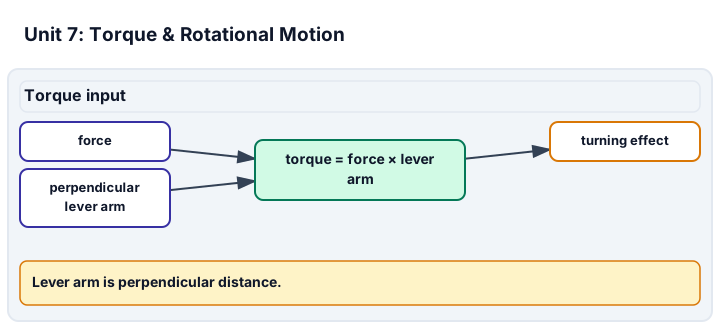
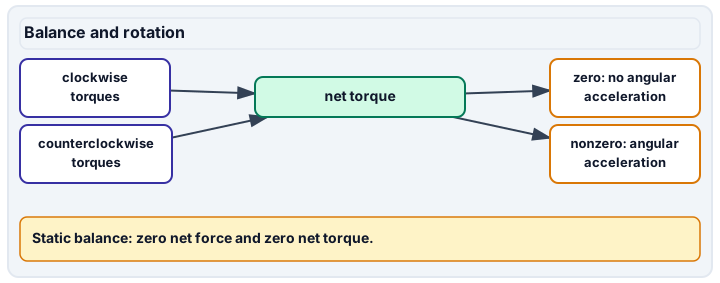
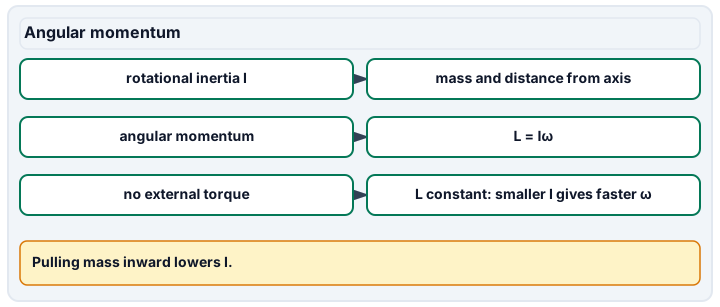
Diagram description
Torque input uses force and perpendicular lever arm for torque. Balance and rotation combines clockwise and counterclockwise torques into net torque and distinguishes zero from nonzero net torque. Angular momentum states rotational inertia, angular momentum, and conservation when external torque is absent.
Data, provenance, and assumptions
| Mass location | Mass (kg) | Radius (m) |
|---|---|---|
| Inner | 1 | 0.2 |
| Outer | 1 | 0.4 |
| Quantity | Value | Unit / meaning |
|---|---|---|
| r | 0.25 | m; force application radius |
| F | 8 | N |
| angle | 30 | degrees between radius and force |
| drag | 0.2 | N m; opposing magnitude |
| omega0 | 2 | rad/s counterclockwise |
| time | 3 | s |
| rim | 0.4 | m; point used for tangential speed |
| Load | Signed x (m) | Vertical force (N) |
|---|---|---|
| Left load | -0.3 | -2 |
| Right load | 0.2 | -3 |
| Quantity | Value | Unit / meaning |
|---|---|---|
| m | 2 | kg |
| R | 0.1 | m |
| h | 0.7 | m vertical fall |
| theta | 30 | degrees |
| g | 9.81 | m/s^2 |
| muS | 0.4 | available static coefficient |
| Body model | beta in I = beta m R^2 |
|---|---|
| Solid cylinder | 0.5 |
| Thin hoop | 1 |
| Solid sphere | 0.4 |
| Quantity | Value | Unit / meaning |
|---|---|---|
| I0 | 0.2 | kg m^2 during pulse |
| omega0 | 10 | rad/s counterclockwise initially |
| Ifinal | 0.1 | kg m^2 after contraction |
| Time (s) | External torque (N m) |
|---|---|
| 0 | 0 |
| 0.5 | 1 |
| 1 | 0 |
Paper investigation sequence and evidence record
Scope and safety: These are supplied-data and paper-model investigations, not laboratory procedures. No launches, high-speed rotors, elevated loads, pressurized vessels, hydraulic builds or improvised apparatus are assigned. An educator must approve any actual practical, equipment, facilities and accessible alternative separately. Synthetic records do not certify hands-on skill or performed lab hours; public answers are nonsecure practice.
Materials and preparation
- [torque-dynamics] Use the supplied rotor-masses, torque-inputs, torque-balance records, assigned source sections, calculator and an accessible graph or diagram. No physical apparatus is required.
- [rolling-energy] Use the supplied rolling-inputs, rolling-shapes records, assigned source sections, calculator and an accessible graph or diagram. No physical apparatus is required.
- [angular-impulse] Use the supplied angular-inputs, angular-torque-time records, assigned source sections, calculator and an accessible graph or diagram. No physical apparatus is required.
Procedure and schedule
- [torque-dynamics] Question: How do torque direction, axis choice and mass distribution determine angular motion and equilibrium? Prerequisites: Use sine of a supplied angle, signed forces, radians, squared radii and constant-acceleration algebra.
- [torque-dynamics] Variables: Compare the original and doubled-radius fixed configurations; analyze the stationary bar as a separate system. Controls: Keep the specified axis, negligible spoke mass and constant applied/drag torque; do not confuse mass radius with force radius. Replication: Check torque dynamics against a separate rotational work-energy calculation; this is model consistency, not repeated apparatus measurement.
- [torque-dynamics] Analysis: Sum inertia about the chosen axis, calculate signed net torque, integrate constant angular acceleration algebraically and check energy and support balance. Review: An educator reviews prerequisites, source interpretation, reasoning and accessibility before assessment. A paper response does not certify unobserved practical technique; approved hands-on work requires a separate record.
- [rolling-energy] Question: When is an energy-based rolling prediction consistent with the force required to prevent slipping? Prerequisites: Use I = beta m R^2, energy conservation, radians, force components and a static-friction inequality.
- [rolling-energy] Variables: Compare beta, available static friction and release height while keeping the selected body model and slope explicit. Controls: Retain release from rest, fixed surface, rigid-body geometry and negligible dissipative losses only where the no-slip test succeeds. Replication: Reconcile energy and force/torque predictions independently; no repeated releases or observed contact motion are supplied.
- [rolling-energy] Analysis: Compute energy-based speed, derive acceleration and required friction, check the normal-force bound, then accept or reject the assumed regime. Review: An educator reviews prerequisites, source interpretation, reasoning and accessibility before assessment. A paper response does not certify unobserved practical technique; approved hands-on work requires a separate record.
- [angular-impulse] Question: How can angular momentum change in one stage and be conserved while kinetic energy changes in the next? Prerequisites: Use torque-time areas, signed L = I omega, fixed-axis assumptions and rotational kinetic energy.
- [angular-impulse] Variables: Compare torque-pulse sign and inertia rearrangement as separate stages with distinct conservation conditions. Controls: Keep the axis and I0 fixed during the pulse; keep net external torque zero only during the stated contraction stage. Replication: Use independent momentum and energy ledgers to check the synthetic model; no measured torque trace or repeated contraction is supplied.
- [angular-impulse] Analysis: Find signed pulse area, update L, apply the later conservation condition and calculate the internal work from endpoint energies. Review: An educator reviews prerequisites, source interpretation, reasoning and accessibility before assessment. A paper response does not certify unobserved practical technique; approved hands-on work requires a separate record.
Record: Retain torque-dynamics, the selected level, original inputs and first attempt, source/date, system and axes, units, assumptions, calculation/graph, uncertainty, correction and fresh transfer. Link only to the stated science criteria. Retain rolling-energy, the selected level, original inputs and first attempt, source/date, system and axes, units, assumptions, calculation/graph, uncertainty, correction and fresh transfer. Link only to the stated science criteria. Retain angular-impulse, the selected level, original inputs and first attempt, source/date, system and axes, units, assumptions, calculation/graph, uncertainty, correction and fresh transfer. Link only to the stated science criteria.
Worked model
[torque-dynamics] Inertia is 1(0.2)^2 + 1(0.4)^2 = 0.20 kg m^2. Net torque is 0.25(8)sin30 - 0.20 = 0.80 N m, so alpha = 4 rad/s^2. After 3 s, omega = 14 rad/s and angular displacement 24 rad. The 0.4 m point moves at 5.6 m/s. Net rotational work is 19.2 J and final net power 11.2 W. The separate bar has torques +0.6 and -0.6 N m and needs a 5 N upward support. [rolling-energy] For the cylinder, v = sqrt(2(9.81)(0.7)/1.5) = 3.025888299 m/s and omega = 30.25888299 rad/s. Translational and rotational energies are 9.156 and 4.578 J, totaling mgh = 13.734 J. Acceleration is 3.27 m/s^2 and required upslope friction 3.27 N. The minimum static coefficient is (1/3)tan30 = 0.19245009, below the available 0.40. [angular-impulse] Initial L is 0.2(10) = 2 kg m^2/s. The triangular torque area adds 0.5 N m s, giving L = 2.5 and omega = 12.5 rad/s before contraction. Conserving that L during contraction gives final omega = 25 rad/s. Rotational energy rises from 15.625 to 31.25 J, requiring 15.625 J internal work, not free energy from conservation of angular momentum.
Numerical calibration
- 0.2 kg m^2
- 0.8 N m
- 4 rad/s^2
- 14 rad/s
- 24 rad
- 5.6 m/s
- 19.2 J
- 11.2 W
- 5 N upward in the separate bar model
- 1 rad/s^2 at the larger inertia
- 3.025888299326 m/s
- 30.25888299326 rad/s
- 9.156 J
- 4.578 J
- 3.27 m/s^2 downhill
- 3.27 N upslope
- 0.19245008973 dimensionless
- 4.279252271133 m/s from the greater height
- 0.5 N m s
- 2.5 kg m^2/s
- 25 rad/s
- 15.625 J
- 15 rad/s for the opposite pulse
Attempt the assigned level
Try the tasks before reading the calibration. These are practice answers, not a secure examination; use a new dataset or changed assumption for the assessed transfer.
Foundation
- [torque-dynamics] Mark the rotation axis and perpendicular moment arm, determine each torque direction, and explain why moving a mass farther from the axis changes inertia even at the same total mass.
- [rolling-energy] Explain why the same gravitational energy does not all become translational kinetic energy. Use the beta table to rank ideal final speeds without calling the largest mass the slowest.
- [angular-impulse] Identify which stage has an external torque and which can conserve angular momentum. State why one axis and one sign convention must be used in both stages.
Check after your attempt
- [torque-dynamics] The force moment arm is 0.25 sin30 = 0.125 m. Applied torque is positive 1 N m and drag negative 0.2 N m. Each point-mass contribution is m r^2, so redistributing mass outward increases inertia without increasing total mass.
- [rolling-energy] Rolling shares energy between translation and rotation. At the same height and with valid no-slip conditions, smaller beta gives greater speed: sphere, cylinder, then hoop. The mass cancels from this ideal speed expression; the distribution of that mass still matters.
- [angular-impulse] The pulse stage has external torque and changes L; the later ideal contraction has zero net external torque and conserves L. Both inertia and angular momentum must refer to the same fixed axis, with the same counterclockwise-positive convention.
High-school core: typically grades 9-10
- [torque-dynamics] Compute the rotor inertia, net torque, angular acceleration, final angular velocity, angular displacement and outer-point speed with compatible angular units.
- [rolling-energy] Compute cylinder speed, angular speed and both kinetic-energy parts; check their sum against the gravitational decrease. State the exact condition linking v and omega.
- [angular-impulse] Compute angular impulse, momentum after the pulse and final angular velocity after contraction. Keep the angular-momentum change separate from the later inertia change.
Check after your attempt
- [torque-dynamics] I = 0.20 kg m^2, net torque = 0.80 N m and alpha = 4 rad/s^2. Final omega is 14 rad/s, displacement 24 rad and outer-point speed 5.6 m/s. Radian-based relations do not accept degree values without conversion.
- [rolling-energy] The cylinder has speed 3.025888299 m/s and angular speed 30.25888299 rad/s. Its kinetic energies are 9.156 J translational and 4.578 J rotational, totaling 13.734 J. The relation v = R omega is a no-slip constraint, not a universal identity for any sliding/spinning body.
- [angular-impulse] Impulse is 0.5 N m s, so L rises from 2 to 2.5 kg m^2/s. At I0 the speed is 12.5 rad/s; after contraction to 0.1 kg m^2 it is 25 rad/s. Treating L as conserved during the external pulse would produce the wrong answer.
Honors extension: typically grades 11-12
- [torque-dynamics] Check rotational work against the kinetic-energy change and calculate final net power. Separately solve both force and torque balance for the stationary bar, including the support force.
- [rolling-energy] Calculate the required friction and minimum static coefficient. Test a hypothetical surface with muS = 0.10 and explain why setting friction to zero while keeping the same rolling solution is inconsistent.
- [angular-impulse] Calculate kinetic energy immediately before and after contraction and account for the increase. Explain what additional terms would be required if radial motion or bearing losses persisted.
Check after your attempt
- [torque-dynamics] Net work is 0.8(24) = 19.2 J, equal to 0.5(0.2)(14^2 - 2^2). Final net power is 0.8(14) = 11.2 W. Bar load torques cancel; a 5 N upward support also cancels the downward forces. Torque balance by itself would not supply that force condition.
- [rolling-energy] Required friction is 3.27 N and minimum muS is 0.19245009. The 0.10 surface fails that inequality; the loss-free no-slip answer is not justified. The friction force supplies the rotational torque even though ideal stationary-contact friction does no net mechanical work. A slipping prediction needs an appropriate friction/dynamics model.
- [angular-impulse] Energies are 15.625 and 31.25 J. The actuator supplies 15.625 J of internal work from another energy store; total energy is not created. Persistent radial kinetic energy, frictional heating or external work would need additional ledger terms beyond the endpoint rotational energies.
History, reading, and writing connection
Use the Archimedes biography and the separate bar model to explain a lever principle and the evidence supporting a historical attribution. Then distinguish static balance from the rotating/rolling models. Cite the source, evaluate a limitation and do not treat a famous quotation as a measurement or complete historical proof.
Write in your own words or use an approved accessible equivalent. Cite a specific assigned section or figure, identify its evidence, and state one limitation or counterargument. Use the AI practice contract only for permitted coaching, never to invent observations or write the assessed response.
Transfer to a new case
[torque-dynamics] In a new fixed configuration, double both point-mass radii but keep the force application radius, net torque and masses unchanged. Predict inertia and angular acceleration without treating inertia as total mass alone. [rolling-energy] Use a 4 kg solid cylinder at the same radius and incline angle, now descending from a 1.4 m height with sufficient static friction and the same loss-free assumptions. Predict its final speed and whether doubling mass alone caused the change. [angular-impulse] Repeat the two-stage model from its original initial state, but reverse the sign of the entire external torque pulse. Keep both inertia values and the later zero-external-torque contraction. Predict the final signed angular velocity.
Calibration: [torque-dynamics] Each m r^2 contribution quadruples, so I becomes 0.80 kg m^2. The same 0.80 N m net torque gives alpha = 1 rad/s^2. This compares fixed configurations; it is not a description of the energy or momentum during a moving-mass rearrangement. [rolling-energy] The new speed is sqrt(2(9.81)(1.4)/1.5) = 4.279252271 m/s. The increase is due to doubled height, giving a sqrt(2) speed factor. Mass still cancels from this ideal speed expression; the required friction force doubles at the same angle. [angular-impulse] The reversed pulse contributes -0.5 N m s, so L after the pulse is 2 - 0.5 = 1.5 kg m^2/s. The same contraction gives omega = 1.5/0.1 = +15 rad/s, still counterclockwise; reversing the pulse did not erase or reverse the initial momentum.
Evidence to retain
[torque-dynamics] Science criteria 1-3: axis and signed moment arm, simultaneous force/torque equilibrium, fixed-axis dynamics and radius-dependent inertia with a work-energy check. No balance or rotor-handling technique is inferred. [rolling-energy] Science criteria 2 and 3: force/torque consistency, ideal inertia factor, translational/rotational energy and an explicit no-slip inequality. These records do not establish a performed rolling experiment. [angular-impulse] Science criteria 3 and 4: same-axis inertia and energy, signed angular impulse, conditional conservation and internal-work accounting. No observed rotor technique is implied by the model.
Record units, calculations, source/date, uncertainty, and what is measured versus inferred. A simulation or supplied dataset must stay labeled as such. These are supplied-data and paper-model investigations, not laboratory procedures. No launches, high-speed rotors, elevated loads, pressurized vessels, hydraulic builds or improvised apparatus are assigned. An educator must approve any actual practical, equipment, facilities and accessible alternative separately. Synthetic records do not certify hands-on skill or performed lab hours; public answers are nonsecure practice.
Return to all eight learning pathways. Print this unit page for the student lessons; the linked five-page packet remains the separate assessment companion.
Match evidence to the actual criterion
Integration is reported separately and cannot lower the science grade or block a science demonstration pass. Science and practical criteria determine that pass. The paper cases assess named analytical criteria, not unobserved hands-on technique. Use an educator-selected fresh variant and retain the first attempt.
- Axis-specific inertia, net torque and rotational motion: science criteria 1, 2, 3.
- Rolling energy requires a physically possible no-slip condition: science criteria 2, 3.
- External angular impulse and internal energy during contraction: science criteria 3, 4.
Unit mastery rubric
| Criterion | Developing | Proficient | Mastery |
|---|---|---|---|
| Torque | Thinks only the size of the force matters, not where it acts. | Uses force times distance but ignores the angle or lever arm. | Calculates torque as force times lever arm, accounts for direction, and explains why a longer wrench is easier. |
| Rotational equilibrium & dynamics | Confuses balanced torque with balanced force or angular acceleration. | Uses a torque equation with incomplete axis or motion conditions. | Checks force and torque equilibrium; applies net torque = I alpha and radian kinematics for a fixed-axis, constant-inertia model. |
| Rotational inertia & rolling energy | Treats inertia as mass alone or ignores rotational energy. | Uses an ideal inertia but omits a rolling condition. | Calculates axis-specific inertia and rotational energy; checks the friction needed before using a no-slip rolling model. |
| Angular momentum | Does not recognize a rotational analog to momentum. | Names angular momentum but cannot apply conservation. | Uses same-axis angular impulse and L = I omega; states external-torque conditions and accounts for energy changes during inertia rearrangement. |
| Lab technique (balance / rotational inertia) | Balances by trial and error with no measurement. | Measures distances but does not predict the balance point first. | Uses a meter-stick balance to predict and then verify equilibrium, reporting the result with uncertainty. |
| Integration (cross-domain) | Makes no supported connection between the source and the science. | Uses the source but needs help connecting evidence, writing, or limitations to the science. | Independently connects History, Reading, and Writing using a cited source, appropriate evidence, a limitation, and a scientific explanation. |
Integration is reported separately and cannot lower the science grade or block a science demonstration pass. Science and practical criteria determine that pass. Use the integration guide's evidence checklist for the separately reported criterion.
“To balance the meter stick I set the torque on the left equal to the torque on the right about the pivot — each is a weight times its distance from the pivot. A small mass far out can balance a big mass close in. And a skater spins faster with her arms in because pulling them in lowers her rotational inertia while angular momentum is conserved.”
“The heavier side always wins, and the distance doesn’t really change anything.”
You demonstrate this unit through balance and rotational-inertia labs plus short oral checks where you reason about torques aloud — not a multiple-choice test. A criterion counts as mastered only when you can both take clean data and justify the physics behind it. Mastery is demonstrated, not awarded.
A 5-page clipboard packet — unit overview, key terms, the mastery rubric, anchor examples, and a score sheet you can print and grade against.