Unit 06 · Simple Harmonic Motion
Anything that gets pushed back toward the middle in proportion to how far it strays will oscillate. This unit isolates that condition — a restoring force proportional to displacement — and works out what sets the period of a mass on a spring and a pendulum, how energy sloshes between kinetic and potential, and what the motion looks like graphed against time. Mastery means you can say what a period does and does not depend on, and prove it with a stopwatch.
Student learning: Simple Harmonic Motion
Choose the level by readiness, not age alone, and record it before instruction. Foundation, core, and honors tasks are study pathways, not an AP course or a promise of college credit. The instructor retains practical assessment and the published science rubric; integration is reported separately.
Prerequisites: [oscillation-models] Use square roots, fractions of a cycle, mean/sample SD, spring potential energy and the meaning of a model approximation.
Suggested sequence: read and discuss the explanation; attempt the worked model; analyze the data at your selected level; check the answers; then complete the source-linked response and a fresh transfer question. These activities supplement, not replace, supervised practical work and the full-year schedule.
Assigned reading and focus
- OpenStax University Physics Volume 1, 15.1 Simple Harmonic Motion. [oscillation-models] Read F = -kx, period, phase and the mass-spring solution; use the supplied normalized quarter-cycle table rather than requiring calculus.
- OpenStax University Physics Volume 1, 15.4 Pendulums. [oscillation-models] Read the small-angle pendulum approximation and its limits. Do not extrapolate the simple period expression to large amplitude without checking the approximation.
- MacTutor, University of St Andrews: Galileo Galilei. Read the historical account of Galileo’s investigations; distinguish a biographical story from an original timing record. Use the assigned pendulum text for the actual small-angle model and its limitations.
Learn the science
Choose a readiness level before instruction. Foundation scaffolds do not by themselves satisfy every Mastery criterion. The assigned college text may also present calculus; these tasks use the stated algebraic models and geometric areas. Source/model reasoning and approved practical observation remain different evidence.
[oscillation-models] Restoring force, phase, energy and period estimates. Simple harmonic motion requires a restoring force proportional and opposite to displacement from equilibrium. In the undamped linear spring model, omega = sqrt(k/m), period = 2pi/omega and energy = k A^2/2. Displacement, velocity and acceleration have different phases: a = -omega^2 x. A simple pendulum is approximately harmonic at small angle, with period 2pi sqrt(L/g), not at every amplitude.
[oscillation-models] Assumptions: The spring is linear with negligible effective spring mass and damping, x is measured from equilibrium, and the phase starts at maximum positive displacement with zero velocity. The pendulum is a separate point-mass/light-string small-angle model at about 5 degrees. Timing trials below are synthetic repeated estimates for 20 complete cycles each, with 0.1 s total-time resolution.
[oscillation-models] Uncertainty: Repeated timing of the same setup estimates timing variability, not variation across an entire population of springs. Reaction-time bias and model errors can remain even when repeat spread is small. The synthetic values do not prove the model or document practical period measurement; large pendulum amplitude can invalidate the approximation.

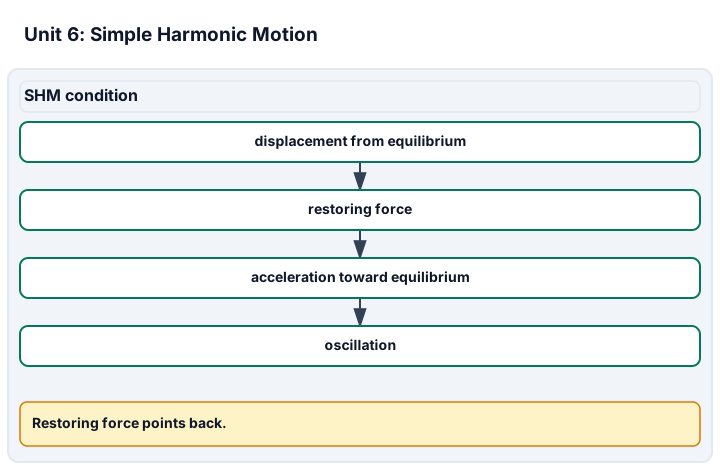
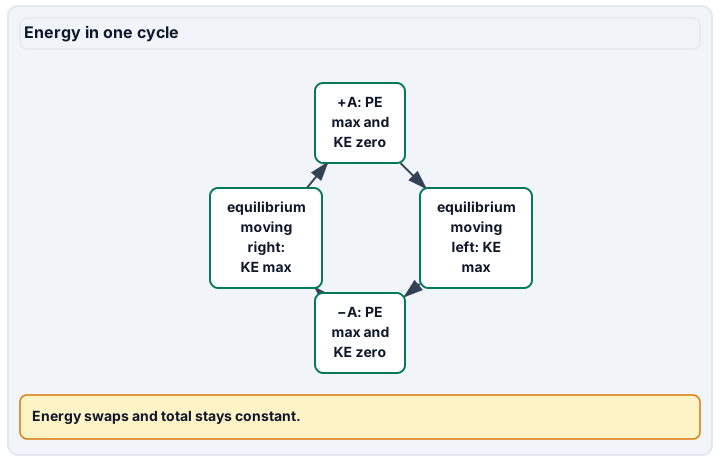
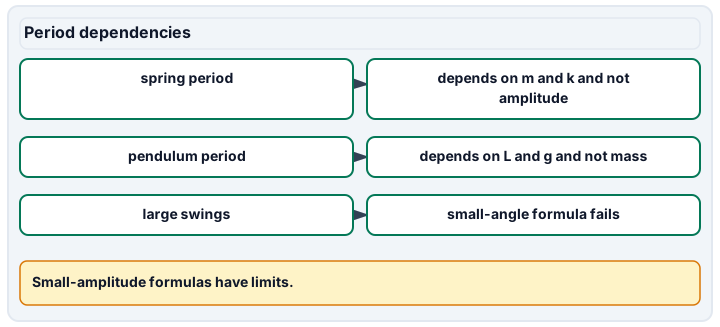
Diagram description
SHM condition links displacement to restoring force, acceleration toward equilibrium, and oscillation. Energy in one cycle places PE maximum and KE zero at each turning point and KE maximum at each equilibrium crossing. Period dependencies state what spring and pendulum periods depend on and when the pendulum formula fails.
Data, provenance, and assumptions
| Quantity | Value | Unit / meaning |
|---|---|---|
| m | 0.5 | kg spring mass |
| k | 50 | N/m |
| A | 0.1 | m spring amplitude |
| x | 0.06 | m spring displacement for energy check |
| L | 1 | m separate pendulum length |
| g | 9.81 | m/s^2 |
| Attempt | Complete oscillations | Total time (s) |
|---|---|---|
| A | 20 | 12.5 |
| B | 20 | 12.6 |
| C | 20 | 12.7 |
| t / T | x / A | v / (omega A) | a / (omega^2 A) |
|---|---|---|---|
| 0 | 1 | 0 | -1 |
| 0.25 | 0 | -1 | 0 |
| 0.5 | -1 | 0 | 1 |
| 0.75 | 0 | 1 | 0 |
| 1 | 1 | 0 | -1 |
Paper investigation sequence and evidence record
Scope and safety: These are supplied-data and paper-model investigations, not laboratory procedures. No launches, high-speed rotors, elevated loads, pressurized vessels, hydraulic builds or improvised apparatus are assigned. An educator must approve any actual practical, equipment, facilities and accessible alternative separately. Synthetic records do not certify hands-on skill or performed lab hours; public answers are nonsecure practice.
Materials and preparation
- [oscillation-models] Use the supplied oscillator-inputs, oscillator-timings, oscillator-phase records, assigned source sections, calculator and an accessible graph or diagram. No physical apparatus is required.
Procedure and schedule
- [oscillation-models] Question: How do phase and energy constrain a spring oscillator, and what can repeated timing actually test? Prerequisites: Use square roots, fractions of a cycle, mean/sample SD, spring potential energy and the meaning of a model approximation.
- [oscillation-models] Variables: Compare phase, amplitude and timing estimates while separating spring parameters from the pendulum model. Controls: Keep the equilibrium origin, starting phase, linear spring regime, count definition and small-angle assumption explicit. Replication: Three synthetic timing attempts describe repeat variability for one setup; do not relabel them as independent springs or real observations.
- [oscillation-models] Analysis: Relate all three phase graphs, calculate period/energy, divide total time by cycles, compute sample spread and test the changed amplitude. Review: An educator reviews prerequisites, source interpretation, reasoning and accessibility before assessment. A paper response does not certify unobserved practical technique; approved hands-on work requires a separate record.
Record: Retain oscillation-models, the selected level, original inputs and first attempt, source/date, system and axes, units, assumptions, calculation/graph, uncertainty, correction and fresh transfer. Link only to the stated science criteria.
Worked model
[oscillation-models] For the spring, omega = 10 rad/s and T = 0.6283185307 s. Energy is 0.25 J; at x = 0.06 m, spring potential is 0.09 J, kinetic energy 0.16 J and speed 0.8 m/s. The separate pendulum period is 2.006066681 s. Synthetic repeat periods average 0.630 s with sample SD 0.005 s; that spread is not proof of model accuracy.
Numerical calibration
- 0.628318530718 s ideal spring period
- 0.25 J
- 0.8 m/s at the specified displacement
- 2.00606668071 s small-angle model
- 0.63 s
- 0.005 s sample SD
- 1 J at doubled spring amplitude
Attempt the assigned level
Try the tasks before reading the calibration. These are practice answers, not a secure examination; use a new dataset or changed assumption for the assessed transfer.
Foundation
- [oscillation-models] Use the phase table to locate maximum speed, zero velocity and acceleration direction. Explain why being at equilibrium does not mean the moving oscillator must stop.
Check after your attempt
- [oscillation-models] Speed is greatest at equilibrium, where x and acceleration are zero; it continues through with nonzero velocity. At the endpoints velocity is zero but restoring acceleration points toward equilibrium. Acceleration always has the opposite sign to displacement in this model.
High-school core: typically grades 9-10
- [oscillation-models] Calculate the spring period, energy and speed at the stated displacement, then calculate the separate small-angle pendulum period. Keep the two systems and their parameter dependencies distinct.
Check after your attempt
- [oscillation-models] Spring period is 0.6283185307 s, total energy 0.25 J and speed at x = 0.06 m is 0.8 m/s. Pendulum period is 2.006066681 s. Ideal spring period depends on m/k; the small-angle pendulum period depends on L/g, not on bob mass.
Honors extension: typically grades 11-12
- [oscillation-models] Compute the three timing-based periods, mean and sample SD; compare with the ideal model while identifying uncertainty that repeat spread misses. Assess a 60-degree pendulum extrapolation.
Check after your attempt
- [oscillation-models] Periods are 0.625, 0.630 and 0.635 s, with mean 0.630 and sample SD 0.005 s. The ideal spring value lies close to these synthetic estimates, but bias and model error are not ruled out. At 60 degrees the small-angle pendulum approximation is not justified; its period is not guaranteed by the simple formula.
History, reading, and writing connection
Compare a source-supported historical timing question with our stated spring and pendulum models. Cite the biography and physics section, explain why repeatability and systematic error differ, and avoid treating a later anecdote or our synthetic repeat table as original historical observations.
Write in your own words or use an approved accessible equivalent. Cite a specific assigned section or figure, identify its evidence, and state one limitation or counterargument. Use the AI practice contract only for permitted coaching, never to invent observations or write the assessed response.
Transfer to a new case
[oscillation-models] Double the ideal spring amplitude from 0.10 to 0.20 m without changing m or k, assuming the spring remains linear. Predict the total energy and whether the ideal period changes.
Calibration: [oscillation-models] Energy becomes 0.5(50)(0.20)^2 = 1 J, four times the original. The ideal period remains 0.6283185307 s because it depends on m/k, not amplitude within this linear undamped model. Real springs may leave that regime.
Evidence to retain
[oscillation-models] Science criteria 1-4: restoring-force sign, phase graph, period dependencies, energy exchange and a bounded timing-data comparison. Timing arithmetic does not earn the separate observed-technique criterion.
Record units, calculations, source/date, uncertainty, and what is measured versus inferred. A simulation or supplied dataset must stay labeled as such. These are supplied-data and paper-model investigations, not laboratory procedures. No launches, high-speed rotors, elevated loads, pressurized vessels, hydraulic builds or improvised apparatus are assigned. An educator must approve any actual practical, equipment, facilities and accessible alternative separately. Synthetic records do not certify hands-on skill or performed lab hours; public answers are nonsecure practice.
Return to all eight learning pathways. Print this unit page for the student lessons; the linked five-page packet remains the separate assessment companion.
Match evidence to the actual criterion
Integration is reported separately and cannot lower the science grade or block a science demonstration pass. Science and practical criteria determine that pass. The paper cases assess named analytical criteria, not unobserved hands-on technique. Use an educator-selected fresh variant and retain the first attempt.
- Restoring force, phase, energy and period estimates: science criteria 1, 2, 3, 4.
Unit mastery rubric
| Criterion | Developing | Proficient | Mastery |
|---|---|---|---|
| Restoring force & the SHM condition | Does not connect oscillation to any force. | Knows a spring pulls back but not that force is proportional to displacement. | Identifies the restoring-force condition (force opposite and proportional to displacement) and recognizes it in springs and pendulums. |
| Period & frequency | Uses period and frequency interchangeably. | Relates them but cannot say what changes each. | Predicts how period depends on mass and spring stiffness (and on length for a pendulum) and what it is independent of. |
| Energy in oscillation | Thinks energy disappears at the turning points. | Knows energy converts but misplaces where each type peaks. | Tracks the kinetic–potential exchange and identifies where each is maximum and where speed is greatest. |
| Graphs of SHM | Cannot sketch displacement against time. | Sketches displacement but not velocity or acceleration. | Sketches and relates displacement, velocity, and acceleration versus time, including their phase relationships. |
| Lab technique (period measurement) | Times a single swing; large timing error. | Times multiple swings but does not vary a parameter systematically. | Times many oscillations, varies length or mass systematically, and plots the relationship with uncertainty. |
| Integration (cross-domain) | Makes no supported connection between the source and the science. | Uses the source but needs help connecting evidence, writing, or limitations to the science. | Independently connects History, Reading, and Writing using a cited source, appropriate evidence, a limitation, and a scientific explanation. |
Integration is reported separately and cannot lower the science grade or block a science demonstration pass. Science and practical criteria determine that pass. Use the integration guide's evidence checklist for the separately reported criterion.
“For the small-angle pendulum model at fixed gravity, period is proportional to the square root of length. A plot could test that dependence over sampled values. Varying length alone cannot establish mass or amplitude independence; those effects need separately controlled comparisons and uncertainty. This reasoning does not document a performed experiment.”
“A heavier bob swings slower, and a bigger swing always takes longer.” This gives no model, angle range or evidence. A large-angle pendulum can have a longer period; check the stated conditions before judging the claim.
You demonstrate this unit through period-measurement labs plus short oral checks where you reason about what sets the period aloud — not a multiple-choice test. A criterion counts as mastered only when you can both take clean data and justify the physics behind it. Mastery is demonstrated, not awarded.
A 5-page clipboard packet — unit overview, key terms, the mastery rubric, anchor examples, and a score sheet you can print and grade against.