Unit 05 · Momentum & Collisions
Momentum is what is conserved when things hit each other. This unit defines momentum and impulse, establishes that the total momentum of an isolated system does not change, and uses that to analyze collisions — elastic ones where kinetic energy survives, inelastic ones where it does not. Mastery means you treat momentum as a vector, know exactly what is conserved in each kind of collision, and can predict the aftermath before the carts even touch.
Student learning: Momentum & Collisions
Choose the level by readiness, not age alone, and record it before instruction. Foundation, core, and honors tasks are study pathways, not an AP course or a promise of college credit. The instructor retains practical assessment and the published science rubric; integration is reported separately.
Prerequisites: [impulse-collisions] Use signed momentum, triangle areas, kinetic energy and perpendicular vector components.
Suggested sequence: read and discuss the explanation; attempt the worked model; analyze the data at your selected level; check the answers; then complete the source-linked response and a fresh transfer question. These activities supplement, not replace, supervised practical work and the full-year schedule.
Assigned reading and focus
- OpenStax University Physics Volume 1, 9.2 Impulse and Collisions. [impulse-collisions] Use force-time area as impulse; the supplied straight segments allow triangle/trapezoid arithmetic rather than calculus.
- OpenStax University Physics Volume 1, 9.4 Types of Collisions. [impulse-collisions] Compare elastic and inelastic collisions and read the separate roles of momentum and kinetic energy.
- MacTutor, University of St Andrews: Isaac Newton. Read the account of Newton’s mechanics and compare it with the assigned modern impulse section; distinguish retrospective history from the original publication and from synthetic collision records.
Learn the science
Choose a readiness level before instruction. Foundation scaffolds do not by themselves satisfy every Mastery criterion. The assigned college text may also present calculus; these tasks use the stated algebraic models and geometric areas. Source/model reasoning and approved practical observation remain different evidence.
[impulse-collisions] Impulse, sticking and vector conservation. A body changes momentum by its net impulse. For a two-body system, interaction impulses cancel while any external impulse remains. Sticking is perfectly inelastic: system momentum may be conserved while kinetic energy becomes internal energy. In two dimensions, conserve each component before finding a speed or direction. For a fixed momentum change, increasing contact duration lowers average force, not necessarily every peak.
[impulse-collisions] Assumptions: The primary two equal-mass carts stick on an ideal horizontal surface with negligible external horizontal impulse. The supplied force pulse is the entire horizontal force on A over contact and is linear between samples; B receives the opposite interaction impulse. The separate two-dimensional example also sticks with negligible external in-plane impulse. No real collision is performed.
[impulse-collisions] Uncertainty: Three force samples would not establish a real pulse shape without the stated interpolation. Alignment, timing, sensor bandwidth and unmeasured external forces matter experimentally. Kinetic-energy loss is not lost total energy, and conserving only scalar speed or only one component is insufficient for a vector collision.

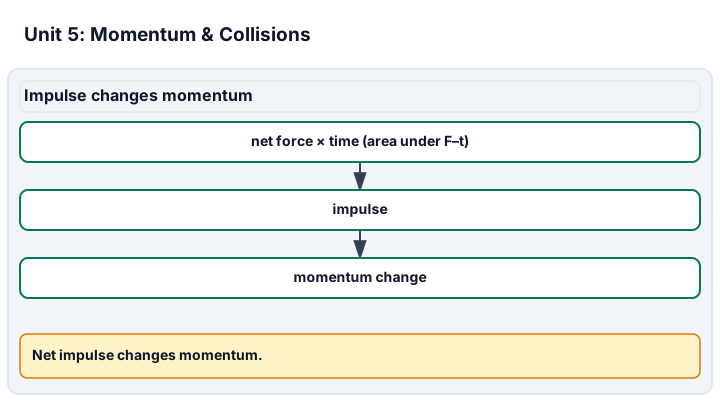
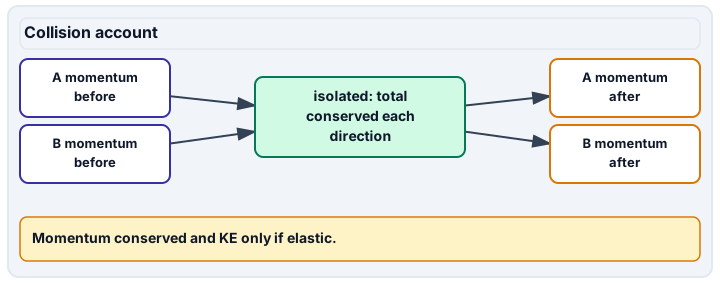
Diagram description
Impulse changes momentum shows net force over time as impulse and impulse as the cause of momentum change. Collision account combines A and B momenta before and conserves total momentum by component to constrain the momenta after, while noting kinetic energy is conserved only in elastic collisions.
Data, provenance, and assumptions
| Cart | Mass (kg) | Initial velocity (m/s) |
|---|---|---|
| A | 2 | 2 |
| B | 2 | 0 |
| Time (s) | Force on A (N) |
|---|---|
| 0 | 0 |
| 0.1 | -20 |
| 0.2 | 0 |
| Cart | Mass (kg) | Initial vx (m/s) | Initial vy (m/s) |
|---|---|---|---|
| A | 2 | 2 | 0 |
| B | 1 | 0 | 3 |
Paper investigation sequence and evidence record
Scope and safety: These are supplied-data and paper-model investigations, not laboratory procedures. No launches, high-speed rotors, elevated loads, pressurized vessels, hydraulic builds or improvised apparatus are assigned. An educator must approve any actual practical, equipment, facilities and accessible alternative separately. Synthetic records do not certify hands-on skill or performed lab hours; public answers are nonsecure practice.
Materials and preparation
- [impulse-collisions] Use the supplied collision-bodies, collision-force-time, collision-vectors records, assigned source sections, calculator and an accessible graph or diagram. No physical apparatus is required.
Procedure and schedule
- [impulse-collisions] Question: Which quantities remain conserved in sticking and elastic models, and which force-pulse features determine impulse? Prerequisites: Use signed momentum, triangle areas, kinetic energy and perpendicular vector components.
- [impulse-collisions] Variables: Compare collision type, component direction and pulse duration while preserving explicit system boundaries. Controls: Keep negligible external impulse, the supplied masses and the piecewise-linear pulse assumption distinct from measured evidence. Replication: Compare pulse area with the independent before/after momentum calculation; these are consistency checks, not independent collision trials.
- [impulse-collisions] Analysis: Compute system momentum first, recover each body impulse, calculate kinetic-energy change and solve vector components before speed. Review: An educator reviews prerequisites, source interpretation, reasoning and accessibility before assessment. A paper response does not certify unobserved practical technique; approved hands-on work requires a separate record.
Record: Retain impulse-collisions, the selected level, original inputs and first attempt, source/date, system and axes, units, assumptions, calculation/graph, uncertainty, correction and fresh transfer. Link only to the stated science criteria.
Worked model
[impulse-collisions] Initial primary momentum is 4 kg m/s, so the stuck 4 kg pair moves at 1 m/s. A changes momentum by 2(1 - 2) = -2 N s, agreeing with the triangular pulse area. Kinetic energy falls from 4 to 2 J. In the separate 2D case, total momentum is (4,3) kg m/s, giving final velocity (4/3,1) m/s.
Numerical calibration
- 1 m/s
- -2 N s
- 2 J converted from kinetic energy
- 1.333333333333 m/s
- 1 m/s
- 1.666666666667 m/s rightward
Attempt the assigned level
Try the tasks before reading the calibration. These are practice answers, not a secure examination; use a new dataset or changed assumption for the assessed transfer.
Foundation
- [impulse-collisions] Identify the system and positive direction, calculate the initial primary momentum, and explain why sticking does not mean all kinetic energy is conserved.
Check after your attempt
- [impulse-collisions] The system includes both carts and right is positive. Initial momentum is 2(2) + 2(0) = 4 kg m/s. Sticking allows deformation/heating and other internal energy changes, so momentum conservation under negligible external impulse does not require unchanged kinetic energy.
High-school core: typically grades 9-10
- [impulse-collisions] Compute primary final velocity, the force-pulse area and kinetic-energy change. Compare a hypothetical elastic head-on collision of the same equal masses.
Check after your attempt
- [impulse-collisions] The stuck pair moves at 1 m/s, A receives -2 N s, and 2 J leaves the kinetic-energy account. In an ideal elastic equal-mass head-on encounter with the second cart initially stationary, velocities exchange: A stops and B moves at 2 m/s, retaining 4 J kinetic energy.
Honors extension: typically grades 11-12
- [impulse-collisions] Solve the separate 2D collision component by component, then assess the claim that doubling collision time guarantees half the maximum force for every possible pulse shape.
Check after your attempt
- [impulse-collisions] The final components are vx = 4/3 and vy = 1 m/s, giving speed 5/3 m/s. Fixed impulse over doubled duration gives half the average force; the peak also depends on pulse shape and is not fixed by duration alone.
History, reading, and writing connection
Use the Newton biography and modern impulse reading to connect historical mechanics with a collision or recoil argument. State the system and external-impulse condition, cite the historical source and identify what it does not document about a particular technology. Do not manufacture rocket trials or claim that action-reaction forces cancel on one object.
Write in your own words or use an approved accessible equivalent. Cite a specific assigned section or figure, identify its evidence, and state one limitation or counterargument. Use the AI practice contract only for permitted coaching, never to invent observations or write the assessed response.
Transfer to a new case
[impulse-collisions] A new 2 kg cart moving at +3 m/s sticks to a 1 kg cart moving at -1 m/s, with negligible external horizontal impulse. Predict their common signed velocity and state what is not conserved.
Calibration: [impulse-collisions] Total momentum is 2(3) + 1(-1) = 5 kg m/s, so the 3 kg pair moves at +5/3 m/s. Kinetic energy is not conserved in this sticking model; its decrease becomes internal energy rather than vanishing.
Evidence to retain
[impulse-collisions] Science criteria 1-4: signed impulse, system boundary, separate momentum/energy ledgers and two-dimensional components. No collision-cart timing or apparatus skill follows from these supplied values.
Record units, calculations, source/date, uncertainty, and what is measured versus inferred. A simulation or supplied dataset must stay labeled as such. These are supplied-data and paper-model investigations, not laboratory procedures. No launches, high-speed rotors, elevated loads, pressurized vessels, hydraulic builds or improvised apparatus are assigned. An educator must approve any actual practical, equipment, facilities and accessible alternative separately. Synthetic records do not certify hands-on skill or performed lab hours; public answers are nonsecure practice.
Return to all eight learning pathways. Print this unit page for the student lessons; the linked five-page packet remains the separate assessment companion.
Match evidence to the actual criterion
Integration is reported separately and cannot lower the science grade or block a science demonstration pass. Science and practical criteria determine that pass. The paper cases assess named analytical criteria, not unobserved hands-on technique. Use an educator-selected fresh variant and retain the first attempt.
- Impulse, sticking and vector conservation: science criteria 1, 2, 3, 4.
Unit mastery rubric
| Criterion | Developing | Proficient | Mastery |
|---|---|---|---|
| Momentum & impulse | Confuses momentum with force or energy. | Computes momentum but not the impulse–momentum connection. | Relates impulse to change in momentum and explains why a longer contact time softens a collision. |
| Conservation of momentum | Does not recognize when momentum is conserved. | Applies conservation but drops the vector directions. | Applies conservation to isolated systems as a vector equation and defends why external forces would break it. |
| Elastic vs. inelastic collisions | Assumes energy is always conserved in a collision. | Knows the difference but cannot say what is conserved in each. | Distinguishes elastic from inelastic collisions and states precisely what is conserved in each. |
| Two-dimensional momentum | Cannot handle momentum off a straight line. | Splits into components inconsistently. | Resolves momentum into components and conserves each direction independently. |
| Lab technique (collision carts) | Measures one cart and ignores the other. | Measures both but does not compare total momentum before and after. | Uses collision carts and timers to measure total momentum before and after and tests conservation with uncertainty. |
| Integration (cross-domain) | Makes no supported connection between the source and the science. | Uses the source but needs help connecting evidence, writing, or limitations to the science. | Independently connects History, Reading, and Writing using a cited source, appropriate evidence, a limitation, and a scientific explanation. |
Integration is reported separately and cannot lower the science grade or block a science demonstration pass. Science and practical criteria determine that pass. Use the integration guide's evidence checklist for the separately reported criterion.
“When the carts stick together it’s inelastic — momentum is still conserved, but kinetic energy isn’t; some went into deforming the bumper and heat. So I use conservation of momentum to find the shared final velocity, and I do not assume the energy carried over.”
“They both keep their energy, so I just add up the speeds and that’s the answer.”
You demonstrate this unit through collision-cart labs plus short oral checks where you reason about what is conserved aloud — not a multiple-choice test. A criterion counts as mastered only when you can both take clean data and justify the physics behind it. Mastery is demonstrated, not awarded.
A 5-page clipboard packet — unit overview, key terms, the mastery rubric, anchor examples, and a score sheet you can print and grade against.